Walk into almost any healthcare organization right now and ask where the technology budget is going. You will hear about online scheduling. Patient portals. Chat widgets. Digital intake forms. AI agents built to deflect inbound volume away from the front desk.
Notice what is missing from that list. The phone.
Somewhere in the last decade, healthcare quietly decided the phone call was a legacy channel. A cost center. A relic to be automated away as fast as possible. That decision was made almost everywhere, by almost everyone, and it was made without looking at the data.
The data tells a different story. The phone call is not dead. It is the single most valuable channel most practices have, and they are treating it like overhead.
The Channel Everyone Underestimates
Start with how patients actually find care today. They search. They compare. They read reviews and weigh several options before they commit. The discovery happens online, and that much the industry got right.
But discovery is not booking. The patient journey follows a clear sequence: search, evaluate, verify insurance and access, then act. And when the moment to act arrives, a large majority of patients still pick up the phone. The phone is not the start of the journey. It is the finish line.
Years of investment have gone into digital booking, yet the overwhelming share of real visits still gets scheduled through a human conversation. That is not a failure of the technology. It is a signal about what patients actually want when the decision matters.
There is a quieter problem with online booking too. The jury is still out on whether a self-service booking holds up the way a booking made with a human does. A few taps on a website is a low-commitment act, and conflating a patient appointment with an OpenTable reservation treats a clinical decision like a casual one. A conversation, where a patient explains why they are calling and a person confirms the plan, carries a weight a web form does not, and the commitment gap tends to show up later as an empty chair.
This is not because patients are behind the times. A patient comparing two surgeons, managing a child’s fever, or weighing a procedure does not want to type a reason-for-visit into a web form. They want a person. The more serious the care, the more true that becomes.
That reframes the whole question. The phone is not a channel of last resort for people who could not figure out the website. It is where your most motivated, ready-to-book patients are choosing to show up.
What Actually Happens When That Patient Calls
Here is the uncomfortable part. Healthcare invests almost nothing in the moment that matters most.
Across medical practices, a meaningful share of inbound calls never connect at all — sent to voicemail, abandoned on hold, or simply disconnected. Industry call-center benchmarks compiled by the Healthcare Financial Management Association point to a recommended hold time of under a minute, a target most practices miss by a wide margin. And voicemail is not a safety net. Most callers who reach a voicemail box never call back. They call the next practice on the list instead.
The patients who do get through are not in much better shape. Research finds that a majority of callers hang up after roughly a minute on hold, while average hold times in healthcare call environments run far longer than that. Practices are, in effect, designed to lose the majority of the people willing to wait.
Then there is the call that gets answered. A real person picks up, a real conversation happens, and the patient still does not book. Most leaders never learn why. The call ended, the patient did not schedule, and the only record is a tally mark saying the phone rang.
Why the Front Desk Is the Wrong Thing to Blame
When a practice does notice it is losing booked appointments, the instinct is almost universal. Blame the front desk. Send the team to another phone-skillstraining. Hope the numbers move.
They rarely move, and the reason is a misdiagnosis. A phone conversation is a remarkably complex event. The reasons a patient does not book are not all the same kind of problem, and treating them as one is where practices go wrong.
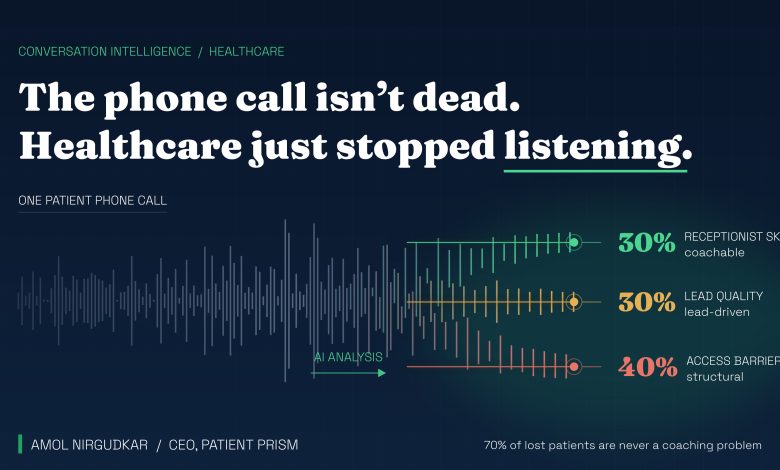
After more than a decade analyzing healthcare calls, our team at Patient Prism has seen a pattern hold with striking consistency. When the phone is answered and the patient still does not schedule, only about 30% of the time is the cause the skill of the person who answered. Another 30% comes down to the quality of the lead itself. The remaining 40% has little to do with the conversation at all.
That last 40% is the part nobody wants to look at. It is an access barrier. Limited capacity. An insurance mismatch. A pricing objection the practice was never set up to handle. These are not coaching failures. They are structural, and no amount of front-desk training will move them.
Sit with the math. Roughly seventy percent of lost calls are not a phone-skills problem. A practice that responds to every lost patient the same way is treating a capacity problem, an insurance problem, and a skills problem with one blunt instrument. That is the real cost of the black box. Not just that the conversation vanished, but that leaders cannot tell which of three very different problems they actually have.
A Black Box at the Center of the Business
This is the structural problem. For decades, the inbound phone call has been the least measured, least examined event in the entire patient journey.
Think about the asymmetry. A practice can tell you its cost per click, its website bounce rate, its email open rate, and its no-show percentage down to the decimal. Ask that same practice why patients who called last Tuesday did not book, and you will get a shrug. The most valuable channel is the only one running blind.
Marketing spend keeps climbing on the assumption that the problem is demand. Not enough leads. Not enough phones ringing. So practices buy more clicks and more campaigns to drive more calls into the same front desk that is already missing one in four of them.
Healthcare does not have a demand problem. It has a capacity problem. The phones are ringing. The patients are calling. The breakdown is happening after the call connects, in a conversation nobody is looking at.
Why AI Changes the Math
For most of healthcare’s history, there was a practical reason the phone call stayed a black box. You could not analyze it. Listening to calls meant a manager pulling a handful of recordings a week and forming an impression. It did not scale, so it did not happen.
That constraint is gone. This is the part of the AI conversation healthcare keeps missing.
Almost all of the AI energy in this space points one direction: deflection. Voice agents built to reduce call volume, to keep patients from reaching a human at all. There are now three dozen voice AI companies competing to abstract away the phone conversation, and the noise can make it feel like a solved problem.
It is not solved yet. Be honest about where the technology stands. Today, most healthcare voice agents are a solid B-minus. They handle a clean, predictable request well. They struggle with the messy, emotional, ambiguous conversation that defines so much of healthcare. That is not a knock on the category. It is a reason to scope it correctly.
Use voice agents for what they are genuinely good at right now. Routine, low-stakes tasks. Confirming an appointment. Answering hours and directions. After-hours overflow. Let them carry the predictable volume so human staff are free for the calls that actually need a human. But do not hand them the high-stakes conversation and assume the problem is handled. Deflection, even done well, still treats the phone call as something to be minimized.
The more interesting application is the opposite. The same underlying technology — speech recognition, natural language processing, conversation intelligence — can analyze every call instead of avoiding it. And it can do something a phone-skills scorecard never could. It can tell the three problems apart.
This is the part that matters. A seasoned operations leader, listening to a single recorded call, can usually hear the difference between a coaching miss, a weak lead, and a patient who walked because the practice could not see them for three weeks. The skill was never the bottleneck. The bottleneck was scale. No human can listen to every call, catch that nuance every time, and do it fast enough to act on it.
That is the needle in the haystack. AI can now do at scale what only an expert could do one call at a time. It can read a full conversation, surface why a specific patient did not book, and sort that reason into the right bucket — skill, lead quality, or access barrier. What used to be a vague impression becomes a precise, fast diagnosis.
Speed is the whole point. When a practice can see within a minute that it lost a patient to a pricing objection or a capacity gap, it can design a specific intervention and reach back out while that patient is still deciding. The lost call stops being a dead end. It becomes a recoverable opportunity.
Other industries figured this out years ago. Sales teams have used conversation intelligence to coach reps for a decade. Healthcare is late, and the phone call finally became a data source. Most practices are still treating it like noise.
What Operators Should Actually Do
This does not require a moonshot. It requires treating the phone with the same rigor every other channel already gets. Four practical moves:
Measure the conversation, not just the call volume. Knowing the phone rang 400 times is close to useless. What matters is how many of those callers booked, and why the rest did not. If you cannot answer the second question, that is the first gap to close.
Find your real abandonment rate. Count the calls hitting voicemail, the holds that end in a hang-up, the after-hours calls nobody returns. Any one of them may be a high-intent patient who just dialed a competitor. This number is almost always worse than leadership assumes.
Diagnose the lost call before you act on it. Stop treating every missed booking as a front-desk failure. Sort the reason first. A coaching gap, a weak lead, and an access barrier each call for a different fix, and the wrong fix wastes everyone’s time.
Point AI at insight, not just deflection. Before you deploy a tool to keep patients off the phone, deploy the capability to understand what happens when they get on it. Automate the routine. Analyze the rest.
The Channel Was Never the Problem
Healthcare did not lose the phone call. It stopped paying attention to it. The industry built an entire technology strategy around the assumption that the phone was dying, and never checked whether the assumption was true.
It was not. The patient in pain still calls. The family choosing a specialist still calls. The person ready to book the expensive procedure still calls. They are calling right now, today, and a predictable share of them are hanging up, hitting voicemail, or quietly deciding not to book for a reason no one will ever examine.
This is bigger than practice revenue. Every one of those calls is a person trying to get care. When a practice can finally see why patients fall out — and tell a coaching gap from a capacity gap from a cost barrier — it can fix the things that actually keep people from being seen. That is an access story, not just an operations story, and it scales anywhere a phone rings.
The technology to do this finally exists. The patients never went anywhere. The only thing missing is the decision to look.