Artificial intelligence has never been easier to access. Anyone can open a chatbot, generate an image or experiment with video in a matter of minutes. Yet access to a tool does not necessarily give someone the confidence, context or judgment to use it meaningfully.
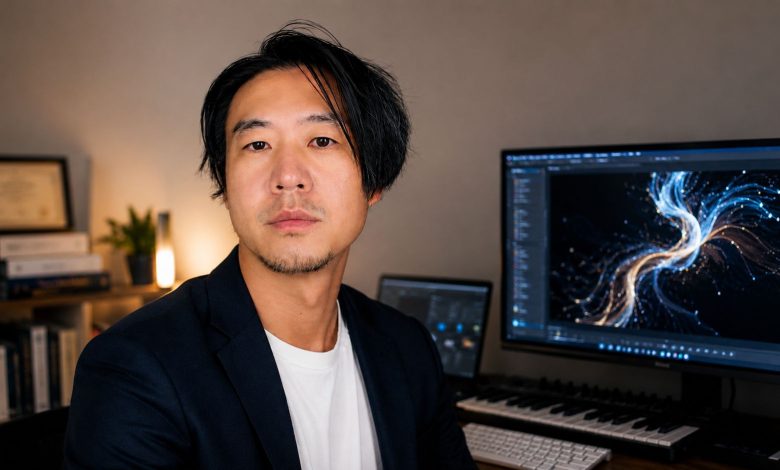
For independent composer, songwriter and interdisciplinary artist Cong Liu, this is becoming one of the most important questions in AI adoption: once the technology is available, who is actually able to turn it into a form of expression, communication or participation?
Liu’s perspective developed through an unusual path. His doctoral work explored how visual information could be translated into sound, mapping qualities such as hue, brightness and saturation onto pitch, timbre and dynamics. Generative AI later let him run that process in reverse—turning sound, language, emotion and imagination into images, animation and visual narratives.
He has since brought that approach into public AI education. In an introductory workshop organized through Asian Media Access, the Asian American Business Resilience Network and Digital Synergy, Liu showed participants how to move from an idea, a piece of music or a written narrative into AI-generated imagery, animation and music videos. He later served as a guest instructor in an advanced AI/VR and digital-experience cohort organized by Asian Media Access, helping participants connect generative media with sound, storytelling, immersive design and audience experience.
His work has also extended into multilingual public communication and an upcoming conference discussion on generative AI and mental wellness.
We spoke with Liu about the difference between AI access and AI agency, what non-technical learners reveal about adoption, and why faster generation must still be balanced by human judgment.
Your interest in AI developed from an earlier project involving perception. How did that lead you toward generative AI?
The starting point was personal.
I am color-blind, so I have always been conscious that perception is not universal. Something that appears clear and consistent to one person may be experienced differently by someone else.
As a composer, I understood sound as my most natural language. For my doctoral work, I explored whether color could be translated into sound, connecting visual qualities such as hue, brightness and saturation with musical ones such as pitch, timbre and dynamics.
The purpose was not simply to build a technical conversion system. I was interested in whether one form of perception could become accessible through another.
When generative AI became more available, I realized I could explore a related process in the opposite direction. My earlier work moved from visual information into sound. AI allowed me to investigate how sound, language, emotion and imagination could become visual.
For me, AI did not create the question. It gave me a new way to explore a question I already had.
You make a distinction between giving people access to AI and giving them agency through AI. What is the difference?
Access means a person can open the tool. Agency means the person understands how to use it in relation to an idea, a need or an experience of their own.
Many people technically have access to AI, but they may still not know where to begin. They may not understand how to turn a vague thought into a process, how to evaluate the output or how to move from an isolated result toward something coherent.
They can generate an image, but they may not yet feel that they are creating.
That difference matters. AI agency includes the ability to make choices, reject outputs, revise ideas and understand why a particular result does or does not communicate the original intention. It also includes the confidence to question the technology. People should not feel that an AI-generated answer is automatically better than their own judgment.
The next stage of adoption cannot be measured only by how many people have accounts or how often a tool is opened. It should also be measured by whether people gain a meaningful new ability to express, create and participate.
What did your first public AI media workshop teach you about the real barriers to adoption?
The workshop was designed for participants who did not necessarily have a technical background.
I did not begin with coding, model architecture or complicated terminology. I began with something the participants already had: an idea, a piece of music, a story or an image in their imagination. From there, we explored how that starting point could become a prompt, how a prompt could become an image, and how a group of images could develop into animation or a short music video.
What I learned was that the first barrier was often not technical ability. It was the belief that AI belonged to technical people.
Once participants understood that they could begin with their own knowledge and experiences, their relationship with the technology changed.
I also noticed differences across age groups. Younger participants often experimented quickly and were comfortable trying multiple directions. Some middle-aged and older participants were more cautious at the beginning, but they also brought years of experience, memory and ideas into the process. For some of them, AI was not simply a new tool—it became a new creative direction.
AI adoption is often a confidence challenge before it becomes a technology challenge.
AI can produce large amounts of material very quickly. How do you distinguish meaningful creation from simple generation?
Generation is fast. Meaning still requires judgment.
AI can produce ten images, ten musical ideas or ten versions of a scene in a very short time. But having more material does not automatically create a stronger work.
My background in composition has shaped how I think about this. In music, not every sound belongs in the final piece. The composer has to make decisions about structure, timing, contrast, development and silence. AI-assisted creation works in a similar way.
The creator still has to ask what the work is trying to communicate, which outputs support that purpose and which should be removed. Individual images may look impressive but fail to form a coherent narrative. A visually strong sequence may still have poor pacing. Music and animation may each be effective on their own yet feel disconnected when combined.
That is why I do not see prompting as the entire creative process. Prompting begins the conversation, but selection, editing, sequencing and revision give the result meaning.
AI can shorten the distance between imagination and experimentation. It does not remove the need for artistic intention.
You later worked with an advanced AI/VR visual-storytelling cohort. Was there a moment that changed how you understood AI’s value?
The advanced cohort moved beyond generating individual images or short clips. Participants had to think about narrative structure, visual continuity, sound, animation, immersive environments and the experience of the audience. They were learning how to move from isolated outputs toward a more complete digital experience.
One student in that program especially stayed with me.
The student was not naturally comfortable expressing ideas directly or verbally. That did not mean the ideas were missing—the creative thinking was there, but putting the full concept into words was difficult.
AI-generated imagery gave the student another starting point. Instead of having to explain everything first, the student could create an image or a visual sequence, show it to others and respond to what appeared. The work could then be discussed, revised and gradually developed.
The images became a form of communication.
AI did not give the student the idea. The idea was already there. AI gave it a form that could be shared.
That experience connected with my earlier work in perception. My doctoral project had explored another channel for experiencing color. In the cohort, I saw how AI could also provide another channel for expression.
Why should community AI adoption matter to the wider technology industry?
Because communities should not only be consumers of systems designed by other people.
When AI adoption is discussed, the conversation often focuses on infrastructure, software, efficiency or workforce productivity. Those are important, but adoption also depends on language, cultural context, confidence, time and the availability of meaningful guidance.
A tool can be technically available and still feel inaccessible. People may not see their own experiences reflected in the examples. They may not know how AI applies to the work they already do. They may also hesitate to question the output because they assume the technology understands more than they do.
Community-based learning creates an opportunity for people to experiment earlier, ask questions and apply AI to their own stories, creative practices and communication needs.
This also matters to the technology industry because real users often reveal problems that are not visible in controlled demonstrations. They show where instructions are confusing, where cultural assumptions fail and where the system does not support the way people actually communicate.
Access is not only about whether the tool is available. It is about whether people feel able to use it with purpose.
What changes when generative AI is used in public-facing or health-related communication?
The level of responsibility changes.
In one recent project, I worked on songs and AI-assisted visual media for a multilingual public-health effort on extreme-heat safety. The purpose was not simply to create an attractive AI video. The information needed to be understood, remembered and acted upon.
Music and lyrics can help organize instructions into a sequence. Animation can show changes in physical condition. Visual storytelling can make information more immediate for people who may not engage with a long written explanation.
But the same tools can also introduce risk. A generated image may illustrate a symptom incorrectly. A translation may be linguistically accurate but culturally unnatural. A character may appear to recover too quickly, which could unintentionally suggest that a serious condition is no longer urgent.
Those details matter.
AI helped support parts of the creative and production process, but it could not take responsibility for factual accuracy, cultural context or public trust. Those required human review, professional feedback and repeated revision.
AI can accelerate communication, but it cannot be accountable for the message.
You are scheduled to speak about generative AI and mental wellness. Where do you see genuine potential, and where should the limits be?
I am interested in the possibility that creative AI tools can help people express experiences that are difficult to communicate directly.
Some emotions do not begin as clear sentences. They may be experienced as pressure, fragmentation, rhythm, color, movement or an imagined environment. For someone who finds direct verbal expression difficult, creating an image, a sound or a visual metaphor may offer another starting point for communication or reflection.
The student in the advanced cohort is one reason this question matters to me. The visual material did not replace the student’s thinking—it gave that thinking a way to become visible.
At the same time, the limits must be stated clearly.
AI is not a therapist. It should not replace diagnosis, professional mental-health treatment or human care. Systems can produce emotionally convincing language without understanding a person’s actual condition. They may also reinforce bias, mishandle cultural context or create a false sense of emotional authority.
The potential value is in supporting expression, reflection and creative participation—not in pretending that a model can replace a trained professional or a trusted human relationship.
What should the next stage of human-centered AI adoption look like?
I believe it should move beyond simple generation.
AI systems are becoming increasingly multimodal, but the important question is whether they will also become more meaningful, more controllable and more responsive to the ways different people perceive and communicate.
I am interested in systems that can work across sound, image, movement, language and immersive space. I also want to see tools that let users make more intentional choices rather than simply accepting the first generated result.
Human-centered AI should not flatten cultural or individual differences. It should make room for them. That means involving non-technical users earlier, designing for different forms of expression and helping people understand both the possibilities and the limitations of the technology.
The most meaningful future of AI is not one in which machines express more on our behalf. It is one in which more people gain the ability to express what was already inside them.
That is what I mean when I describe AI as a bridge.