Abstract: Too often, the AI conversation centers on job loss. This article refrains from discussing how AI is becoming a teammate rather than a replacement. Dr. Keith A. Morneau, Dean of Cybersecurity at ECPI University, explores how AI is changing the skills people need, opening new roles, and reshaping daily work. The focus is on how people and technology can grow stronger together.
Moving Beyond the Mainstream Media’s Job Loss Narrative
From the first industrial revolution to the current AI revolution, every wave of innovation has carried the same warning that machines will take our jobs. Yet history tells us a more nuanced story. Each technological leap has displaced some roles but has also created entirely new ones. The emergence of AI marks not the end of work, but its next reinvention.
Recent surveys reflect how deeply AI has already been integrated into the workplace. The Conference Board found that 56% of U.S. workers report using generative AI in their day-to-day work, and KPMG and the University of Melbourne found that 58% of global respondents intentionally use AI in their work.
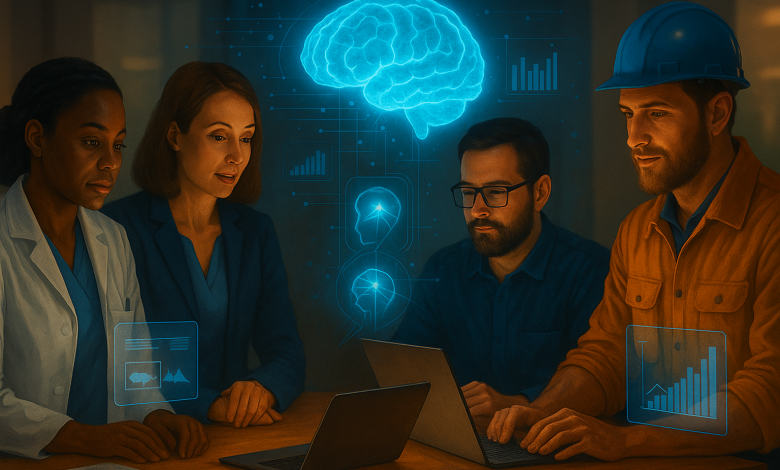
We must look past the fear that AI will take over jobs and focus on what’s really happening: AI is becoming a collaborator and amplifier of human ability. The rise of AI marks not the end of human work but its reinvention, where technology people and technology are working together to create new possibilities.
From Automation to Augmentation to Transformation
AI is redefining work in real time, reshaping roles, skills, and the relationship between people and technology.
At the surface is automation, where AI manages routine tasks and allows people to focus on more meaningful work. Alongside it is augmentation, where AI expands and enhances human capability. And then there is transformation, the most profound stage, where AI completely changes entire systems of work.
We can already see these layers of change playing out across industries. In the healthcare industry, for example, radiologists are using AI to highlight anomalies they may not catch on their own, while still making the final diagnosis themselves. In the retail sector, companies like Target are using AI systems to support designers, merchandisers, and marketplace managers, freeing them to focus on higher–value creative and strategic work.
Together, these shifts signal a larger change: work is no longer defined by what machines can do, but by how people choose to use them.
Reskilling for an AI-Ready Workforce
As new tools and technologies are constantly being introduced in the AI age, continuous reskilling will become the norm. This means staying on top of developments in the field. Just as many organizations regularly promote cybersecurity awareness, we also need to build AI awareness.
The skillsets needed in the emerging AI revolution are not much different from those earlier industrial revolutions demanded. Success still depends on critical thinking, adaptability, empathy, data literacy, creativity, and innovation. What’s new is the need to connect these strengths to technology through AI literacy.
As the link between human ability and machine capability, AI literacy has become the defining skill of this new age. It involves understanding AI’s capabilities and limitations, as well as knowing how to effectively incorporate it into our work.
For educators and industry leaders, this shift highlights the need for developing continuous learning systems that make ongoing reskilling possible.
The Emergence of New Human Roles
As AI reshapes industries, it is giving rise to entirely new roles that demand new skills. Many of these roles focus on guiding, managing, and improving how AI systems are built and used in real-world settings.
Among them are AI ethicists, who help ensure fairness, transparency, and responsible use, and prompt engineers, who design effective instructions that help users get the most value from AI systems. AI engineers are also becoming essential, designing, building, and deploying AI models for specialized business applications.
These new roles only mark the beginning of what’s to come. As the AI age develops, new roles will continue to emerge, opening up a world of exciting opportunities.
Human–AI Collaboration in Practice
Most people still think of AI as just another tool. To make the most of its capabilities, we need to change our mindset and start seeing AI as a teammate we can learn with. To foster this collaborative relationship, it’s essential to understand how we can integrate AI effectively into our day-to-day activities.
A typical collaboration cycle between human and AI can look like this:
- AI brainstorms and creates the initial draft.
- The human reviews the output and provides feedback.
- AI learns from the feedback and updates its response.
- The human refines and finalizes the product.
One useful everyday application is using AI to manage emails. It can highlight important content, like meetings and flights, and build a daily or hourly schedule in a matter of minutes. If this had to be done manually, it would likely take much longer.
AI can also support more complex tasks, such as analyzing multiple vendors against specific requirements and providing reasoned recommendations. This kind of collaboration highlights the need to start seeing AI as an active partner in problem-solving.
Leadership in the AI-Transformed Organization
Many organizations are still in the pilot stage of AI adoption, focusing mainly on automation to test how the technology fits into their operations. To make real progress, they need to move towards true AI transformation.
Effective leadership in this era means developing AI literacy, building confidence across teams in an organization, and treating AI as a strategic partner. This calls for integrating it into the organization’s mindset and culture.
The organizations that learn to harness AI effectively are the ones that will lead the next wave of innovation.
The Future of Work in the AI Age
It’s important to remember that the real question isn’t “Will AI replace us soon?” but rather “How can we collaborate with AI?”
As a society, we need to understand that AI is here to stay, and we must adapt to the new realities of the world. Yes, there will be difficulties as AI progresses. But adaptation begins with developing an AI-ready mindset. By learning how to work with AI and integrating it thoughtfully, we can stay ahead.
When used as a collaborator, AI can be an enabler of human creativity. However, we must do our due diligence in analyzing its output and being an active participant. In the AI-augmented workplace, human skills such as communication, empathy, judgment, and imagination are more essential than ever to carry organizations into the future.