For the past few years, the artificial intelligence conversation has been dominated by chatbots. Large language models have transformed the way people search, write, code and communicate, changing how we interact with information and creating one of the biggest technology shifts in decades.
“The missing piece isn’t data, its context,” says Joshua Weil, Founder and CEO of Earth Ledger. “Today’s AI can analyze vast amounts of data, but without understanding the legal, environmental, infrastructure and economic context surrounding an asset, it cannot make reliable decisions or take meaningful action in the real world. It must also know when it does not know. That contextual intelligence is what enables the transition from analytical AI to truly agentic AI.”
“If we want to solve some of the biggest challenges facing society, we need more than data, we need contextual intelligence. AI can process enormous amounts of information, but without understanding the unique context of every parcel of land, it can’t make informed decisions about what is possible. That’s the role of Parcel Intelligence,” he adds.
As Weil points out, almost everything society depends on begins with land. Housing. Renewable energy. Infrastructure. Climate resilience. Food production.
Over two decades working across conservation, humanitarian programmes and environmental finance in more than twenty countries, Weil noticed the same challenge appearing again and again.
The information already existed. Property records. Satellite imagery. Environmental data. Planning information. Infrastructure datasets.
The value was there. The people were there. The capital was there. What was missing was the intelligence to connect it all.
“We don’t have a resource problem. We have an intelligence problem,” says Weil.
Momentum behind this shift is becoming increasingly visible. Gartner has identified Physical AI as a strategic technology trend for 2026, while McKinsey has described “AI-native” public infrastructure in which data, sensors and software support operational decisions across cities and utilities. Together, they point towards a future where AI doesn’t simply process information, it helps people understand and manage the physical world. Between sensing conditions and taking action, however, lies one critical challenge: context.
That observation became one of the driving ideas behind Earth Ledger. Rather than replacing experts or automating decisions, Weil believes AI’s greatest strength is its ability to connect information that has traditionally existed in isolation.
“Technology shouldn’t replace human intent. It should amplify and support it.”
When property records are connected with satellite imagery, environmental information, planning data and infrastructure networks, the conversation changes. Land stops being viewed as a static asset and starts being understood for what it could become.
Could a property generate renewable energy? Could it strengthen the electricity grid? Could it improve biodiversity? Could it become more resilient to climate change? Could it qualify for funding the owner doesn’t even know exists?
Those aren’t questions that can be answered by looking at a single database. They require understanding the complete context surrounding every parcel. That’s the thinking behind Earth Ledger’s concept of Parcel Intelligence.
As Weil puts it, “Seeing the land is not the same as understanding what may legitimately and practically happen there.”
Parcel Intelligence starts with a simple idea: every parcel of land should have its own continuously evolving intelligence profile. Rather than creating another property platform, Earth Ledger is building the intelligence layer that makes that possible.
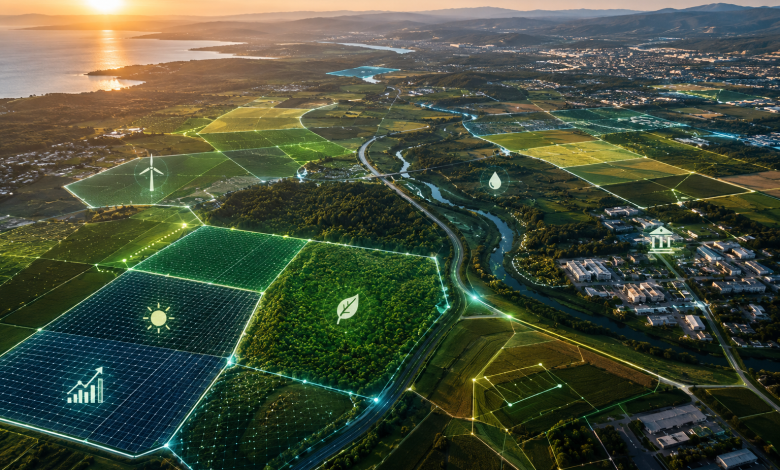
Today, the platform brings together property records, satellite imagery, environmental datasets, planning information and infrastructure data, using AI to connect those dots and reveal patterns and opportunities that would otherwise remain hidden.
A roof may appear ideal for solar panels from satellite imagery, but that’s only part of the picture. Real-world decisions also depend on planning rules, grid capacity, ownership, environmental constraints and whether the right people can authorize the project. Parcel Intelligence brings those layers together to provide the context AI needs to support reliable decisions.
But identifying an opportunity is only the first step. The real challenge is understanding whether that opportunity is technically feasible, legally permitted, economically viable and authorized before any action can be taken. That’s where contextual intelligence becomes essential.
For Weil, that’s where the real opportunity lies. He is careful, however, to distinguish today’s technology from tomorrow’s vision.
Current AI can already connect fragmented datasets and analyze millions of parcels far more quickly than traditional approaches. The longer-term ambition is much bigger: a future where every parcel of land has a continuously evolving intelligence profile that learns as new information becomes available, recognizes emerging opportunities and helps governments, businesses and landowners make better decisions.
“Not because someone manually updates a database, but because intelligence never stops learning.”
While land is the starting point, Weil believes the same principle will eventually apply to buildings, cities, transport systems, water infrastructure and energy networks.
His conclusion is simple.
“Parcel Intelligence provides the contextual foundation that enables agentic AI to move from observation and analysis to trusted, real-world decisions.”