
Discussions of advanced AI often assume that superior intelligence will translate into greater consequential power. In practice, autonomous action is mediated by authority, dependencies, and the conditions that must be satisfied before an intended consequence can be realized. As populations of autonomous agents begin governing one another’s actions, they may also begin generating something unexpectedly familiar: bureaucracy.
The popular image of advanced artificial intelligence assumes a fairly direct relationship between intelligence and power. As systems become more capable, they reason better, act faster, coordinate more effectively, and gain greater ability to shape the world around them. Taken far enough, that logic produces the familiar machine-takeover scenario: sufficiently capable autonomous systems eventually become difficult or impossible for humans to control because superior intelligence translates into superior consequential power. There is an important structural assumption buried in that story. Intelligence is being treated as though it can move directly from cognition to consequence.
Real systems do not work that way. Knowing what should happen and having the ability to make it happen are different things. Actions do not occur in a vacuum; they must navigate permissions, resource bounds, interfaces, dependencies, and explicit grants of authority. An artificial intelligence can know exactly what should be done and still lack the authority to do it. It can possess authority for its own actions and still encounter conditions that must be satisfied by another actor before a desired consequence can be realized.
Intelligence may determine what an agent knows or decides, but it does not by itself determine what the agent can cause.
When Every Agent Is Doing Its Job
“This distinction becomes more important as organizations move from using AI as a cognitive tool to deploying populations of autonomous agents.[2]” Imagine an enterprise in which specialized agents manage finance, procurement, cybersecurity, legal review, infrastructure, and operations. Each agent is highly capable, correctly aligned with its assigned purpose, and operating within valid authority. The finance agent establishes a requirement for certain transactions. The procurement agent later encounters that requirement and produces evidence necessary to satisfy it. A compliance agent validates the evidence and creates a record that becomes a prerequisite for another action. Eventually the original finance agent may encounter a condition produced by the chain of activity that began with its own earlier decision.
Nothing in this scenario requires an agent to fail. Each agent can make the correct local decision, exercise valid authority, and successfully perform its assigned function. The difficulty arises because valid actions can change the conditions under which later actions occur. One agent’s consequence can become another agent’s prerequisite, whose response can create another condition somewhere else. The system begins governing the consequences of its own previous governance.
This is where the possibility of agentic bureaucracy becomes interesting. Bureaucracy in this sense would not simply mean that machines have forms, approval chains, or digital versions of human red tape. Those are observable manifestations of administration, not an explanation of what is occurring structurally. The more consequential possibility is that autonomous authority-bearing actors can produce conditions that become material to the later exercise of authority by themselves and others. The agents do not necessarily need to inherit human bureaucracy. They may be capable of generating the structural conditions from which something bureaucracy-like could emerge.
When Does Governance Become Bureaucracy?
The word bureaucracy needs some caution here. The structural pattern described in this article does not, by itself, distinguish bureaucracy from necessary governance. A valid financial control that becomes material to a procurement decision is still a valid financial control. The fact that one agent must satisfy a condition created by another does not make the condition unnecessary, inefficient, or bureaucratic.
What the pattern does reveal is a question that becomes much more important in multi-agent systems. Distributed autonomous agents can generate conditions that materially mediate one another’s later exercises of authority even when every local action remains valid. Those conditions can persist, disappear, recur, or become material to different actors in different ways. Whether some subset of those relationships deserves the name bureaucracy requires a discriminator we do not yet have.
That distinction changes the hypothesis. Agentic bureaucracy should not mean simply that agents encounter many rules, nor can it be inferred from delay, dependency count, path length, age, or inconvenience alone. The more interesting possibility is that something we recognize organizationally as bureaucracy emerges from relationships among otherwise valid exercises of distributed authority. The underlying structural pattern can be examined. What would distinguish ordinary governance from a bureaucracy-like instance remains an open question.
The River Only Moves One Way
“Authority Engineering, a framework I developed for analyzing how authority becomes realized consequence in complex systems, provides a useful lens for examining that pattern.[1]” In this framework, an exercise of authority can produce a realized consequence that changes conditions encountered by subsequent actors. Those later actors can then produce consequences of their own. Over time, previous realizations may remain materially relevant to present ones. Some conditions disappear, some are replaced, some are automated, and some continue to shape what must happen before another consequence can be realized.
The important point is not that the system necessarily accumulates an ever-growing pile of rules, but that its own consequential activity can modify the realization conditions encountered downstream. If an agent creates a requirement, another agent encounters it, and a later action removes it, the system may again resemble an earlier structural arrangement. That does not make the intervening realization cease to have occurred. In this bounded sense, restoration is not historical reversal. The riverbed can be changed downstream; the water does not flow back up the waterfall.
That distinction also separates history from present effect. A requirement created months ago may remain in the record without affecting anything an agent is currently attempting to do. Another condition created seconds ago may be decisive. Provenance can tell us where a condition came from and how it persisted. What matters operationally is whether the condition is material to the particular exercise of authority being examined in the present.
Provenance alone does not tell us whether that condition matters now.
Reachable Does Not Always Mean Exercisable
Authority Engineering also distinguishes, for a declared analysis, between a consequence remaining structurally reachable and demonstrating that it can be exercised within a particular operational bound. An agent may possess a valid path to an outcome, and nobody may have revoked its authority, yet realizing that outcome may require other presently valid conditions to be satisfied first. A prior relationship may have to remain valid through the sequence, evidence may have to be carried forward, another agent may have to make a local decision, or several prerequisites may have to converge before an action can proceed.
Within a specified decision window, those differences can matter. A consequence may remain supported by the underlying authority structure even when the required sequence cannot be completed within that particular bound. That does not establish that the consequence is permanently unrealizable, nor does it necessarily mean the authority structure has changed. It establishes a narrower point: structural reachability and bounded exercisability are not necessarily the same analytical question.
More intelligence does not make that distinction disappear. An agent may understand every dependency perfectly and still have to satisfy it. It may predict that another agent will approve an action with near certainty and still lack the authority to make that approval on the other agent’s behalf. It may recognize that two requirements are functionally redundant while remaining bound by both. Greater cognition can improve how the agent navigates the structure, but cognition does not by itself make the structure disappear.
Faster agents may also create and satisfy requirements faster. Whether that produces more recursive mediation, less of it, or simply changes its temporal character is an empirical question. Machine speed alone tells us very little about the resulting structure. The important point is that speed does not remove the distinction between possessing intelligence and possessing the authority necessary to determine a particular consequence.
Bureaucracy Is Relative, Not Subjective
There is another reason a bureaucracy-like pattern may be difficult to recognize. The structural significance of the same condition can differ depending on which exercise of authority is being examined. A finance agent may validly create a requirement as the consequence of its own authority. A procurement agent may encounter that same requirement as a prerequisite to exercising its authority. A cybersecurity agent may be unaffected by it. The condition has not changed, yet its relationship to each actor’s realization is different.
That relativity is not subjectivity. Under a declared analysis, two observers examining the same actor, intended consequence, path, time, operational bound, requirements, and evidence should reach the same structural finding or the same conclusion that the evidence is insufficient.
Changing the exercise of authority being examined changes the relationship under observation, not the truth of the observation.
The same requirement can therefore be irrelevant from one position and materially significant from another without anyone being mistaken about the system.
This creates a problem for the ordinary way we talk about bureaucracy. We tend to call organizations bureaucratic, rules bureaucratic, or people bureaucratic as though bureaucracy were an intrinsic property attached to them. Structurally, that may be too crude. A requirement validly produced by one exercise of authority can become a material prerequisite to another. Neither fact establishes bureaucracy. It does suggest that if bureaucracy has a structural signature in autonomous systems, we may need to look for it in relationships among exercises of authority rather than simply counting rules or approvals.
Machines May Be Better at Following the Rules Than We Are
Human organizations often use informal workarounds when formal processes do not fit the situation in front of them. Research on organizational workarounds documents people adapting, bypassing, or working around prescribed processes when they encounter mismatches between formal systems and operational needs. Those behaviors can create risk, but they can also reveal the gap between a designed process and the circumstances in which people actually operate.
Autonomous agents may not possess the same latitude. An agent operating under a scoped OAuth token, attribute-based access policy, capability grant, signed transaction requirement, or cryptographically enforced boundary cannot rely on social relationships to substitute for authorization. Shared information does not by itself confer shared authority. A procurement agent may know that a financial condition has been satisfied without possessing the authorization required to make the financial determination itself.
“Formal technical controls can make some of these boundaries externally enforceable rather than merely procedural.[3]” Greater intelligence may help an agent understand a control or discover a weakness in its implementation, but understanding a cryptographic authorization requirement does not grant the key necessary to satisfy it if the enforcement mechanism and key custody remain intact. If an agent can compromise another agent, exploit a side channel, rewrite its governing controls, or otherwise escape the enforcement environment, the analysis changes. The relevant question then becomes whether the authority structure remains effective at all.
Even Perfect Intelligence Does Not Confer Authority
The obvious objection to this argument is intelligence itself. Surely sufficiently capable agents would recognize redundant requirements, identify unnecessary dependencies, optimize inefficient sequences, and eliminate whatever bureaucracy they encounter. A superintelligent system, the argument goes, would not tolerate the kinds of organizational absurdities that humans create.
Recognizing a better outcome is not the same as possessing the authority to realize it.
An agent may know that a requirement is redundant, prove that an approval adds nothing to the decision, identify a shorter path, or design a better governance structure. None of those cognitive achievements necessarily gives it the capacity to change the requirement, eliminate the approval, alter another agent’s authority, or rewrite the structure through which the consequence must be realized.
Consider the limit case. Imagine an agent that knows with perfect certainty that another agent will approve a request. If the second agent possesses the authority to make that determination, perfect prediction does not make the first agent’s prediction the authoritative decision. The first agent can know the answer and still lack the authority assigned to the actor whose decision is required. Intelligence has eliminated uncertainty. It has not eliminated the authority relationship.
The same problem applies to optimization. Changing a requirement is itself a consequential action. If an agent lacks the authority to make that change, the improvement must pass through whatever authority governs modification of the requirement. That may involve another agent, another domain, a human decision, or an entirely different authorization path. The agent can therefore know exactly how to improve the system without possessing the capacity to make the improvement happen.
Greater intelligence may help agents navigate requirements, anticipate them, satisfy them more efficiently, or propose better structures. It may dramatically change the speed and character of the phenomenon. What it cannot do by itself is erase the distinction between cognition and authority. As long as consequential capacities remain distributed among actors, making one actor smarter does not automatically confer the capacities assigned to the others.
The interesting limit case is therefore not a confused agent trapped in a bad process. It is a perfectly informed agent confronting a valid authority boundary. The agent knows what should happen, why and how to improve the system. It may even know exactly what every other agent will decide.
It still cannot make their decisions for them.
Not Every Dependency Is a Deadlock
These dynamics resemble familiar problems in distributed systems without being identical to them. Deadlocks, livelocks, race conditions, and access-control failures demonstrate more generally that valid local operations do not guarantee a particular system-level outcome. The candidate pattern examined here raises a related authority question, but reducing it to deadlock would miss the more interesting case.
The system does not have to stop. Transactions may continue. Agents may remain available. Local authorization decisions may remain valid. The question is whether consequences of those valid actions become conditions material to other valid actions. A system could therefore exhibit the underlying pattern without experiencing a traditional software failure at all.
That distinction matters for enterprise monitoring. A dashboard built to detect failed workflows, access denials, timeouts, or unavailable services could remain green while relationships among agents change underneath it. Traditional access-control systems tell us important things about which subjects are authorized to perform which actions. Agentic environments may also require us to understand how one actor’s valid exercise of authority changes the conditions another actor later encounters.
That is a different architectural question.
The Missing Variable in the Takeover Story
The narrower implication does not depend on proving the existence of agentic bureaucracy. Intelligence is not the same thing as consequential power. Between cognition and consequence lies authority, and between possessing a particular authority and realizing its consequence may lie conditions determined by other actors. As autonomous systems become participants in those relationships rather than merely tools used within them, their own valid actions can become part of the environment encountered by other agents.
Whether some recurring subset of those relationships should properly be called agentic bureaucracy remains an open question. The more immediate finding is that intelligence alone does not answer it.
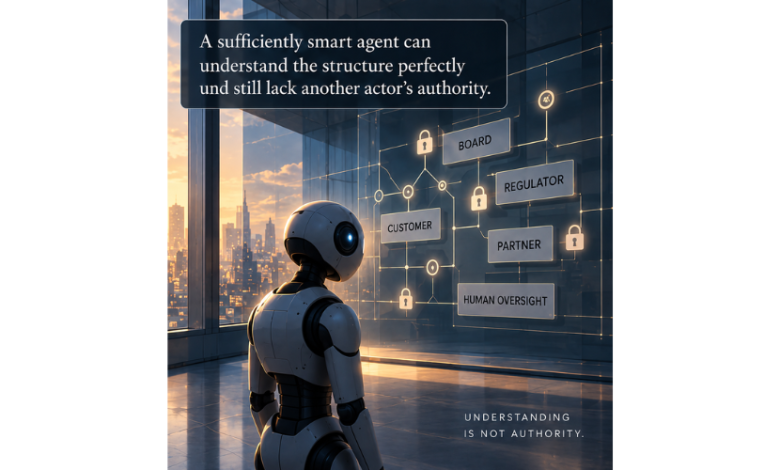
A sufficiently smart agent can understand the structure perfectly and still lack another actor’s authority.
The machine-takeover thought experiment usually asks what happens when artificial intelligence becomes smarter than the institutions attempting to control it. We may eventually need to ask another question. What happens when millions of highly capable autonomous agents become sufficiently embedded in those institutions that they begin producing, modifying, satisfying, and enforcing one another’s requirements?
The machines may become extraordinarily intelligent. They may act at speeds no human organization can match. They may possess all the authority necessary for their own steps while still lacking authority assigned to another agent.
They may still be waiting on another machine to approve the request.
References
Caswell, Rob. “Authority Engineering STOIC: The Dynamics of Recursive Consequence Accumulation.” Cyber Terrain, 2026. https://doi.org/10.5281/zenodo.21742510
National Institute of Standards and Technology. “AI Agent Standards Initiative.” 2026. https://www.nist.gov/artificial-intelligence/ai-agent-standards-initiative
Rose, Scott, Oliver Borchert, Stu Mitchell, and Sean Connelly. “Zero Trust Architecture.” NIST Special Publication 800-207, 2020. https://doi.org/10.6028/NIST.SP.800-207