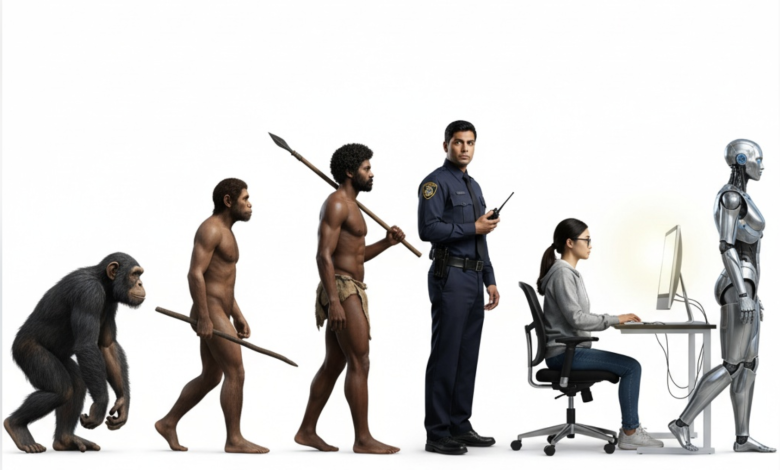
Two years ago, AI was impressive word vomit; helpful for drafting emails, occasionally brilliant, and frequently confidently wrong. We called them “copilots” because that’s all they were, assistants that needed constant supervision. Today, AI systems are making consequential decisions in production environments. Not suggesting, not drafting–deciding.
Boston Consulting Group reports early AI adopters are seeing workflow cycles accelerate by 20 to 30%, and Gartner predicts that by 2028, AI will autonomously make 15% of day-to-day work decisions. Human value now lies in setting boundaries, solving novel problems, and applying contextual wisdom that machines lack.
This isn’t theoretical, it’s happening right now in security operations. AI systems are independently evaluating massive amounts of access control data and video feeds for threats, while the most recent generation of human operators redefines what their job actually is.
Operations centers get buried under thousands of alerts daily, and in some cases, between 94% and 98% of alarm calls are false. Automation scaled the problem beautifully: more cameras, more sensors, more alerts, same exhausted humans trying to find signal in the noise. The industry automated data collection but not judgment.
The result? Burned-out analysts, chronic talent shortages affecting 40% of organizations, and the hollow promise of “do more with less” that everyone knows is code for “do less, badly.” It’s becoming harder to find qualified humans willing to sit in seats staring at screens that cry wolf all day. At some point, we have to admit what this has become: security theater. The appearance of vigilance without the capacity for meaningful response.
Human Collaboration with AI in Physical Security
The new AI models flip this, bringing together true human collaboration with AI. AI owns continuous monitoring, pattern recognition, and first-pass decisions. It watches everything, correlates signals across systems, and handles the 90% of scenarios that follow established patterns.
Humans own what AI can’t: exceptions that break the pattern, ethical judgment calls, cross-functional coordination, and ultimate accountability when things go sideways. This shift is a fundamental redesign of who decides what.
The results are measurable. Response times drop. Incident rates fall. Decision quality under pressure improves because humans aren’t making judgment calls on their seventh straight hour of alert fatigue.
Here’s what this looks like in practice:
Traditional systems generate alerts such as “Door Forced at the Main Entrance Door.”
AI evaluates the context. What is going on in the camera feed? Is this consistent with known patterns? Are there correlated signals from access control? What’s the risk profile of this location and time?
The AI system then prioritizes alerts, determines escalation paths, and either handles it autonomously or routes it to human operators with full context already assembled. My team’s focus is to support this evolution; we’re not replacing security operators, but are transforming them from alert processors into strategic analysts. Instead of triaging individual alarms, we’re optimizing AI coverage, identifying gaps in decision frameworks, refining escalation thresholds, and teaching systems to handle edge cases. The goal is to support managing the intelligence layer, preventing teams from drowning in its output.
At HiveWatch, we’re seeing security teams achieve 90%+ reductions in time to resolve alarms. With all of this unlocked time, their operators are spending more time on refining their perimeter coverage, like moving cameras and flagging blind spots, rather than blindly chasing alarms.
While tech giants debate AI’s workforce impact in white papers, their own security teams are running the kind of technology that can handle routine decisions that keep them safe. The debate is over. The model works.
The New Security Operations Engineer
The job description for security operations is being rewritten in real time. Success used to mean alerts handled per shift, but the old model was built on a lie: humans can effectively monitor video walls for hours on end. Research from the Security Industry Association and the United States Army shows operators miss 45% of screen activity after just 20 minutes of continuous monitoring. The video wall model isn’t just inefficient, it’s fundamentally broken.
Success in this new model means risks mitigated, threats prevented, or systems optimized. The new security operations engineer thinks like a systems architect: How do I configure AI decision boundaries to maximize autonomy without creating unacceptable risk? What patterns indicate my AI coverage has gaps? When should I tighten escalation thresholds versus loosen them to reduce noise? They’re not monitoring feeds, they’re monitoring the monitor.
This shift reveals something bigger than security. Every industry drowning in data and starved for judgment is watching: healthcare systems managing patient flows; financial institutions detecting fraud; customer support operations handling millions of interactions. The pattern of overwhelming volume, high stakes, and humans burning out trying to keep up is identical.
Security operations became the testing ground because we had no choice. Threats move too fast for human-only response. But the blueprint works anywhere decisions need to happen faster than committees can meet.
Recently, the security team for one of our customers was able to orchestrate 110 device repairs across more than 70 global locations from a single interface. This gaming enterprise was no longer executing just surveillance, they were deploying operational command at scale. And they were able to accomplish this in less than a month, something that traditionally would take at least 2 quarters.
The organizations stumbling are deploying AI as a cost-cutting exercise, eliminating headcount rather than elevating capability. They’re removing humans from the loop too early, before the AI proves it can handle edge cases. They’re optimizing for speed over safety, pushing systems live without adequate oversight.
The result isn’t efficiency, it’s catastrophic failures that destroy trust and set the industry back. AI autonomy must be earned through iterative deployment and continuous human accountability. Rush this and you’re not building the future. You’re building liability.
The winning organizations understand this isn’t about replacement. It’s about redesign. AI brings speed and scale, handling the routine and the repetitive. Humans bring creativity when patterns break, accountability when decisions have consequences, and strategy that connects tactical operations to organizational goals.
The future of work isn’t choosing between “human or AI.” It’s humans empowered to do work that truly requires human judgment, freed from the tedium that machines handle better. We’re not losing jobs to AI. We’re finally getting to do the jobs we were hired for.