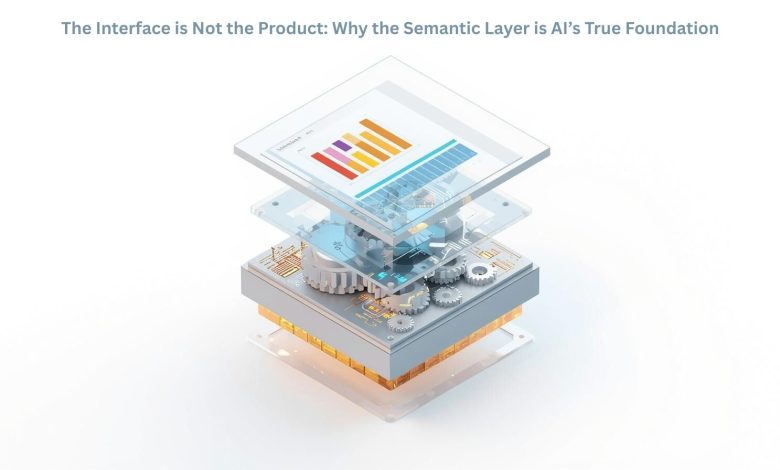
For years, the analytics industry operated under a collective illusion: we believed the dashboard was the product. We celebrated sleek visualizations, interactive filters, and executive-ready layouts. Tools like Tableau, Looker, and Power BI competed fiercely on visualization quality and user experience.
Then AI arrived, and the interface advantage collapsed.
Today, Large Language Models (LLMs) and agentic AI systems can generate charts from natural language prompts in seconds. They can query databases, summarize trends, and build ad hoc dashboards dynamically. If AI can generate any chart on demand, what is left of the traditional analytics stack?
The answer reveals the industry’s structural reality. The true value was never the dashboard. The true foundation is the semantic layer.
The Reality Check: A Personal Experiment
I recently experienced this friction firsthand during conversations with several engineering managers. Their request was clear and seemingly logical: “Build us an AI Agent that replaces the dashboard.”
The goal was to cut costs and reduce complexity to strip away the licensing layers of Tableau, Looker, or Power BI and simply let stakeholders “chat” with their data.
However, as we moved from concept to execution, we hit a wall. The project revealed two insurmountable gaps:
- The Missing Semantic Layer: Without a governed modeling layer, the Agent had no concept of “Net Revenue” versus “Gross Revenue.” It was trying to write SQL against raw tables, leading to inconsistent and untrustworthy numbers.
- The “Feature Parity” Trap: We quickly realized that a chat window cannot easily replicate the density of a mature BI tool. Managers didn’t just want answers; they wanted the features they were used to complex filtering, drill-down capabilities, conditional formatting, and interactive heatmaps.
Trying to rebuild ten years of Tableau’s UI engineering inside a custom AI Agent was not just difficult; it was a distraction. The lesson was clear: The Agent is a powerful interface, but it cannot function without the governance and structure that traditional tools provide.
The Dashboard Was Always Just a Surface
Dashboards are merely the visible surface of deep analytics systems. They answer the “what”. What was revenue last quarter? Which regions are underperforming?, But they are only as trustworthy as the definitions behind them.
Behind every simple KPI (Key Performance Indicators) lies a complex chain of logic:
- Which tables are joined?
- Are refunds included in “Revenue”?
- Is the time zone standardized to UTC or local time?
- Are we calculating gross or net?
The chart is merely the output. The core asset lies in the encoded business logic that produces it. This is the domain of the semantic layer.
The Structural Mismatch: Probabilistic AI vs. Deterministic Business
There is a fundamental friction between how AI works and how business operates, one that is often overlooked in the hype cycle.
Business Intelligence is deterministic.
Given the same inputs and definitions, a CFO expects the exact same output every time. It is a world of precision. AI Agents are probabilistic. Even with similar prompts, they may generate slightly different SQL queries, infer different joins, or hallucinate schema relationships.
We saw a critical example of this friction in 2024 with New York City’s ‘MyCity’ chatbot. Intended to guide business owners through local regulations, the AI confidently advised landlords that they could discriminate based on income sources and told employers they could take a cut of workers’ tips, actions that are explicitly illegal. The system generated these answers because it was predicting plausible language, not referencing a governed, deterministic rulebook.
In a public advice portal, this created a legal mess. In a financial reporting context where an AI agent might misinterpret revenue recognition rules the cost would be regulatory disaster.
The Technical Gap: Why “Text-to-SQL” is a Trap
Many organizations are currently attempting to solve this by pointing LLMs directly at their raw database schemas (a process known as “Text-to-SQL”). This approach is structurally flawed for enterprise use.
Modern data warehouses are messy. They contain hundreds of tables, cryptic column names (e.g., amt_net_v2_final), and deprecated legacy data. An LLM, no matter how powerful, lacks the historical context to know that table_sales_2023 should be ignored in favor of table_sales_consolidated.
Without a semantic layer, the AI is forced to guess the schema relationships. It acts like a new junior analyst on their first day, eager to please, but lacking the institutional knowledge to know where the bodies are buried.
A semantic layer solves this by flattening the complexity. It presents the AI with a clean, curated list of metrics (e.g., Metric: Monthly_Recurring_Revenue) rather than a tangled web of raw tables. It turns a “Text-to-SQL” problem into a “Text-to-Metric” retrieval task, which is exponentially more reliable.
Why AI Agents Struggle Without Governance
Consider Airbnb’s famous data journey. Before they built their internal semantic layer (known as “Minerva”), they famously had dozens of different definitions for a “Booking” across the company. If you asked Data Science, Finance, and Marketing how many bookings occurred yesterday, you got three different numbers.
If you unleash an AI agent on that kind of raw, ungoverned data, the AI will simply amplify the chaos. It might choose the Marketing definition for one query and the Finance definition for another.
The semantic layer solves this by acting as a governed abstraction between raw data and the AI. It standardizes how metrics are defined and accessed. When an AI agent is asked for “Revenue,” it shouldn’t generate SQL from scratch; it should query the semantic layer’s pre-approved definition of “Revenue.”
The Rise of “Headless BI”
This shift is giving rise to a new architecture often called “Headless BI.”
In the traditional model, business logic was trapped inside the BI tool (e.g., calculated fields inside a Tableau workbook). This meant that if you wanted to access that same “Revenue” metric in a different tool, say, a CRM or an AI chatbot you had to rebuild the logic from scratch.
The Semantic Layer decouples the logic from the interface. The logic lives in a central repository, and “heads” (interfaces) sit on top.
- Head 1: A traditional dashboard for the CEO.
- Head 2: An Excel plugin for Finance.
- Head 3: An AI Agent for the Product Manager.
All three “heads” pull from the exact same definition. The AI becomes just another consumer of the semantic layer, ensuring that the chatbot and the dashboard never disagree.
The Industry is Pivoting: Microsoft, Salesforce, and Google
This isn’t just theory; the market is aggressively pivoting toward this architecture.
- Microsoft is betting heavily on Microsoft Fabric, which centers around “OneLake” and semantic models. Their “Copilot” doesn’t just look at raw files; it relies on the semantic model to understand what the data means.
- Salesforce launched Tableau Pulse, which moves away from complex dashboards toward Agentic Analytics and “Metrics Layer” approach. The focus is no longer on building the perfect chart, but on defining the perfect metric that AI can then summarize for users.
- Google Cloud continues to leverage LookML (Looker’s modeling language) not just for dashboards, but as a grounding layer for their Vertex AI agents.
These giants realize that AI without a semantic layer is a hallucination engine.
The Hybrid Future: AI on Top of Governance
The winning architecture is not “AI replacing BI.” It is AI operating on top of a governed semantic layer.
In this model, the semantic layer defines the metrics and controls access, while the AI agent handles the interface and exploration. Queries are generated but constrained. Outputs are flexible, but definitions are fixed. This creates a powerful balance: exploration without chaos, and intelligence without sacrificing trust.
The True Foundation
Lasting value in software is rarely about features; it is about embedded systems. An AI interface can replicate a dashboard in minutes, but it cannot easily replicate a decade of negotiated metric definitions, org-wide alignment on KPIs, and complex security policies.
The semantic layer accumulates “organizational gravity.” It is not flashy, and it is not visible. But it is structurally sticky. AI may change how we ask the questions, but the semantic layer ensures we agree on the answers.
Author Bio / Byline:
Laxmi Supriya Ketireddy is a Senior FinOps Engineer and SRE at Equifax. Her focus is in Enterprise FinOps, AI cost optimization and cost analysis, helping organizations bridge the gap between engineering and finance to maximize stakeholder value and ROI.