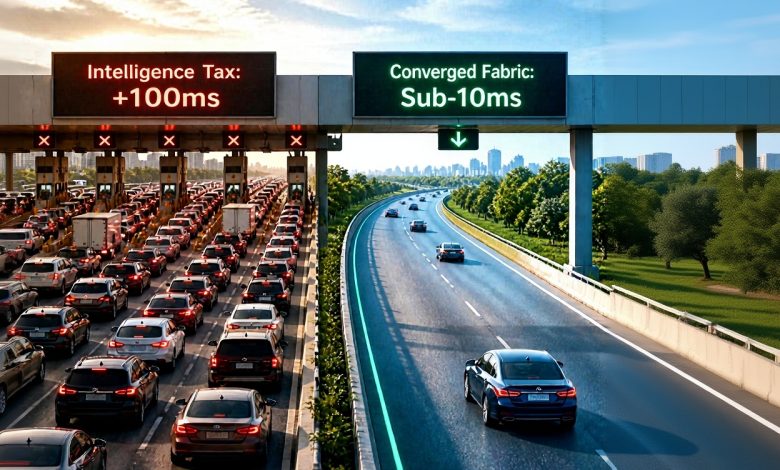
A silent crisis is stalling enterprise innovation. We have entered the age of distributed intelligence, where AI models promise to predict threats, optimize performance, and personalize experiences. Yet, the very infrastructure meant to enable this is imposing a crippling cost—an “Intelligence Tax.” This is the latency, operational overhead, and security risk created by forcing data to traverse a maze of disconnected networks, cloud security gateways, and central AI engines. In a world where real-time response is paramount, this architectural debt is becoming unsustainable.
The emerging consensus is clear: the only way to abolish this tax is through architectural convergence. This isn’t about buying another tool; it’s about engineering a new foundational layer. My experience leading the multi-year transformation of a legacy networking product into a global, cloud-native Secure Access Service Edge platform was a direct confrontation with this problem. The goal was not to add features, but to reconceive the network as a single, intelligent fabric where security, connectivity, and data are born integrated.
The Latency Imperative: Intelligence at the Edge of Access
The first pillar of this convergence is a non-negotiable rule: intelligence must live where access happens. The traditional model of backhauling user traffic to centralized data centers for inspection is mathematically incompatible with the future. Industry analysis consistently shows this can add 80-100 milliseconds of latency, a death knell for real-time collaboration, financial trading, or IoT systems.
The solution we engineered was a globally distributed fabric of enforcement points. The insight wasn’t the infrastructure itself, but the architectural mandate it served: security and access policies must execute within a predictable, sub-10-millisecond window from any user, anywhere. This meant embedding critical services—like a Zero Trust engine that verifies every request—directly into this fabric. When your policy enforcement is everywhere, your AI-driven security can act instantly, not after the fact.
The Programmable Fabric: Turning Policy into Live Code
Convergence fails if it creates a more complex monolith. The second insight is that the network itself must become a programmable, API-first substrate. The scale of modern enterprise—with organizations using an average of over 300 SaaS applications—makes manual configuration and static rules a guaranteed point of failure.
Our approach was to build the core platform as a suite of microservices communicating via immutable APIs. This wasn’t a technological preference for modernity; it was a practical necessity. It allowed security and networking logic to be defined as code—”Policy as Code.” An AI system analyzing threat trends could, via an API call, dynamically quarantine a suspicious segment of the network or enforce a new access rule across millions of sessions in seconds. The lesson is stark: your infrastructure’s agility directly dictates your AI’s operational relevance. A slow, manual network cannot host a fast, autonomous intelligence.
Orchestrating Convergence: The Human Architecture
The most formidable barrier is not technical, but human. The “Intelligence Tax” is often an organizational tax. When networking, security, and cloud teams operate in silos with different goals and tools, convergence is impossible. Industry reports note that such misalignment can waste over 20% of engineering time on reconciliation and blame, not innovation.
The pivotal challenge in our build was orchestrating this new model across globally distributed engineering, product, and operations teams. Success required aligning everyone around a shared logic: that the performance of the AI-driven services they were building depended entirely on the resilience and programmability of the fabric they were constructing. Convergence is a workflow and governance challenge first, a technical one second. Building the culture where “Policy as Code” is a shared discipline is more critical than writing the code itself.
The Next Frontier: The Self-Optimizing Network
The current shift to converged platforms like SASE is just the beginning. It lays the groundwork for the true future: the AI-Native Network. This is a system where the fabric doesn’t just carry data and enforce static policy, but continuously learns and adapts.
Imagine a network that can predictively isolate a compromised device based on behavioral anomalies before it exfiltrates data; one that dynamically re-routes traffic to optimize bandwidth for a critical AI training job; or a system that self-diagnoses a latency spike to a specific microservice. This is not science fiction. It is the logical endpoint of a fully converged, programmable, and instrumented system. The organizations investing now in this architectural foundation will be the ones whose infrastructure doesn’tjust support AI, but actively participates in it as a cognitive partner.
The Intelligence Tax is a choice. It is the cost of clinging to a fragmented past. The mandate for leaders is to invest not in incremental point solutions, but in the engineered convergence of their core infrastructure. The future belongs to those who build a nervous system for their enterprise that is as integrated and intelligent as the technologies it aims to host.