Data centres are the silent backbone of modern life. Every time someone streams a movie, stores a file in the cloud, or receives a response from an AI assistant, that request is routed through massive facilities filled with high-powered servers. These centres keep the digital world running, but they also come with hidden costs.
The most visible concern has long been their hunger for electricity. Yet increasingly, researchers and policymakers are paying attention to another scarce resource being drained at scale: water. Unlike the water that flows through household taps and usually returns to treatment systems, much of the water consumed by data centres is lost for good.
The Government Digital Sustainability Alliance (GDSA) report warns that global water consumption driven by AI could rise from 1.1 billion to 6.6 billion cubic metres by 2027 — a volume exceeding half of the UK’s total annual water use. The sheer scale of this prediction highlights how intertwined digital growth and environmental sustainability have become.
Why water matters in digital infrastructure
A typical data centre contains thousands of servers stacked in racks, all running continuously. These machines generate an extraordinary amount of heat, and without constant cooling, they would quickly fail. This is where water enters the story.
One of the most common cooling methods involves mechanical chillers, which function like oversized refrigerators by using refrigerants to absorb heat from servers and release it through condensers. In the process, large quantities of water evaporate that cannot be recovered.
The numbers are sobering. A single 1-megawatt data centre – enough to power around 1,000 homes – can consume up to 25.5 million litres of water per year. With UK data centre capacity estimated at roughly 1.6 gigawatts, and global capacity near 59 gigawatts, the total demand quickly adds up.
Unlike water from dishwashers or toilets, which is typically treated and returned to local systems, water used for cooling often escapes as vapour into the atmosphere. While it technically remains part of Earth’s broader water cycle, it is effectively lost to the immediate environment. For communities already struggling with water scarcity, this distinction is critical.
Location, scarcity, and strain
Since 2022, the majority of new data centres have been built in areas already prone to drought or water stress. Locally, this can tip delicate balances in water availability. Once evaporated, the water may eventually return as rainfall, but not necessarily in the same place, or within a timeframe that makes it useful to the original community.
In practice, this means data centre water use is largely non-renewable in the short term. Unlike electricity – which can be sourced from renewables such as solar and wind – water availability is far more geographically constrained.
The rise of artificial intelligence has intensified this challenge. Large language models, image generators, and other advanced tools require enormous amounts of computing power. Running these systems pushes servers harder and produces more heat, in turn driving higher water consumption for cooling. For instance, training a large-scale model such as GPT-3 can consume more than 700,000 litres of water for a single training cycle.
The International Energy Agency (IEA) reported in April 2025 that data centres worldwide already use more than 560 billion litres of water annually. If trends continue, that figure could more than double to 1.2 trillion litres by 2030.
Exploring alternatives
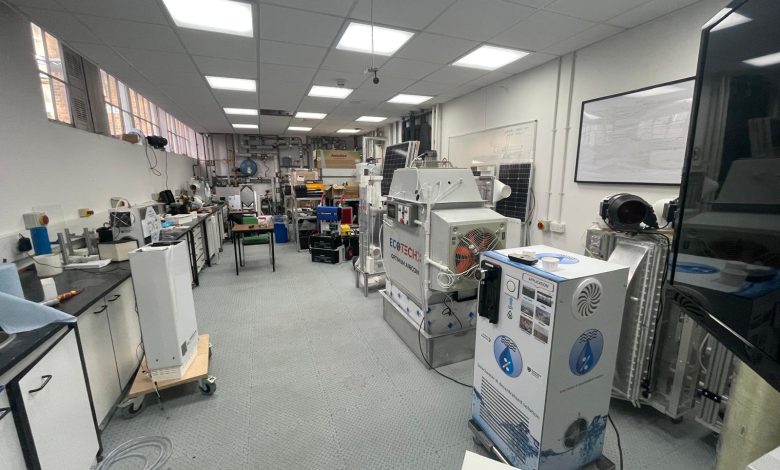
The silver lining is that not all cooling strategies are equally water-intensive. My team and I have been working on groundbreaking research to test new designs that aim to reduce reliance on both water and chemical refrigerants.
One of these designs uses thin aluminium foil to separate moist and dry air streams. Heat transfers through the foil without allowing moisture to mix, cooling server rooms while keeping humidity in check. Early trials at Northumbria University have shown promise: the system can outperform conventional chillers in energy efficiency while consuming far less water, and it can be powered entirely by solar energy.
These innovations highlight that solutions exist, but scaling them requires significant investment and global coordination. As demand for AI and cloud services grows, so too will the pressure on data centres. Meeting this challenge will require a shift in how these facilities are designed, regulated, and powered.
Several principles could guide that transformation, starting with transparency: operators should disclose water usage alongside energy consumption, enabling policymakers and communities to understand the local impact. But investment in research and first-of-a-kind alternative methods will also be crucial not only to develop more efficient cooling technologies, but also scale them to have a meaningful impact globally – whether it’s foiled-based cooling, or closed-loop water systems that reduce reliance on evaporation-heavy methods. Finally, policy has a role to play: introducing efficiency standards, similar to Power Usage Effectiveness which is tracked by data centres, would help incentivise improvements to water usage and efficiency.
Data centres are often described as the engines of the digital age, but engines can overheat. The invisible thirst of these facilities is becoming harder to ignore, especially as climate pressures intensify worldwide.
The choice is not between digital progress and environmental responsibility, it is about designing infrastructure that allows both to coexist. By rethinking cooling technologies, aligning regulations with sustainability goals, and recognising water as a finite resource, the digital economy can continue to expand without leaving local ecosystems dry.
The conversation around data centres is no longer just about megawatts, it is also about megalitres. The faster policymakers, industry leaders, and researchers act, the more likely we can ensure that the digital services shaping daily life do not compromise the resources we depend on most.