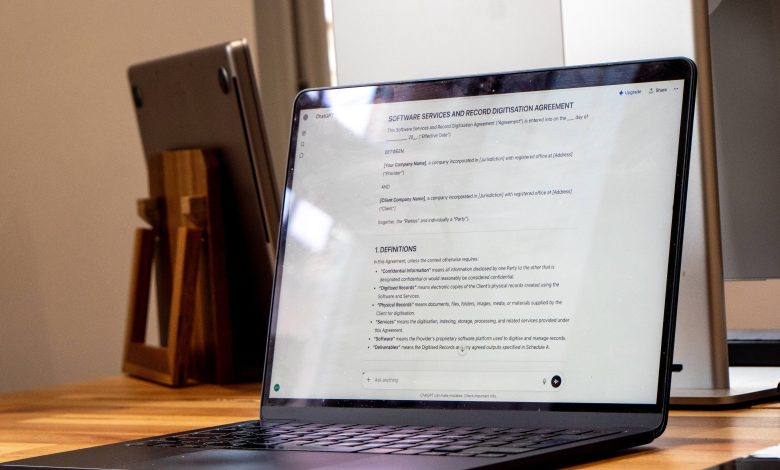
AI can be a great starting point for drafting contracts, but sole reliance on the technology could land businesses in a world of trouble, as Lewis McKeown, commercial lawyer at Square One Law, explains…
Artificial intelligence is rapidly becoming a go-to tool for producing first drafts of commercial documents, including contracts.
While AI can provide impressive speed and structure, there are important legal and practical limitations that make relying on AI to produce such documents incredibly risky.
Firstly, it has limited understanding of the full legal picture. AI-generated contracts are built on patterns rather than a true understanding of the commercial relationship or the full legal framework governing it.
Most agreements sit within a broader ecosystem: supply chains, regulatory requirements, competition law considerations, and sector-specific obligations for example.
An AI tool may produce provisions that look correct in isolation but fail to align with the parties’ actual commercial intentions, industry-specific regulatory nuances and interdependencies between clauses. This can lead to internal inconsistencies or gaps that only become apparent when a dispute arises.
A more subtle, but equally significant, issue lies in drafting structure. AI systems often generate contracts with basic clause numbering or bullet points but without clear sub-clauses or subdivisions. At first glance, this may seem harmless. In practice, however, it can create serious problems when paired with standard boilerplate provisions, particularly severance clauses.
Most AI-generated contracts also correctly include a severance clause, which provides that if a provision is found to be unenforceable, it can be removed without invalidating the rest of the agreement. This is good drafting hygiene and aligns with standard legal practice. However, the effectiveness of a severance clause depends heavily on how the document is structured.
Under English law for example, courts generally approach severance by removing offending provisions rather than rewriting or selectively editing them. In other words, the court can “edit” a clause, but only by striking out wholesale or discrete, clearly separable parts.
If a contract is not properly divided into sub-clauses, the court may only be able to remove an entire clause, even if only a small part is problematic. This can result in disproportionate outcomes, stripping out commercially important terms and making contracts unbalanced or unworkable as a result.
By contrast, well-drafted agreements use layered clause numbering (e.g. 1.1, 1.2, etc.), allowing specific sub-clauses to be severed without undermining the overall structure.
AI can be a helpful starting point for drafting contracts, but it should not replace legal oversight, particularly given that structural precision matters as much as substantive accuracy, boilerplate clauses are only effective if the document is drafted to support them and small drafting choices (like sub-clause numbering) can have significant legal consequences.
Ultimately, contracts are not just about what they say, but how they are structured. AI can accelerate drafting, but without careful legal input, it can also embed hidden risks. Used properly, it is a tool, used without proper scrutiny, it is a liability.