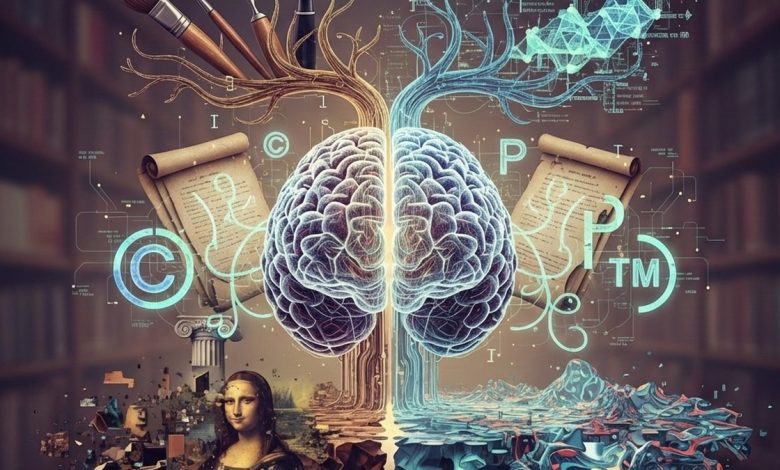
The growing anxiety around generative AI and intellectual property is widely framed as a legal problem: who owns what, who can claim authorship and who should be protected when machines are involved in creation. Yet this framing assumes something that has rarely been true: that ideas originate from isolated individuals, acting alone.
In reality, creation has always been collective. Every idea draws on shared language, inherited knowledge, cultural norms and prior work. Innovation does not emerge from nowhere; it accumulates. Generative AI has not disrupted this pattern so much as made it visible and in doing so, it has unsettled systems built on the myth of solitary originality.
This is why the current debate feels so charged. We are not facing a simple legal gap, but a deeper need to rethink how creation, contribution and responsibility are understood in a world where cognition has always been shared, and is now increasingly distributed between humans and machines.
For centuries, intellectual property frameworks have relied on a stable assumption: tools do not act, people do. Whether a pen, a printing press or a piece of software, tools were understood as extensions of human intent, not participants in it. Generative AI unsettles this assumption. These systems do not merely record or transmit ideas; they generate, transform and recombine meaning in ways that feel participatory. As a result, organisations are struggling to locate where agency and therefore authorship truly sits.
That struggle extends beyond how AI is used, to how it is made. Every generative system is built on a large language model, and it is the provenance of those models: what data they were trained on, under what licences and with what permissions that now sits at the heart of ownership disputes. Questions about authorship increasingly begin upstream, long before any individual output is produced.
The discomfort many leaders feel is not just about infringement or compliance. It is about orientation. They cannot clearly answer a fundamental question: who is responsible for this work?
From tools to delegated participants
Generative AI is often described as “assistive”, but this language understates what is happening inside real organisations. In practice, these systems are being delegated creative and strategic labour: drafting communications, synthesising research, proposing options, shaping tone, even influencing decisions. Once delegation occurs, the output is no longer merely instrumental. It becomes consequential.
From a cognitive perspective, this matters deeply. Humans are highly attuned to agency, to recognising who acts, who decides, and who can be held accountable. When agency becomes diffuse or obscured, anxiety follows. The unease around AI-generated work is therefore not surprising. It reflects a breakdown in how responsibility is perceived, rather than a failure of technology itself.
Existing IP law struggles because it was never designed for distributed cognition. It presumes a single author or a clearly bounded group acting through inert tools. Generative systems disrupt that symmetry. They behave less like hammers and more like junior collaborators whose contributions are difficult to separate from those of their human counterparts.
Why tighter constraints miss the point
Much of the current response focuses on tighter controls: watermarking content, restricting training data, or demanding ever greater technical transparency. While these measures may reduce risk at the margins, they do not address the core issue. You cannot resolve a conceptual mismatch through constraint alone.
This is especially evident in debates around derivative works. When a document is produced with the assistance of AI, uncertainty quickly arises: who owns the result and how much human modification is required before authorship can be claimed? Existing IP law offers partial analogies, but no clear guidance for work that emerges through iterative human–machine collaboration rather than direct copying.
History offers a useful parallel. When complex financial models entered mainstream decision-making, the crisis was not mathematical opacity but responsibility diffusion. Failures occurred not because models existed, but because no one could clearly say who stood behind decisions made within them. Governance stabilised not by banning models, but by re-anchoring accountability.
The same pattern is emerging with AI. Trust will not be restored by weakening systems or over-policing their outputs. It will be restored when organisations can clearly articulate who remains the author of record and under what conditions delegation occurs.
Authorship as a governance function
Seen this way, authorship is not a philosophical abstraction. It is a governance mechanism. Authorship anchors responsibility. It tells courts, customers and employees where accountability lies. When authorship is unclear, legitimacy erodes even in the absence of obvious legal wrongdoing.
This helps explain why IP disputes are proliferating. Many arise not because harm has occurred, but because organisations sense that something foundational has shifted. The law is being asked to resolve a problem that originates earlier: in system design, data governance and organisational thinking.
A more robust approach reframes generative AI systems not as independent creators, but as delegated participants. Delegation is familiar territory in human systems. Managers delegate analysis, teams delegate drafting, leaders rely on advisors. These arrangements function because responsibility remains explicit. The delegate acts; the author remains accountable.
The same principle must apply to AI. The question is not whether machines “create”, but whether humans have retained visible and enforceable authorship over what machines produce on their behalf, including responsibility for how those systems were trained and how their outputs are transformed into final works.
Creation has never been solitary
Part of the unease surrounding generative AI stems from an overly narrow conception of creation itself. Modern IP regimes are built on a cultural story that treats ideas as originating from discrete individuals, as if innovation emerges fully formed from a single mind. Yet this has rarely reflected reality.
Isaac Newton’s remark that he stood “on the shoulders of giants” was not rhetorical modesty; it was an accurate description of how knowledge advances. The development of calculus, like many foundational innovations, emerged independently and almost simultaneously from multiple thinkers working within the same intellectual conditions. Progress in science, art and technology has always been cumulative, shaped by shared language, inherited frameworks and collective effort.
Historically, knowledge functioned less as a commodity and more as a shared survival resource. Long before ideas were packaged, priced and traded, they circulated because collective understanding increased the chances of group survival. Modern intellectual property systems emerged alongside print, markets and professional authorship – useful structures, but not timeless truths about how knowledge itself works.
In this sense, generative AI is not an aberration. It makes visible what was previously implicit: that creation is often distributed across people, tools, traditions and time. The machine does not introduce collaboration into authorship; it exposes how collaborative authorship has always been.
The tension arises because this long-standing reality collides with legal and economic systems that continue to reward a myth of isolated originality. Intellectual property has never been a perfect mirror of how ideas emerge. It has been a pragmatic structure for allocating incentive, ownership and responsibility within a particular cultural and economic context.
Rethinking originality, responsibility and inclusion
Recognising the collective nature of creation does not mean dissolving authorship or abandoning ownership. It means redefining them with greater accuracy. Authorship need not claim that an idea emerged from a single, isolated mind. It can instead signify who takes responsibility for an outcome — who stands behind it, defends it and is accountable for its consequences.
Generative AI brings this question into focus because it sits uncomfortably between categories we have relied on for centuries. It is not human, yet it is no longer inert. Treating it as either a rival author or a mere tool obscures what is actually happening: cognition is being shared across a wider system, one that now includes non-human participants.
The challenge, then, is not to decide whether machines belong in the story of creation – they already do – but to decide how responsibility is assigned within that story. Inclusion without accountability is chaos; accountability without inclusion is denial.
The future of intellectual property will not be secured by defending the myth of solitary originality, nor by pretending that creation was ever human-only. It will stabilise when our frameworks reflect how ideas are actually made: collectively, cumulatively, across human and non-human contributions, with responsibility deliberately and visibly assigned.
Seen this way, the generative AI IP debate is not a crisis to be contained, but an invitation to mature, not only in how we govern technology, but in how we understand ourselves as participants in a broader creative system. One that has always been shared and is now simply more explicit about it.