The World Cup is over, but it always leaves people thinking about the players who might come next. For young soccer players, that journey often starts with better feedback, clearer goals, and the right support at the right time.
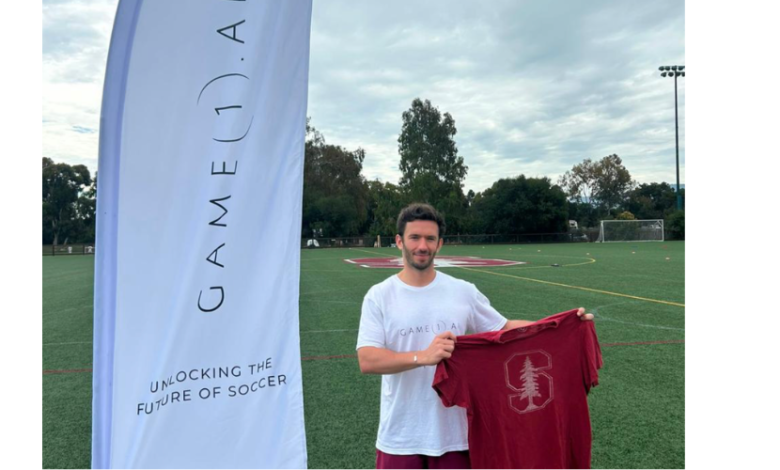
That is where Amir Donath is focusing his work. As Co-Founder and CEO of Game1.ai, he is building an AI-powered player identification and development platform for players aged 10 to 16. The platform uses standardized testing to turn youth performance into feedback players can use in training.
Your background includes sport, consulting, startups, venture capital, and Stanford. How did that lead to Game1.ai?
Amir Donath: Sport has shaped most of my life. I grew up in Switzerland playing soccer and later coached young players. That gave me a close look at how much good feedback can change a player’s development.
At Stanford, the idea became clearer. I was spending time around AI and sports business, and I kept thinking about the kind of tool I would have wanted as a young player: something that could show me where I stood, what I needed to work on, and how I was improving.
My earlier career helped me see how to build it. McKinsey taught me how to break down complex problems. Bird showed me how to build and scale in real markets. Venture capital helped me understand how companies and markets are evaluated. Game1.ai came from bringing those pieces together around a problem I had already seen on the field.
What problem are you addressing in youth soccer?
Amir Donath: Youth development still depends too much on opinion, access, and short-term performance.
Many coaches are judged by wins, not by how well they develop players over time. That can favor early developers, the kids who are already taller, faster, or stronger, while late developers with long-term potential get overlooked.
Professional players often have video analysis, performance data, and specialist coaching. Young players usually have much less. Game1.ai is trying to close that gap by giving players clearer feedback on where they are, what to improve, and how they are progressing.
How does Game1.ai help with that?
Amir Donath: We run standardized tests that any club can set up, and players are measured using our computer vision technology that works on a regular smartphone. No special hardware, no lab environment — just a phone.
Every player gets an objective picture of where they stand across physical and technical ability, game impact, mental strength, and biological maturity, benchmarked against data from thousands of youth athletes, including players who came through elite European academies and now play at the top of the game. Because the tests are standardized, a player in a grassroots club is measured the same way as a player at a professional academy.
For me, the point is simple: help the player, parent, and coach see the next step more clearly. What is improving? What needs more work? What should the player focus on in training? The technology only matters if it answers those questions.
Why did you start with soccer?
Amir Donath: Soccer is the sport I know best. I played competitively, captained teams, and later coached young players. That gave me a direct understanding of how development happens and where feedback can be inconsistent.
Soccer is also global, played across countries, cultures, and income levels. The youth environment is fragmented, with clubs, academies, coaches, and private trainers often evaluating players differently. Game1.ai is focused on making those insights more consistent and useful.
What makes data useful for young athletes?
Amir Donath: Data is only a tool, but it can point to things the eye may miss. It has neither an opinion nor an incentive.
That matters in youth development. A statistic alone has limited value, but clear data can help a player, parent, or coach see what needs attention, track progress, and make better training decisions.
What has the early stage of Game1.ai involved?
Amir Donath: We secured our seed funding from athletes, club owners, and institutional investors. We used funds to build the product and launched it across four continents. At this stage, the work is about continuing to scale while listening carefully and improving the product with each club we work with.
Youth sports are personal. Parents, coaches, and clubs want to know if the technology helps the player instead of adding noise.
As CEO, I work across strategy, operations, partnerships, investor relations, go-to-market, and product direction. The important work happens in conversations with clubs and academies, because that is where we learn what problems they deal with every day and how the platform can help.
E-scooters and youth soccer are very different worlds. What did Bird teach you that still applies to Game1.ai?
Amir Donath: They are very different worlds, but the operating lessons carry over.
At Bird, I learned how to build in fast-moving markets where plans change quickly, and execution matters every day. The company scaled across many countries, and I helped launch more than 20 markets across Europe, Israel, and Australia.
The main lesson was that a good strategy has to work on the ground. That applies to Game1.ai too. We can have a strong vision for youth soccer analytics, but the product still has to work for real clubs, real coaches, and real young players.
You also launched a nonprofit with your brother and co-founder, Yaniv. How does that connect to your work now?
Amir Donath: Yaniv and I previously launched a nonprofit connecting migrant kids with locals through sport. The goal was to break barriers and cultural differences through the love of the game.
That experience reinforced my belief that sport can build connection and opportunity. Game1.ai is a technology company, but access is an important part of the mission. Talent is not limited to one geography, one type of club, or one income group.
What role do you think AI can play in youth sports?
Amir Donath: AI can make athlete development more personalized, objective, and accessible.
It can support clearer progress tracking, more consistent assessments, individual development plans, and better communication between players and coaches. It will also help reduce inconsistency in talent identification.
The technology has to be applied carefully. Youth sports are also about confidence, learning, enjoyment, and motivation. AI should support development without creating unnecessary pressure.
What is your long-term vision for Game1.ai?
Amir Donath: The long-term vision is to build Game1.ai into the leading platform for youth athlete development globally.
We are starting with soccer because we know the sport deeply. But the need is bigger than one sport. All young athletes want to know how they are doing, what to work on, and whether they are getting better.
AI can make that clearer and more accessible without taking the joy out of playing, empowering every young athlete.