In 2008, Robert Kaplan and David Norton published The Execution Premium (Harvard Business Press). Their argument was straightforward. Most organisations fail not because they lack strategy, but because they can’t execute it. The companies that could reliably translate strategic intent into operational reality earned a premium.
Better margins. Faster growth. Competitive advantage that compounded over time.
The book became foundational. It sat behind a generation of management systems, balanced scorecards, and strategy maps.
And buried inside its thesis was an assumption so fundamental that nobody thought to question it.
Execution was hard.
It required systems, discipline, alignment, and skilled people. The premium existed because most organisations couldn’t do it reliably. The ones that could were rewarded precisely because the capability was scarce.
That assumption held for fifteen years. It doesn’t hold any more.
The premium isn’t shifting. It’s evaporating.
AI hasn’t just made execution easier. It has begun to collapse the economic value of execution itself.
This is not the same as saying AI helps organisations execute their strategies better. That would be the Kaplan and Norton version, updated for 2026. A better balanced scorecard. A smarter dashboard.
What’s actually happening is more structural. The cost of skilled production work – the work that professional services firms have charged a premium for, the work that justified headcount – is falling. Not because the work got simpler. Because AI can now do significant portions of it.
The premium doesn’t shift to a different team or a different geography. It evaporates from the transaction entirely.
The 14% haircut
In February 2026, KPMG International negotiated a fee reduction with its own auditor, Grant Thornton UK. The argument was blunt. KPMG told Grant Thornton that AI and automation should be making audits faster and cheaper, and that those efficiencies should be reflected in pricing. As reported by the Financial Times, when Grant Thornton resisted, KPMG reportedly threatened to find a new auditor.
The result: Grant Thornton’s fee for KPMG International’s 2025 accounts fell from $416,000 to $357,000. A 14% reduction.
The numbers are small. The signal is enormous.
Grant Thornton didn’t replace its auditors with AI. The audit still required experienced professionals, regulatory expertise, and human judgement. But KPMG didn’t need Grant Thornton to have fully automated anything. They just needed the existence of AI to be a credible basis for saying: we both know the economics of this work have changed, so your old prices can’t be justified.
This is the execution premium collapsing in real time. Grant Thornton’s value proposition was skilled execution: experienced auditors, established methodology, regulatory expertise applied to a defined scope of work. KPMG’s counter was that the execution component of that work is now worth less than it was twelve months ago.
Not worthless. Worth less.
The audit itself – the independent verification, the professional judgement, the regulatory accountability – still matters. What KPMG repriced was the production work wrapped around it. The lesson for every professional services firm is that trust and execution have been bundled into a single fee for decades.
AI is forcing the unbundling.
And here is the part that should concern every professional services firm in the market: KPMG just handed every one of its own audit clients the same playbook. If AI justifies lower fees when KPMG is the buyer, it justifies lower fees when KPMG is the seller. The logic is symmetric. The market will not forget.
From fee compression to fee elimination
The KPMG example is about compression. The execution premium gets squeezed, but the transaction still exists. An auditor still does the work. A fee is still paid.
But there is a stage beyond compression. What happens when the person closest to the problem stops hiring the expert altogether?
For decades, professional services ran on hand-offs. Someone with a problem wrote requirements. Those requirements went into a queue. Another team interpreted them, made judgement calls about scope and priority, and eventually delivered something back.
Manufacturing calls this “Waiting” waste. Professional services never eliminated it. We institutionalised it.
AI collapses the waiting entirely. A finance analyst who needs a reconciliation tool doesn’t submit a ticket. They describe what they need to an enterprise AI platform and iterate until it works. A product manager who needs a dashboard doesn’t wait three sprints.
They build it in an afternoon.
When this happens, their colleagues don’t ask who gave them permission. They ask when they can get the same tool deployed for their team. Months of development, side-stepped in a single conversation.
The design loop has collapsed. The person closest to the problem can now build the solution, without waiting in a queue, without translating requirements for someone else to interpret, without the compromises that come from putting layers between the problem and the fix.
This connects directly to Kaplan and Norton’s original insight, inverted. In 2008, execution was the scarce capability that earned the premium.
In 2026, execution is the commodity that no longer justifies one.
Three stages of the same collapse
Seen together, these examples trace a single phenomenon through three stages.
Stage one is the Kaplan and Norton world. Execution is hard. The premium goes to organisations and firms that do it well. This was the professional services model for decades, and it worked because the capability genuinely was scarce.
Stage two is the KPMG world. Execution is becoming cheaper. AI compresses the cost of production work, and buyers know it. Fees come under pressure not because the work disappeared, but because the economics underneath it shifted.
The same engagement takes fewer hours, or fewer senior hours, or fewer humans altogether. The premium compresses, but it shrinks with each passing quarter.
Stage three is already here. Execution is near-free for the person closest to the problem. The PM builds the app. The analyst builds the model.
The operator builds the workflow. No fee negotiation, because there is no fee. No vendor selection, because there is no vendor. The premium doesn’t compress.
It ceases to exist as a line item.
Most professional services firms are pricing as though they are still in stage one. Their clients are already in stage two. Some of their clients’ employees are in stage three. The gap between those positions is where margin erosion lives.
Where the premium relocates
But the story doesn’t end with evaporation. Not in every domain.
In software, this works. Someone builds a tool, it has a bug, the stakes are low. Someone spots it, fixes it, moves on. The cost of error is a conversation, not a lawsuit.
Now transplant that logic into finance. A CFO at a mid-market business backed by private equity uses AI to build a margin analysis across 14 entities. The AI pulls from unstructured project notes, incomplete timesheets, and three different general ledger systems. It produces a clean output.
The numbers look plausible.
Who validates it? Against what definitions? On whose authority?
In domains where the output carries legal, fiduciary, or investment consequences, getting stuff done without constraints isn’t innovation. It’s exposure.
This is where the execution premium doesn’t evaporate. It relocates.
It moves from production to trust architecture.
The question is no longer “can you get stuff done?” AI can get stuff done. The question is “can anyone verify it was done correctly?”
That requires something AI alone cannot provide: deterministic constraints that don’t flex based on who is asking or which model is running.
I call this architecture the Deterministic Sandwich. The concept is straightforward. AI sits in the middle – doing the extraction, the pattern recognition, the synthesis. It is powerful, flexible, and probabilistic.
It is also, by its nature, non-deterministic. The same prompt can produce different outputs on different days. In domains where the output has consequences, that variability is unacceptable.
So we bound it. At the base: a fixed taxonomy. Standardised definitions that ensure “revenue” means the same thing across every entity and every query. The taxonomy constrains what the AI is allowed to interpret and how it categorises what it finds.
At the top: verification logic. Outputs are checked against known constraints before they are released for decision-making. Does this margin figure fall within the expected range? Does this classification match the taxonomy?
If not, the output is flagged or rejected before it reaches anyone who might act on it.
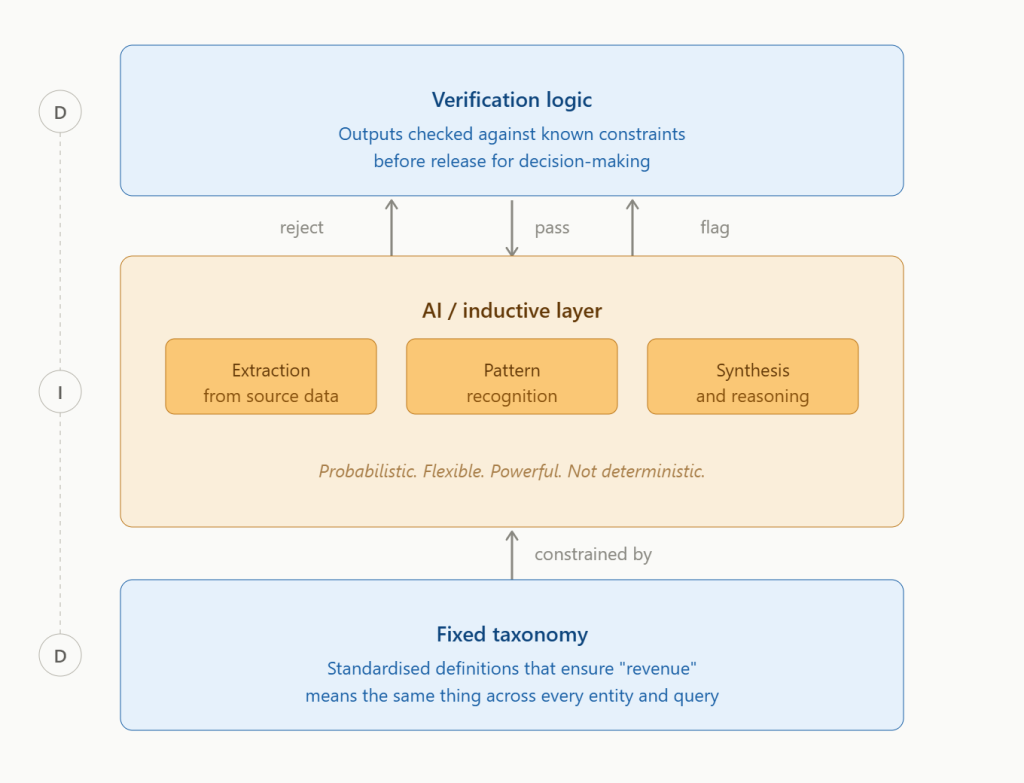
The Deterministic Sandwich: an architecture for trustworthy AI in high-stakes domains. The inductive layer (I) – where AI does the extraction, pattern recognition, and synthesis – is bounded above and below by deterministic layers (D). A fixed taxonomy at the base constrains what the AI can interpret. Verification logic at the top gates what it can release.
The sandwich doesn’t slow down the democratisation that Stage Three enables. It is what makes that democratisation safe enough to deploy in domains where being wrong has consequences. Without it, every self-service AI output in finance, audit, or regulatory reporting is a liability waiting to surface.
The old execution premium was human skill applied to production tasks. The new execution premium is the architecture of trust.
The teams that build this properly are the ones whose AI outputs can be relied on for investment decisions, board reporting, and regulatory compliance. Everyone else is producing plausible-looking work that nobody can verify at speed.
If execution is no longer scarce, what are you charging for?
Kaplan and Norton’s framework assumed that execution would remain hard. That assumption was correct for fifteen years. It is no longer correct today, and the speed of change is accelerating.
The professional services firms that built their economics on the scarcity of skilled execution need to answer that question honestly. Fee compression is the polite version of the market asking it. Fee elimination – the PM who builds the app, the CFO who builds the model, the operator who builds the workflow – is the structural version.
The firms and teams that thrive in this landscape will be the ones who recognised early that the premium was relocating, not disappearing. That it moved from “we can get stuff done” to “we can prove it was done right.” From production to architecture.
From execution to trust.
The execution premium collapsed. The trust premium is just getting started.