Every year, leadership teams walk into board meetings trying to show they have a solid plan to grow their business, but volatility often throws those plans off course.
In fact, about a third of business leaders now cite cost management as their most critical priority, and the levels of market disruptions are driving leaders to launch contingency plans like supply chain redesigns. Some brands are raising prices to offset tariff-related margin pressure, while others, are avoiding price hikes by tightening their operations.
Leaders are wrestling with questions like “How do we keep investing when margins are so tight?” The reality is that operations teams now have to juggle the ultimate business paradox – boosting revenue while slashing costs.
The warehouse challenge
Warehouses are up against it. Driven by the continuous explosion in e-commerce, leaders are tasked with meeting growing expectations for more deliveries in less time, while also keeping operations as reliable and profitable as possible.
At the same time, calls for cost cuts and efficiency gains ring true across every industry, set against a backdrop of geopolitical chaos, changing consumer behaviour, resource constraints, and supply chain disruptions.
In this environment, reactive cost cutting isn’t enough. Quick savings can provide temporary relief, but sustainable results come from cost optimisation, a proactive approach that fosters a culture of cost-conscious decisions that create value and support long-term strategy.
Costs in warehouses vary widely depending on location, size, and product mix, with rent and labour often being the largest expenses. Optimising these costs not only improves profitability but also makes operations faster and more efficient, helping businesses fulfil orders faster and offer better pricing to customers.
More importantly, cost optimisation makes warehouses leaner and more adaptable. It reduces waste, maximises resources and frees up funds that can be reinvested in innovation, growth, or enhancing the customer experience.
How technology and automation solve this challenge
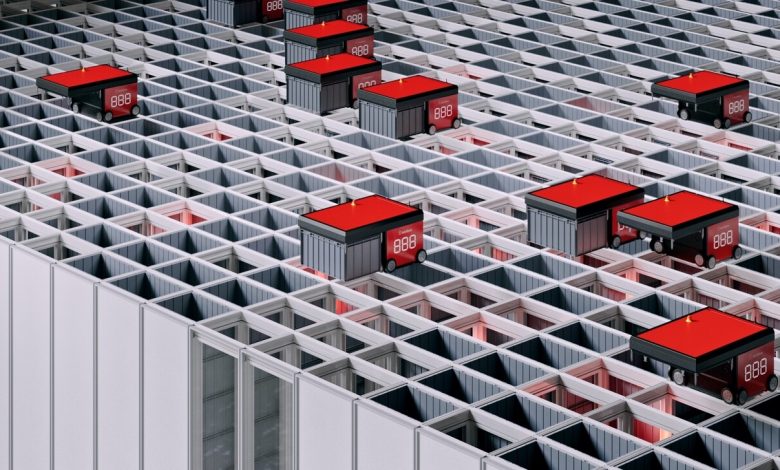
Technology is now the backbone of modern warehouses. Intelligent, software-driven automation solutions are transforming fulfilment, particularly through high-density, cube-based storage systems that use advanced software to automate and orchestrate order fulfilment. These solutions maximise vertical space by stacking bins in a compact grid structure that often reaches ceiling height.
By making better use of the space they already have, businesses can shrink their physical footprint and lower overhead costs such as rent, utilities, and maintenance. Automation also significantly cuts labour costs.
By automating the storage and retrieval of goods and extending automation to processes like picking, packing, and shipping, warehouses can streamline their operations while minimising the need for manual material handling and the associated labour expenses. What’s more, by automating heavy lifting, these systems allow warehouse workers to focus on less physically demanding tasks, boosting productivity while creating better workplaces.
These systems are also able to handle high throughput requirements, efficiently managing order peaks and variations, while improving order accuracy and helping reduce the costs linked with returns and reverse logistics.
The real benefit comes when intelligent software connects the entire operation. When real-time inventory, advanced routing and retrieval data are integrated into warehouse management systems, businesses can gain predictive insights that enable more accurate forecasting, smarter inventory planning and tighter inventory management.
This combination of hardware and software orchestration streamlines operations by reducing carrying costs, supports precise cycle counting, and helps minimise the risk of excess or obsolete inventory.
Investing in scalable growth
Many businesses are naturally nervous about making large capital investments at a time when markets are so unpredictable, and demand can change overnight. It would be both inefficient and expensive to make repeated large buildouts every time you need to expand. Equally, investing in spare capacity means you don’t need to expose yourself to additional business risks by tying up more capital.
The smarter path is to design operations that can scale up or down as demand changes. Modular, software-enabled storage and retrieval systems allow businesses to add capacity quickly without major disruption, ensuring they can stay agile in an era of constant change. In many cases, additional storage capacity can be added or removed in just a few days without disrupting operations.
Retail will always move fast, and warehouse operators need to be able to pivot just as quickly. With so many product types, fulfilment channels, and storage formats, flexibility becomes the closest thing to a future-proof strategy. Technology-driven fulfilment that’s powered by automation and intelligent software is now the most reliable way to achieve that agility while keeping costs in check.
Striking the balance
Warehouses are battling limited space, rising labour costs, safety and compliance demands, and constantly shifting customer expectations. Amid all this, operations must remain fast, flexible, cost-efficient, reliable and scalable – a tough balancing act.
The future of fulfilment lies in intelligent systems that combine robotics with predictive software, enabling real-time decision-making and continuous optimisation. As algorithms become more sophisticated and machine learning starts to guide how robots pick and deliver bins, predict demand and manage inventory, fulfilment operations will shift away from siloed processes to proactively self-optimising networks.
These solutions deliver speed, accuracy and the resilience needed to help businesses grow without increasing costs. In fulfilment, the future belongs to those who recognise that resilience is central to their operations, and who harness the ability to adapt and transform not just as a necessity, but as a strategic advantage in an increasingly complex world.