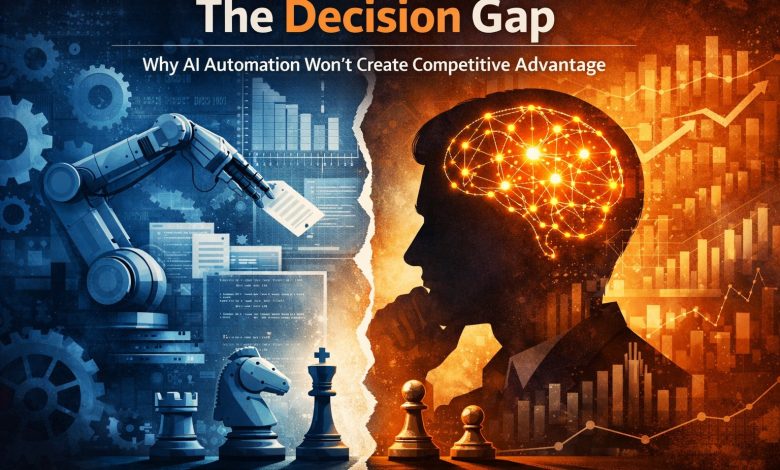
The dominant question in boardrooms today is straightforward: How many jobs will AI replace?
The honest answer is quite a lot. Knowledge work is being compressed. Call centers are being restructured. Drafting, coding, analysis, and content generation are increasingly handled by systems that never sleep, never tire, and cost a fraction of human employment. This is not a speculative future. It is unfolding now.
But focusing solely on labor substitution misses a more consequential shift. Automation changes cost structures. Decision-making changes competitive structures. And the two are not the same.
As foundational models converge in capability and AI tools become accessible through standardized APIs, the ability to automate tasks is rapidly becoming table stakes. Cost reduction, once achieved, is easily replicated. Every company can deploy AI to summarize documents, analyze spreadsheets, or generate code.
Automation equalizes. What does not equalize is judgment.
The real leverage of AI lies not in task execution but in decision participation. When AI is provided with sustained organizational context, integrated internal knowledge, historical memory, strategic objectives, and market data, its role begins to evolve. From worker to analyst to strategic participant.
At that level, AI no longer simply executes predefined instructions. It identifies patterns, surfaces blind spots, challenges assumptions, and contributes to directional decisions. The companies that win will not be those that replace the most employees. They will be those that build superior decision systems, systems in which AI is embedded not as labor but as part of cognitive authority.
The Trap of Treating AI as Labor
Recent research from Wharton highlights why framing AI as a worker substitute is problematic . In sequential workflows where work passes from one person to the next, introducing AI does not just substitute for workers. It rewires how team members monitor one another, how effort is sustained, and what managers must pay to keep performance high. Automation decisions are also organizational design decisions, and focusing on cost cutting alone can backfire.
The study found that replacing one person with AI can change everyone else’s motivation, even if their tasks are untouched by AI. Workers who believe AI might replace them become more tempted to shirk, requiring higher wages to keep them motivated. The indirect incentive costs of automation often outweigh the direct cost savings.
This is the trap of treating AI as labor. It ignores that organizations are systems, not collections of discrete roles. Inserting AI into a system changes how the system behaves. The same technology that reduces headcount can simultaneously degrade the motivational dynamics that made the organization function.
The Architecture of Decision Systems
A recent analysis by the Kyndryl Institute draws a parallel between today’s AI adoption and Detroit’s robotics investments in the 1980s . General Motors spent billions on robots, positioning them exactly where human workers had stood. Job classifications remained intact. The pacing of the assembly line went untouched. The robots were treated as compliant substitutes for labor rather than as catalysts for redesign.
Toyota approached the same tools differently. Engineers examined how the presence of robotic capabilities changed the logic of the production system itself. They reconfigured plant layouts, redesigned work cells, and tied quality feedback tightly into every movement of the line. Human workers shifted from task execution to managing production lines, enabling rapid detection and correction of variation.
Both companies had access to similar technology. Only one reconsidered the architecture around it.
The lesson for AI adoption is direct. Once a capability enters the system, the system either adapts to exploit it or resists and diminishes it. The unit of analysis should not be the role being replaced but the workflow being redesigned and the decision rights being reallocated.
Intelligent Choice Architectures
The World Economic Forum recently highlighted a framework called Intelligent Choice Architectures . These combine generative and predictive AI capabilities to create, refine, and present choices for human decision-makers. They actively generate novel possibilities, learn from outcomes, seek information, and shape the range of available choices.
This is fundamentally different from automation. Automation executes predefined tasks. Intelligent Choice Architectures participate in deciding which tasks matter.
Research cited at Davos shows that 95% of enterprise AI pilots have failed to deliver measurable value . The gap is not technical. It is architectural. Most organizations bolt AI onto existing workflows instead of redesigning decision processes around AI’s capabilities. They ask what tasks AI can take over rather than what choices AI can improve.
To successfully implement these architectures, organizations must first rethink what constitutes an agent when decision-making is distributed across human-AI networks rather than confined to individuals. Leadership becomes less about control and more about designing systems where humans and machines can make informed choices together.
When Humans Move to the Boundary
As AI capabilities improve, human roles transform. In customer support, agents now handle 80-90% of tickets. The human role is no longer about handling volume but about managing the boundary region where a customer is distressed without saying why, or where empathy for a particular context requires overriding policy.
In urban planning, AI may simulate traffic patterns and model density to generate options. Human roles gain value in mediating between incompatible visions of what a city should be, incorporating moral, cultural, and historical context that AI does not adequately factor.
The organization becomes a moving boundary between what the agentic work system can do and what humans must still provide. Leading such an organization requires attention to the evolution of that boundary, because it determines where new opportunities emerge and where hidden risks accumulate.
The Capability Sensing Problem
As agentic capabilities evolve, the value of human capabilities is constantly revalued. Traditional skill models assume that capability value changes slowly. They were built for a world where experience accumulated over years and organizational roles stayed stable. In a system shaped by agentic capabilities, those assumptions collapse.
A skill taxonomy can become outdated faster than HR can update it. A job description can lose relevance when a workflow is redefined. Organizations begin to misallocate people because their frames for evaluating capability are anchored in a past that no longer exists.
This creates a capability-sensing problem for leaders. Firms struggle to understand which human capabilities are rising or falling in value, how internal talent should be redeployed, and where new gaps are emerging. The solution is not to manage employees more tightly but to develop better capability sensing mechanisms and better capability allocation.
Decision Velocity as Competitive Moat
In today’s economy, the real differentiator is not just decision quality but decision velocity. The ability to decide faster than competitors while maintaining accuracy defines market leaders.
AI agents enable this velocity. They operate without fatigue, continuously processing billions of data points and presenting insights in real time. This speed enables leaders to seize opportunities before rivals, mitigate threats before they escalate, and respond to disruption with precision.
Companies deploying AI agents for strategic decisions report 20-40% faster time-to-decision and up to 25% higher ROI on strategic initiatives. These are not productivity metrics. They are competitive moats.
But velocity without judgment is dangerous. The organizations that win will be those that combine machine speed with human wisdom, treating AI not as a replacement for thinking but as an accelerator of better thinking.
The Redistribution of Authority
AI will reshape workforce structures. That is inevitable. But its deeper transformation lies in the redistribution of decision authority.
As AI becomes more context-aware and strategically embedded, leadership shifts from being the sole locus of synthesis to becoming a coordinator of human-AI judgment systems. Executives who once relied on intuition and fragmented reports gain access to continuous intelligence that challenges assumptions and highlights blind spots.
This shift requires new governance. When decisions are made by human-AI networks, accountability must be explicitly defined. Who owns intent? Who owns execution? Who owns outcomes? AI does not remove these questions. It forces enterprises to finally clarify them.
Beyond Automation
The narrative that AI is primarily about labor replacement is seductive because it is simple. Count the roles. Subtract the cost. Capture the savings. But this framing misses what actually compounds.
Cost reduction is linear. Every dollar saved is a dollar earned once. Judgment quality compounds. A better decision today leads to better outcomes tomorrow, which enable better decisions the day after. Over time, the gap between organizations that automate and organizations that decide becomes unbridgeable.
The enterprises that will outperform in the AI age are not those that eliminate the most headcount. They are those who design superior decision architectures. They build sustained contextual memory across systems. They allow AI to interrogate assumptions, not just execute directives. They integrate AI into strategic review cycles. They measure improvements not only in cost savings but in decision accuracy and speed.
Automation will change who does the work. Decision systems will change who wins.