
Two decades ago, when Salesforce-era CRM systems began to take hold, plenty of commercial leaders were skeptical. Reps didn’t want to log activities. Managers were wary of cultural resistance. And many teams believed that selling was too nuanced to fit inside rigid stages, required fields, and standardized workflows. But over time, discipline won in most organizations. It made pipelines visible, forced a shared language, and created a common cadence for forecasting and management. And once leaders experienced what that discipline unlocked – more consistency, higher productivity, fewer surprises – it permanently changed expectations for how commercial organizations should operate.
That experience left a lasting impression: if technology can impose structure on a messy,
human-driven functions like pipeline management, then technology should be able to do the same elsewhere in the commercial organization. It’s a reasonable assumption and exactly why many expect Commercial AI to follow the same pattern, delivering predictable gains simply by deploying the right tools at scale.
But AI is fundamentally different. CRM improved commercial performance by constraining behavior, forcing consistency where none existed. AI removes friction from decisions and execution. When the underlying assumptions aren’t sound, AI accelerates the wrong decisions faster and with more confidence than before. Getting the foundational elements right has never been more important.
More Spending on AI Doesn’t Necessarily Translate Into More Value Creation
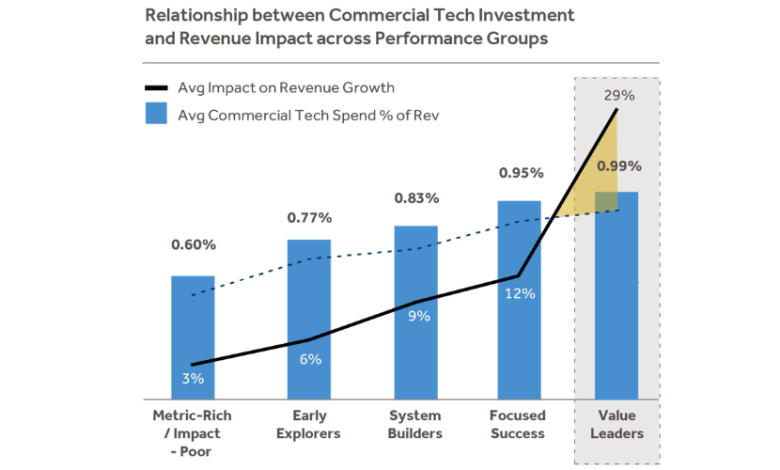
As discussed in an article on our blog last month, one finding shows up consistently across industries: more Commercial AI spend doesn’t automatically translate into more value. In our late 2025 survey of over 150 commercial leaders, companies across a wide range of Commercial AI spending levels report similar, or even lower, revenue growth impact. Simply put, just spending more on Commercial AI is not the answer.
Profile 1: Low and Evolving Readiness Companies (Why Spend Fails Early)
Among companies in early stages of Commercial AI deployment (87% of companies surveyed), impact remains very limited. Most organizations in this group report modest or inconsistent results, reinforcing the perception that Commercial AI is unpredictable or difficult to scale. Yet, there are early signs of divergence. Some companies are beginning to generate meaningfully better results than their peers, despite operating at similar levels of overall maturity.
Within this group, high- and low-impact performers are not differentiated by the specific tools they adopt for commercial functions, such as voice-of-customer, content creation, lead generation, or customer support. Nor is the difference explained by heavier spending. In fact, companies generating relatively higher impact at this stage are often spending less on commercial technology and AI as a percentage of revenue.
Instead, the differentiator appears to be where AI investments are targeted. Companies seeing early traction are investing disproportionately in building foundational capabilities that many AI initiatives quietly depend on to work.
These foundational investments include:
- Improving data quality and accessibility
- Clarifying ideal customer profiles (ICPs) and targeting logic
- Standardizing core commercial workflows
- Defining clear boundaries between human judgment and system-driven decisions
When these foundations are absent, AI produces noisy insights, uneven adoption, and minimal downstream impact, reinforcing the belief that Commercial AI “doesn’t work.” With these foundations present, even modest AI deployments begin to generate results.
Profile 2: Value Leaders (Why Spend Suddenly Works)
The pattern changes once companies move past a minimum threshold of readiness. Among Value Leaders, those who report more than 15% impact on revenue growth from Commercial AI, investment continues to rise and the average number of deployed solutions increases dramatically –about 2X the number of solutions as the lower impact groups. But this isn’t indiscriminate expansion. It’s a shift in how AI is used.
Value Leaders aren’t just buying more tools. They are taking actions not seen in lower performance groups:
- Embedding predictive capabilities powered by machine learning into core workflows (e.g., identifying customers at risk of churn, improving forecast accuracy)
- Prioritizing execution-enabling use cases (e.g., sales enablement, sales management and coaching, pricing)
- Deploying AI across interconnected parts of the commercial engine (e.g., account targeting scores and pipeline forecasting in CRM along with lead scoring in account-based marketing)
The result is a step-change improvement in impact – an inflection point, rather than linear improvement.
Why Timing and Readiness Matter More than Spend Levels
Taken together, these profiles explain why Commercial AI returns are fundamentally non-linear. The same dollar invested early produces little value, but once readiness is in place value creation is outsized. The question is no longer whether to invest in Commercial AI, but when and where.
Understanding the Commercial AI inflection point, and what unlocks it, separates firms that waste money from those that have compound value.
The Commercial AI Inflection Point
The Commercial AI inflection point is not a moment of technological sophistication; it is a moment of operational readiness, when the commercial engine has foundational elements in place for AI to create leverage instead of noise. This happens when four conditions are true:
- Foundational commercial basics are in place: a well-defined sales process; clear ICP and segmentation logic; reasonable consistency in how work gets done
- Workflows are repeatable: core activities follow defined paths; success doesn’t depend on individual heroics; variability can be observed and diagnosed
- Data is directionally reliable: not perfect data, but trusted enough to inform decisions; CRM reflects reality more than it misleads
- KPIs are operationalized: teams know what success looks like; metrics are used to manage, not just report; feedback loops connect insight to action
Before a company reaches this point, discipline matters far more than spend. Commercial AI value comes from a narrow set of focused use cases that improve visibility and reduce friction. Spending more on AI rarely adds value and frequently adds confusion.
After the inflection point, the economics change. AI becomes viable across the whole commercial engine. Improvements reinforce one another. Incremental investment compounds. That’s why high-impact companies don’t just spend more. They get more from the same level of spending.
As companies assess where they sit on the Commercial AI readiness curve, the priority is not increasing spend, but strengthening the foundational elements that determine whether investment creates leverage or noise.