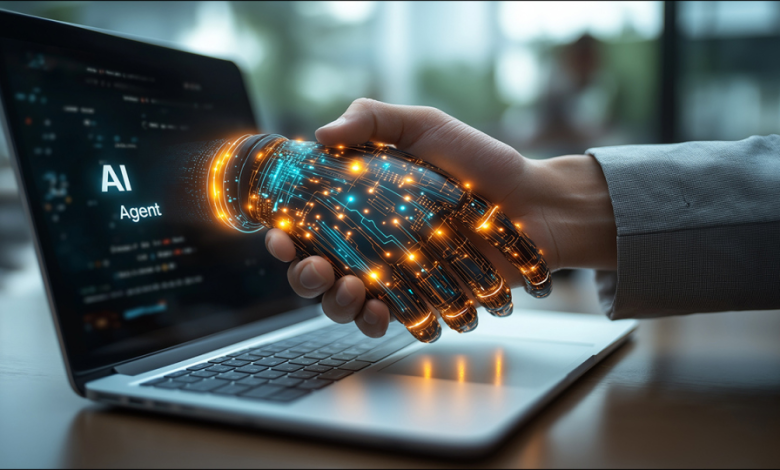
Human life has changed profoundly through four industrial revolutions. Steam-powered machines replaced manual labor, electricity enabled mass production, computers brought automation, and digitization made industries smarter and faster. These reshaped how we live, work, travel, and communicate over the decades. Continuous advancements in semiconductor technology are driving unprecedented growth in computing capacity, improved performance and greater efficiency while lowering costs. These developments made AI technically and economically viable, leading towards what many describe as the fifth industrial revolution, where automation powered by intelligence, gives way to autonomy, and human creativity merges with machine intelligence.
As we navigate 2026, the conversation around AI usage in the enterprise has shifted significantly. Leaders are no longer captivated by the novelty of generative AI or its creative potential. Instead, the focus has moved to much more strategic, structural inquiries: what does it take to build an enterprise that can think, decide, and act autonomously with intelligence on scale? How do we build such an enterprise and operate within strong governance frameworks.
This is the dawn of the AI-First strategy, a blueprint for what it truly means to become a “Future Ready Enterprise.”
From Systems of Record to Systems of Action
For decades, enterprise systems were designed to store information. ERPs, CRMs, and data platforms functioned as systems of record, repositories requiring human interpretation and action.
This means people had to dig up information from these systems, extract intelligence to make decisions in running the business. Then came “systems of engagement” and “systems of insight”, which improved interaction and decision making, supported by the initial wave of predictive AI. Yet these advances still worked as sophisticated signaling systems, at best to indicate what might happen, while leaving it to humans to interpret the insights and take decisions.
The current revolution is centrally powered by Agentic AI, which introduces a new paradigm where software agents are not mere tools but goal-oriented, collaborative partners. These agents form powerful “systems of action”, intelligent and autonomous networks, that harvest and share intelligence, recommend optimal choices to human counterparts, and execute tasks to achieve business objectives. This collaborative ecosystem is designed to learn and improve continuously, ensuring humans remain engaged at all critical stages of business processes.
Strategy for creating AI-First Enterprise
Transitioning to an AI-First, future-ready enterprise is not a superficial change; it requires a deep re-engineering of the organization’s core DNA. While technology is a crucial component, the larger, more complex challenge lies in profound cultural and structural transformation. This transformation journey is built on five core pillars.
This evolution starts with leadership alignment. A shared, enterprise-wide vision serves as the North Star, guiding decision-making and investment priorities. Unified leadership is essential to navigate the complexity of cultural and structural transformation, ensuring all innovative efforts are purposeful, coordinated, and anchored in business value.
Once the vision is established, it’s essential to evaluate and redesign processes with an AI-first approach as part of the transformation. Organizations should move away from legacy workflows and replace them with tailored business processes, using a mix of AI agents and humans, with the objective of dramatically reducing human effort while shifting human roles from execution to collaboration, supervision, orchestration, and AI governance.
To maintain a transformation anchored in practical outcomes, strategy must include value driven measurable KPIs. In our experience, AI initiatives deliver meaningful impact when enterprises clearly define the business problems they want to address, rather than leading with technology alone. Adopting an AI-first approach requires enterprises to implement scalable systems that address orchestration of multi-agent systems, monitor models’ performance, identify and correct the drift automatically, evaluate execution costs, and critically assess impact against defined business KPIs, be it 30% improvement in forecast accuracy or10% reduction in logistics costs. This creates a powerful feedback loop where robust, reliable systems drive sustainable growth.
The success of an autonomous enterprise hinges on its people. A critical part of the strategy involves transforming both employee skills and the organizational culture. This requires significant investment in upskilling the workforce, enabling employees to manage intelligent systems effectively. Fostering a culture that encourages innovation empowers team members to contribute their unique human qualities like strategic insight, empathy, and ethical judgment etc., ensuring technology serves human objectives.
Trust is the foundation upon which this ecosystem must operate at a higher level of reliability and within strict ethical guardrails. Granting autonomy without accountability can lead to serious risks. Emerging capabilities ensure these core-principles are embedded in an agent’s decision-making process. For example, an AI agent focused on reducing shipping costs should not inadvertently breach labor laws, environmental regulations, or company values.
By integrating Human-in-the-Loop checkpoints, organizations can ensure that high-stakes decisions; ones with major financial, legal, or safety consequences that require the AI agent to present its reasoning and obtain explicit human approval before proceeding. When these checkpoints are implemented, agents can both enhance human capabilities and safeguard against risk.
A Leadership Mandate for the Future-Ready Enterprise
The principles of the autonomous enterprise are universally applicable across all industries. Companies are already embarking on this transformation. A manufacturing firm, for example, uses a Supply Chain Agent that not only identifies weather-related disruptions but also collaborates with Logistics and Procurement Agents to reroute shipments and adjust order volumes, all under human supervision. On talent development, AI agents act as career co-pilots, matching employees to new opportunities, while in finance, agents proactively sense market shifts and rebalance portfolios. This new form of ‘digital teamwork’ enables business velocity to scale through technology, seamlessly complemented by human collaboration.
Ultimately, becoming a “future ready enterprise” is not a destination but a continuous state of being perpetually adaptive by orchestrating intelligence. For today’s leaders, the question is no longer whether the enterprise will become autonomous, but how rapidly they can drive the foundational shifts across leadership, processes, talent, value creation, and governance needed to lead in this new era.