Organisations are running an AI race, but not all are on the same path.
The motivations for entering also vary. Some fear being left behind, others feel the urgency to move before competitors do, and others want to demonstrate that AI is on the agenda. Three years after the starting pistol, many leaders are looking back at the effort and investment and questioning whether they have been running the right race at all. Others carry on at full speed without a second thought….
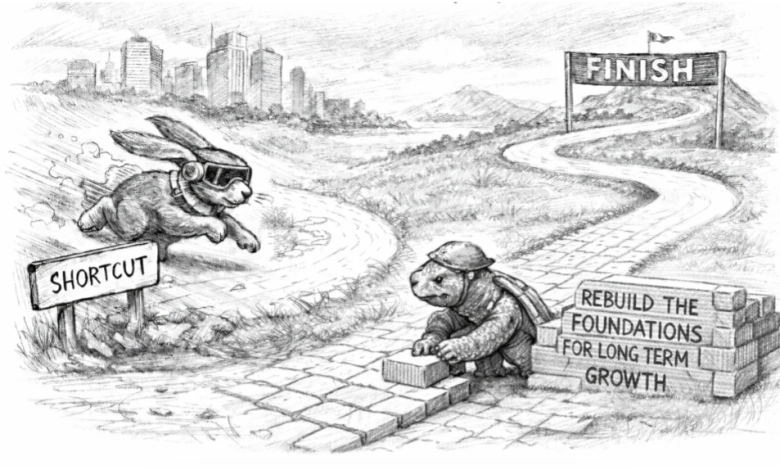
The old analogy of the tortoise and the hare comes to mind.
The hare was always fast, but is now dangerously turbo-charged by AI’s considerable power. It changes direction quickly, assuming the easiest route to the finish line is the best one. Speed-to-deployment. Headcount reduction. Efficiency gains measured in weeks rather than years. We have all seen the public announcements: workforce cuts as high as 50% at some organisations, all in the name of AI-driven transformation.
The tortoise takes a different path; examining foundations, operating models, ways of working and customer experience before deploying technology at scale. These organisations take the time to understand what an AI-driven enterprise actually requires. They recognise that people are the most critical asset and that when people are enhanced by AI rather than replaced by it, they can elevate enterprise value together. They build AI capability and literacy and understand that investments and commitments like this lead to deep-rooted changes that take time to implement.
Speed creates motion. Momentum creates advantage. Moving fast feels rewarding. Compounding gains require a fundamentally different leadership mindset. This article explores what separates these leaders and which is likely positioning for the marathon rather that the sprint.
—————————————–
The pressure on leaders to move fast has never been greater. CEO tenure has shortened by nearly two years since 2001, roughly 15 to 20 per cent, as boards, investors, and markets demand faster evidence of value creation. When performance is judged quarter by quarter, executives are incentivised towards rapid, visible results over slower, compounding investments. That structural pressure runs directly against what AI transformation actually requires.
In addition, leaders of established businesses are watching the rise of frontier firms; AI-native organisations built without the legacy structures the rest of us are working to dismantle. They start from blank sheets of paper, unconstrained by inherited complexity. In the SaaS market, by the end of 2025, median growth in the sector had fallen to around 12%. In early 2026, approximately $2 trillion in software market capitalisation disappeared within thirty days as AI agents began replacing entire product categories. Some of that reflects hype and market reaction, but the underlying signal is real: business models that felt stable two years ago are no longer safe.
Faced with these pressures, the temptation is to run faster, but the leaders navigating this well know something the hare does not. The courageous response to competitive pressure is not to accelerate blindly, but to frequently make the right short-term decisions that build for sustainable long-term growth, and keep culture, people, and technology in balance.
After close to thirty years working with senior leaders through major change, and the extensive research that informed my book, I have one clear conclusion about AI transformation failure rates, which some research places as high as 95%. The failures almost always trace back to the mismatch between how willing leaders are to make the courageous decisions and to accept that what got them here may now be exactly what is slowing the organisations they lead.
—————————————–
Three Fault Lines
In almost every failing transformation I have studied, three structural failures surface. They point back to leadership every time.
The identity gap. Senior leaders have built their credibility on a clear model: being the person with the answers. The one whose pattern recognition and accumulated expertise moved decisions forward. AI has now made that analytical capacity broadly available. The insight that once justified hierarchy is accessible to anyone who can ask the right questions.
The disruption is identity. The leader who insists on personally reviewing every major decision is no longer demonstrating competence, but constraint. Unknowingly, this makes them become the bottleneck because their model of leadership has not kept pace with the system they are supposed to be leading.
I have experienced this myself. When AI began performing many of the analytical tasks I had spent decades developing, I had to ask an uncomfortable question: was my value in the answers I produced, or in the quality of the questions I could frame? The honest answer changed everything about how I lead. Most leaders never pause long enough to ask it.
The clarity gap. Most AI transformations launch without clarity about what value is actually being created and for whom. Leaders invest in tools, measure adoption, count users, and track dashboards. But they cannot answer the foundational question: which core processes in our organisation generate real margin, and how does this AI investment connect to them?
Without that clarity, AI deployments become a thousand small experiments adding up to nothing. I have worked with organisations showing impressive metrics where the most popular AI prompts had no connection to the business whatsoever. Usage is not value and adoption is not transformation.
The clarity gap is also displayed in how strategic intent travels. When logic or strategy does not translate cleanly into operational direction, functions can interpret it differently and optimise individually. The trouble is the final connection is rarely perfect. During one of my past projects I saw months of cross-functional preparation become worthless when a board member asked the 4 workstreams: “Have you even spoken to each other before today?” The impact from that question has had a lasting impact on me.
The human clock. AI compresses time. It accelerates analysis, speeds up decision cycles, and shortens windows of opportunity. What it cannot compress is the ‘human clock’, the pace at which people develop capability, build trust, shift behaviour, and internalise a new way of working.
The most common pattern in failing transformations is straightforward: the operational and strategic clocks accelerate while the human clock is left behind. Organisations move faster than their people can follow, then spend considerable effort trying to understand why engagement has fallen and talent is leaving. The answer is almost always that speed outran trust. As Amy Edmondson of Harvard Business School has shown through decades of research, organisations that make speaking up costly pay for it in ways that are slow to appear but long-lasting in their damage. When AI acceleration adds pressure to already stretched psychological safety, the consequences compound.
—————————————–
Becoming the Conductor
The leaders handling these fault lines most effectively are changing how they lead and collaborate. The shift is from control to orchestration, from being the person who holds the answers to the person who creates the conditions in which others flourish.
A conductor does not play every instrument. They set direction, coordinate, and create the conditions under which collective performance becomes possible. They are indispensable both for what they know, but also for creating a system that cannot be achieved alone.
This requires leaders to release the identity of the indispensable expert. They realise their value has been repositioned: from doing and checking, to framing, integrating, and using good judgement through ambiguity.
The mindset this requires is a shift from “what is the best I can do here?” to “what is the best our system can produce, and how do we create the right conditions?” That gap between those focused on personal best and those building for collective best is where I see significant untapped value in AI-era leadership.
—————————————–
What the Best Leaders Do Differently
Four practical patterns distinguish these leaders.
They lead with questions rather than answers. In an environment where AI generates analysis at scale, the scarce resource is human judgement, the capacity to assign meaning to insight, weigh trade-offs, and make values-led choices under uncertainty. Their authority comes from the quality of the questions they ask, not the speed with which they produce conclusions.
They invest in capability at the same rate as technology. Organisations that increase platform investment while cutting people development are eroding the foundation their AI depends on. Trust, capability, and cultural alignment are the conditions that determine whether transformation delivers. The principle I hear from the most advanced organisations: match your technology investment with capability investment, pound for pound.
They design for coordination, not adoption alone. I have watched organisations measure AI usage as their primary success metric, when what actually matters is the value gained by the business. Leaders who understand this ensure that AI-enabled decisions travel across functions without losing context, intent, or meaning. They design coordination so enterprise value is consistently created.
They protect the human clock. This means deliberately slowing things down to allow people within the system to keep pace. Leaders who understand that transformations run on three clocks (strategic, operational, and human) keep all three moving in sync. Accelerating strategy and technology while sacrificing the human clock is one of the most expensive mistakes an organisation can make.
—————————————–
Reimagining Everything: How to Fix the Gap
The organisations that have made real progress share leaders who reimagined their identity, their decision-making foundations, and even their entire operating model.
The leaders I have seen do this well have dismantled structures built for a different era: hierarchies requiring sign-off across eight or ten layers, standing meetings that consumed weeks of leadership time without producing decisions. These structures were rational responses to an earlier kind of complexity. They are incompatible with how AI-enabled organisations need to function.
What replaces them is clarity about who decides what, at what pace, and with what accountability. When decision rights move beyond the traditional chain of command, trust increases and the distance between insight and action reduces. The organisation can start to act collaboratively in real-time on problems and opportunities.
The leaders who make this shift also do the identity work. They stop deriving their authority from being the ‘approver’. They become the architects of a system in which others who are empowered, capable, and trusted make better decisions faster. One of my CEO clients told me: “I had to decide what I must release. My mindset had to evolve, to coach more, release control and execution pride, and help others create greater combined value.” That is not the hare looking for a fast fix, but a leader recognising the transformation required to win in the long term.
—————————————–
A Question That Often Produces a Long Silence
In my executive retreats, there is a question I ask every group. It produces a long but important silence.
Are you the conductor of your AI transformation or the bottleneck?
Most leaders know how to perform. They know how to drive teams, deliver results, and make difficult decisions. What this question demands is willingness to examine whether the identity, habits, and instincts that built those careers are now the very things slowing the organisations they lead.
Failure rates of 95% are a pattern, not an anomaly. The limiting factor across almost every case I have studied is leadership, not technology.
The organisations that build real, durable advantage from this period will be led by people willing to do the harder work: rebuilding their foundations, placing people at the centre, and creating the conditions for AI to deliver its potential alongside human expertise. The measure of success is not speed of deployment. It is depth of value created for customers, for people, for the business.
The future belongs not to those who optimise for speed, but to those who elevate potential with purpose. The word purpose is deliberate. It describes what the tortoise is actually doing; laying each stone with intention, building a path designed to compound over time. That is what winning the long race requires.
The race is still on and both the hare and the tortoise are competing. The question worth asking is whether your finish line is fast and expedient growth, or building something that lasts, sustaining the combined value of human and artificial intelligence together.
—————————————–
Peter Whealy is the author of Lead with AI. Stay Human. (How Modern Leaders Orchestrate Enterprise Value) with LID Publishing, March 2026. He is the founder of Elevate Potential a leadership consultancy, and also runs AI Leadership Labs for executives navigating AI related change.