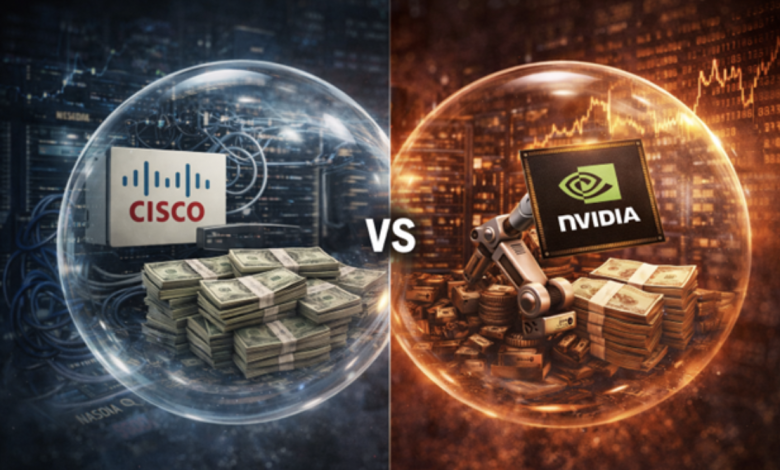
We’re in a bubble, and it’s about to burst. That’s this year’s dominant narrative in AI. Such framing is convenient, but in reality there are very few scenarios where AI collapses in the way people imagine. The reason is structural: this isn’t speculative demand chasing empty promises. There is real usage, and it’s growing fast, underpinned by a technology that is simultaneously improving and getting cheaper.
Why AI Is Not The Same As Dot-Com Bubble, Even If It Looks Familiar
Yes, investor behavior rhymes with the late 1990s. People are buying future growth, and the smarter investors are selling picks and shovels. In the dot-com bubble, Cisco was the most valuable company in the world for a while, and after the crash it took them 20 years to recover their share price. Now it seems that NVIDIA is playing a similar role. But the comparison breaks on fundamentals:
- During the dot-com era, companies were valued on projections without traction. Pets.com sounded like a great story, but revenues weren’t there. AI companies today actually have revenues. The 10 fastest-growing companies in history are AI companies founded in just the past few years, with healthy unit economics.
- The internet was physical. You needed devices, cables, infrastructure — growth was capped by physical rollout. With AI, penetration is instant: five billion people already have connected devices.
- There was no open source equivalent back then. In AI, open source massively increases the pace of innovation. One idea can spread to hundreds of companies in a week, raising quality and adoption speed.
- The application layer is emerging earlier. After the dot-com era, the most valuable companies ended up being applications like Google, Amazon, and Facebook. Today we already see application-layer companies like Perplexity rising quickly, while NVIDIA also plays in both hardware and application layers.
The dot-com crash was a reset from fiction to reality. AI is already operating in reality.
The Illusion of Growth: When Money Loops Back on Itself
But that doesn’t mean today’s situation is 100% healthy. There is a systemic risk in a part of this market where money circulates in loops.
Look closely at how money moves through the AI stack. A startup earns revenue from users. It spends that revenue on model tokens. Model providers spend on infrastructure. Infrastructure providers pay chip manufacturers. Each layer reports growth. Each layer shows revenue. Sometimes, even profit. But zoom out, and the same dollar is being counted multiple times.
This creates an illusion of expansion. On paper, every company is scaling. But when you look at it as a system, you see that the same money is being counted multiple times. Then we trade these companies at 100 times their revenue — which is a distortion that eventually needs to be corrected.
Three Ways This Corrects
There are three scenarios for how it could correct:
- Demand slowdown (unlikely)
Very unlikely, because as models get better and cheaper, usage will increase. But if usage ever stopped growing, the demand would shrink, and companies couldn’t recoup their infrastructure investments.
- Hardware oversupply (probable)
Much more likely. If inference costs drop quickly — say, because NVIDIA makes it dramatically cheaper — then supply could overshoot demand. Hyperscalers like Azure spend $100M on GPUs and depreciate them over six years, but hardware cycles move much faster. In three years, billions could be locked up in outdated chips. Cloud providers would then have to write that off and raise prices, which slows the exponential growth into something more linear (but still growth!)
- Systemic shocks (low probability, high impact)
Very unlikely, but possible. Geopolitics, supply chain disruptions, or systemic failures that don’t just affect AI, but reshape the entire global economy. A disruption in Taiwan, for example, would hit NVIDIA supply chains immediately. Ironically, AI companies might still feel strong because demand would massively exceed supply.
What the Correction Will Reward
As AI keeps improving and getting cheaper, the label “AI” stops being a differentiator and becomes a baseline. We don’t know exactly how far it scales, but we do know that in just the last year, comparable-quality models dropped in price by 700x. That means something unprofitable today might be profitable in six months — not because the business changed, but because the underlying economics did.
AI won’t collapse. It will just stop forgiving weak business models. But the companies that use AI to solve real problems with sustainable processes will win.