
Businesses spent the summer buying into agents. A survey of 500 US senior leaders shows almost all of those investing in AI getting a return on it, and only 14% with agents actually running. Agentic AI adoption is where the money gets stuck, and the model has very little to do with it.
By Evgenii Garde, Technology Adoption Specialist, AI Bear
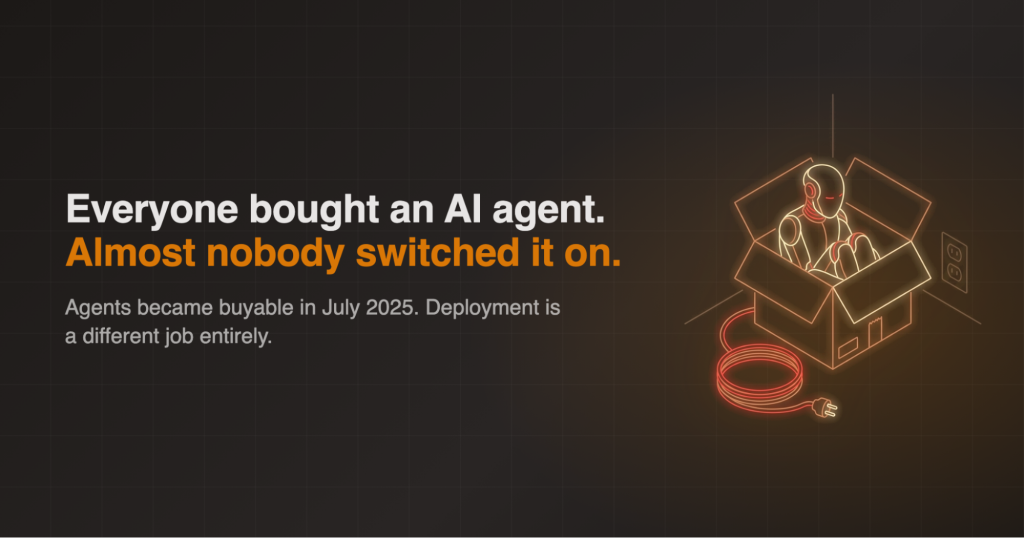
On 17 July, OpenAI launched ChatGPT Agent. Not a chatbot that answers questions, but a system with its own virtual computer that clicks around websites, fills in forms, edits spreadsheets and pulls together research on its own. It folded in two earlier tools, Operator and Deep Research, and rolled out to Pro, Plus and Team users the same day. OpenAI even flagged it as “high capability” in the biology and chemistry domain, a precaution rarely seen in a launch note.
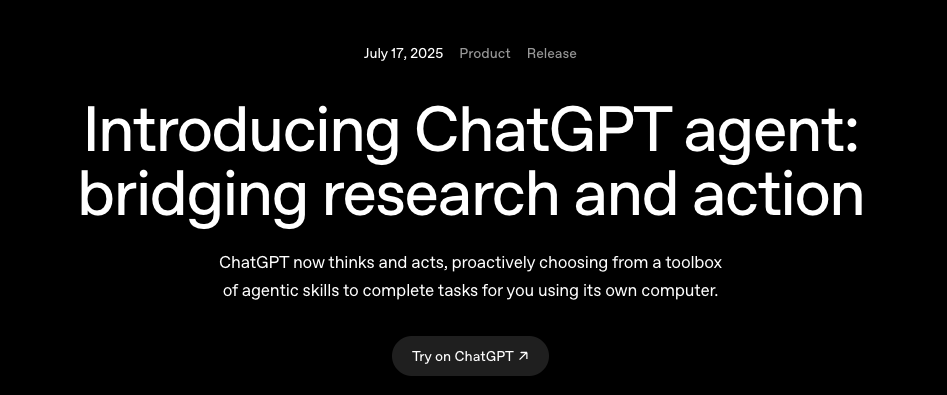
It was the moment agents stopped being a demo and became a product anyone could buy.
Twelve days later, a survey landed that told a quieter story. Its fieldwork ran in April, three months before the launch, which is exactly why it is worth reading. It shows the ground the launch landed on.
The two numbers that look like a contradiction
EY published the third wave of its US AI Pulse Survey on 29 July, polling 500 US decision-makers at senior vice president level and above. The topline reads like a triumph. Almost every leader whose organisation invests in AI says they are seeing a positive return: 97% of them.
Further down the same report sits a much smaller number. Only 14% say agentic AI is fully implemented in their organisation.
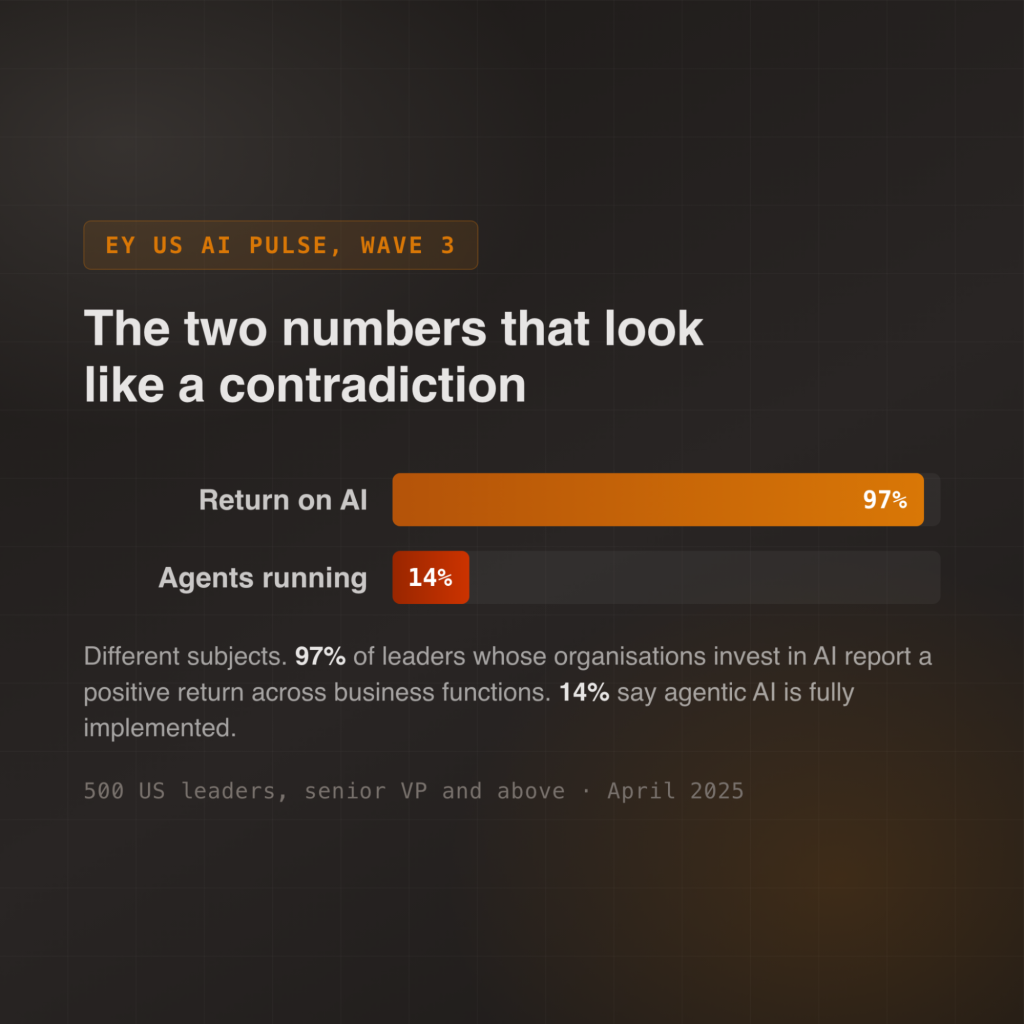
The two figures look like a contradiction. They are not, and the difference between them is the whole story. EY’s 97% covers the return on AI across business functions, which means the whole portfolio a company already runs. The 14% covers agentic AI specifically. AI is paying its way. Agents are not there yet. Companies are booking a return on the software already in production while the agent they bought this summer sits unwired.
EY’s own report has the neatest description of it: a revolution stuck in an evolution.
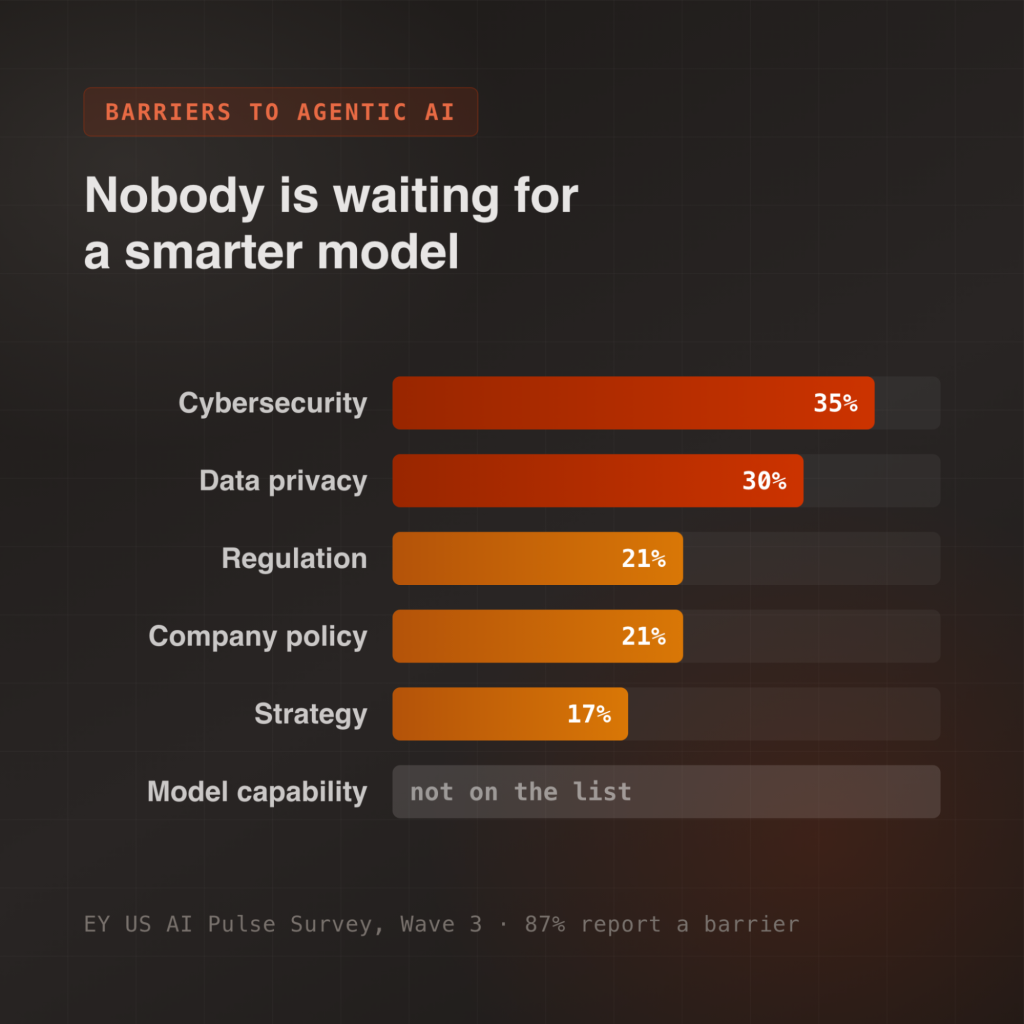
What is holding it up is not the technology. Asked what stands in the way, leaders named cybersecurity most often, then data privacy, then the absence of clear regulation and the absence of any company rule for how an agent should behave. Model capability did not make the list. Nobody in that survey is waiting for a smarter model.
Why the gap is real, and why it isn’t about the model
The hard part was never the intelligence. It was everything around it.
An agent that books travel or reconciles invoices has to touch live company systems. It needs the right permissions, a place to fail safely, someone accountable when it gets something wrong, and data clean enough to act on. That is integration, governance and operating discipline, and none of it ships in the box. A model can be brilliant in a demo and useless in a finance function, because a finance function runs on a permission model and an audit trail the demo never had to respect.
Matt McLarty, the CTO at Boomi, made the point plainly in MIT Technology Review the same day the OpenAI agent shipped. His advice was almost rude in its simplicity: keep agents simple, start with the low-hanging fruit, and stop over-engineering autonomy nobody needs yet. He compared the moment to blockchain, a technology that arrived with enormous capability and then spent years hunting for a problem it was clearly the best answer to. The risk with agents has the same shape. Buy the capability first, look for the use case later, and the result is an impressive thing nobody uses.
Gartner has put a number on where that leads: it expects over 40% of agentic AI projects to be cancelled by the end of 2027. Not because the agents failed to think. Because the projects were pointed at the wrong problems, or launched without the plumbing to make them safe.
How the gap gets closed
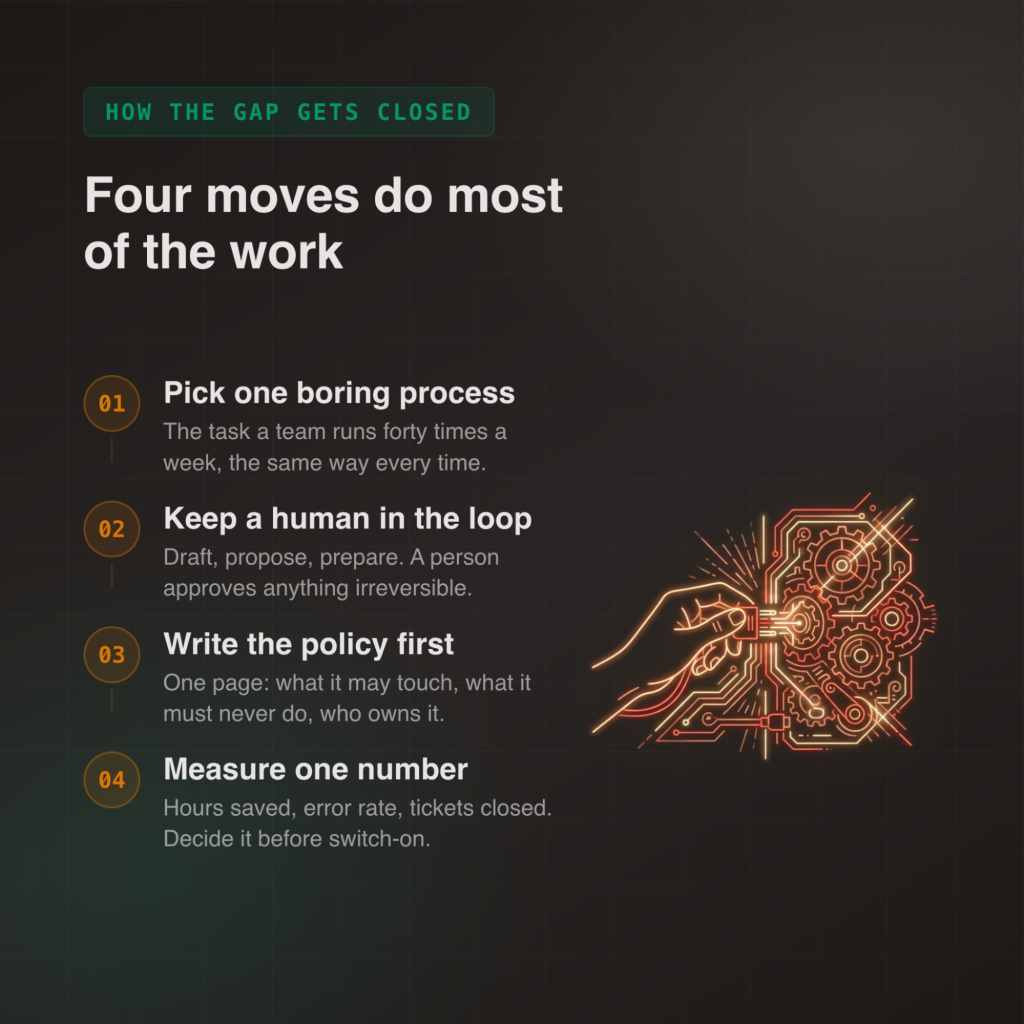
None of this is an argument against agents. The organisations that have them running are getting real work out of them, and the pattern is consistent: the agent assists or manages a process rather than owning it, in customer support, marketing, IT and security. That is the shape of what works right now. The lesson is to narrow down and wire in. Four moves do most of the work.
Pick one boring, repetitive process. Not the moonshot. The task a team runs forty times a week that follows the same steps every time. Boring is where agents earn their keep, and boring is where a mistake is cheapest to catch.
Keep a human in the loop, on purpose. EY’s leaders were near-unanimous that built-in human intervention will always be crucial, and for now they are right. An agent designed to draft, propose and prepare, with a person approving before anything irreversible happens, takes the two barriers leaders named most often, cybersecurity and data privacy, off the critical path.
The policy comes before the scale-up. One of the four barriers leaders named was simply the absence of a company rule for agent behaviour. One page will do: what the agent may touch, what it may never do, who owns it when it breaks. Cheap to produce, and it is what lets a business say yes to the next ten use cases without a fresh argument each time.
Measure one number. Decide what “working” means before switch-on. Hours saved, error rate, tickets closed. A programme that cannot name its number has bought capability in search of a use case, which is exactly the trap McLarty warned about.
Agentic AI adoption is a process problem, not a model problem
The summer of 2025 will be remembered as the moment agents became buyable. It should also be remembered as the moment the market learned that buying and deploying are different jobs. The 97% measures what AI already delivers. The 14% measures what has actually been handed over. The gap between them isn’t a verdict on the technology. It is a verdict on how ready an organisation’s processes, permissions and policies are to let software do real work.
Three questions are worth putting to a board before the next agent gets bought. Which repetitive process does the business run most often and understand best? Who signs off before the agent does anything that cannot be undone? And what single number will show within a month whether it worked?
Most organisations can answer the first. Very few can answer all three. The ones that can are the 14% with agents running.