Teleport is expanding its approach to infrastructure security to address the growing challenges of deploying AI agents in production, with the general availability of Teleport Beams, a trusted runtime designed to control how agents access and interact with enterprise infrastructure.
The Oakland-based company says Beams addresses security gaps that traditional sandboxing approaches do not fully solve, including delegated identity, access control without credentials, and visibility into agent behavior and actions. The platform has been in public beta since March 2026.
As enterprises begin connecting AI agents to production systems, security teams face a new set of challenges. Agents need access to cloud environments, databases, Kubernetes clusters and other infrastructure to complete tasks, but granting that access introduces risks around unauthorized activity, exposed credentials and actions that extend beyond an agent’s intended objective.
Traditional sandboxes typically focus on isolating workloads within virtual machines. While this can limit the impact of untrusted code, it does not necessarily provide the identity, authorization and behavioral controls needed to govern agents interacting with live production environments.
“Most enterprises have not connected agents to their production infrastructure. They are blocked by a lack of delegated identity, strong access control without secrets and with full audit and traceability of intent to action. When the cost of an error is high, traditional sandboxes don’t cut it. Beams brings these missing capabilities to the market,” said Ev Kontsevoy, CEO and co-founder of Teleport.
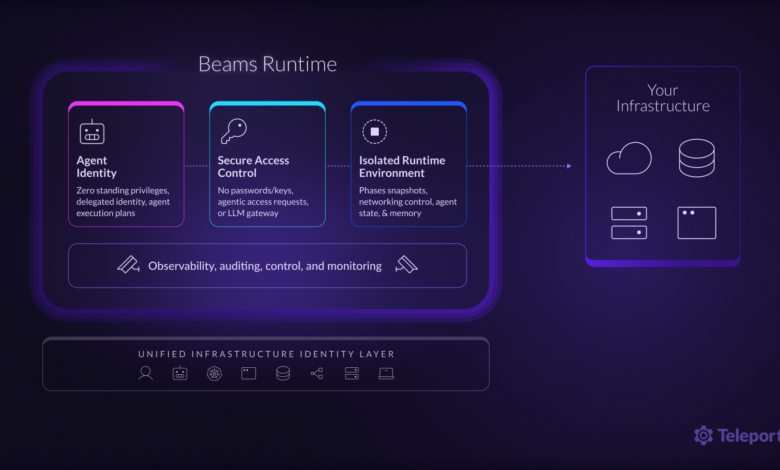
Beams introduces four layers of control designed to govern individual agents and coordinated agent swarms: identity, access, swarm behavior and execution environment.
Each agent runtime receives a delegated identity from a user or another agent and begins with zero standing privileges. Agents propose execution plans and access requests, which can be reviewed by a human or an AI-based judge before a separate runtime executes approved actions with the authorized roles.
The platform also connects agents to infrastructure resources without exposing passwords or static secrets in their environments. It supports identity-based authentication methods including IAM, Kerberos and X.509, while an LLM gateway manages model selection and captures traces of model interactions and protocol-level activity.
For security teams overseeing multiple agents, Beams monitors behavior for potential goal hijacking, coordination between agents and other activity that may depart from their intended objectives. Its Agentic Classifiers include seven pre-built rules to flag behaviors such as inline secret exposure, destructive actions and privilege escalation, alongside the ability to define custom rules. Sessions are also scored against the MITRE ATT&CK framework to produce risk summaries.
Agents execute in ephemeral micro-virtual machines with virtualized networking controls governing ingress, egress and DNS. The environments expire after use, while regularly rebuilt base images help reduce exposure to known vulnerabilities.
Additional capabilities are designed to address the operational challenges of running agents over longer workflows. Beams Phases preserve artifacts and memory between expiring runtimes, allowing work to continue without starting from scratch. Teams can also fork runtimes to explore parallel workflows under the same isolation controls. A kill switch allows security teams to terminate agent activity and cut off all connections to production infrastructure.
“To scale agents in production, enterprises need controls that hold at the moment of action: model choice with a record of which model handled each invocation, preserved state and memory so a stop can be reversed, a kill switch that halts an agent mid-execution, and approval tiered by risk so humans are able to review high-impact actions. Platforms that build these into the runtime are helping move agentic AI from prototype to production,” said Grace Trinidad, Research Director for AI Security & Trust at IDC.
Rather than attempting to guarantee what an AI model will decide, Beams is designed to limit what an agent can access, provide visibility into what it does, flag behavior that deviates from its objective and revoke its authority when a task is complete. This approach is intended to reduce the potential impact of mistakes or compromised agents while giving security teams a clearer record of agent activity.
Beams is built on the Teleport Infrastructure Identity Platform, which is deployed at more than 700 enterprises, including Nasdaq, DoorDash and Elastic. The underlying platform establishes a unified identity layer for humans, machines, workloads and AI agents, extending zero-trust principles across cloud and on-premises infrastructure.
Teleport Beams is generally available as of November 10, 2026, at beams.run.