Contact centres are a critical part of any business that has one. They need to deliver exceptional customer service, efficiently and cost-effectively – which is one reason organisations are increasingly turning to AI-based solutions. But as environmental regulations tighten across EMEA and sustainability becomes a board-level priority, contact centre operators face a critical challenge: balancing the use of AI with the need for more sustainable operations.
The value of AI for contact centres
It’s not hyperbole to say that AI is revolutionising contact centre operations. By automating routine tasks and enhancing agent capabilities, AI is transforming how organisations manage customer interactions.
One of the most impactful applications is intelligent call routing, where AI analyses customer data, sentiment, and enquiry type to connect callers with the most appropriate agent. This reduces wait times and increases first-contact resolution rates, which makes for higher customer satisfaction scores and better agent usage. Post-call analytics provide insights into customer pain points and emerging trends, informing product development and service improvements.
AI-powered chatbots and virtual assistants now handle straightforward queries, freeing human agents to focus on the more complex issues that require empathy and nuanced judgement – and removing the need for live agents to work out-of-hours. This reduces operational costs and improves agent job satisfaction by eliminating repetitive work and shift work. Natural language processing now understands context and intent, providing accurate responses that feel genuinely helpful rather than frustratingly robotic.
Real-time AI assistance is transforming agent performance. During live calls, AI systems analyse conversations and surface relevant knowledge base articles, suggest appropriate responses, and flag compliance risks. This support enables newer agents to perform at higher levels whilst reducing training time and costs, and improves the experience for all agents, reducing staff turnover.
Predictive analytics powered by AI helps contact centres forecast call volumes with remarkable accuracy, enabling better workforce management and reducing both understaffing and overstaffing issues. This optimisation directly impacts the bottom line through more efficient resource allocation.
The environmental impact of contact centres
The cumulative effect of these AI-driven enhancements is massive: reduced operational costs, improved customer retention, higher Net Promoter Scores, and increased revenue through better customer experiences. Organisations implementing AI in their contact centres are gaining competitive advantages whilst building stronger, more profitable customer relationships.
However, organisations with contact centres are already traditionally some of the most resource-intensive businesses, and there can be concern over the additional impact of AI tools. Environmental regulations are increasing across Europe, and sustainability is now a board-level priority in many organisations.
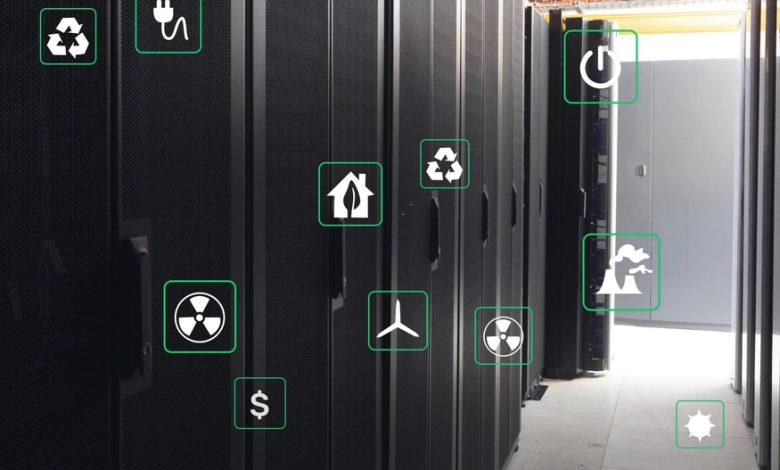
The visible resources of a contact centre are easy to quantify – you can quickly estimate the environmental impact of sprawling office spaces filled with desks and chairs, lighting and power. But unseen, there’s also energy-hungry hardware: on-premises servers, telecoms and networking equipment, desk phones, and extensive cooling systems. These systems consume vast quantities of electricity, while the hardware itself creates long-term electronic waste, with short technology cycles making equipment obsolete every few years.
Transport emissions from staff travel also contribute significantly to a contact centre’s environmental footprint when you consider all of the employees commuting daily to a centralised location – which could be in the thousands when you consider the largest operations.
So how are these businesses also reducing their carbon footprint? For organisations with contact centres, there’s a new approach that’s helping to reduce emissions: a shift from physical facilities to cloud-based contact centre as a service (CCaaS) platform.
The advantages of virtualised systems
With cloud-based CCaaS, processing power for communications and backend systems move to virtual platforms hosted in off-site data centres, replacing a larger number of onsite servers and racks with a smaller number of high-capacity, data centre-specific infrastructure. Because the hardware is optimised for long-term use in these environments, it lasts longer, reducing e-waste. Where a data centre is, for example, supplied by green electricity, the positive environmental impact of reduced emissions becomes available to all the data centre users.
Using hosted platforms can also deliver direct cost savings, reducing the capital costs associated with new equipment and maintenance requirements.
Some of the most substantial carbon reductions from CCaaS adoption come from enabling distributed workforces. There’s no longer a need for agents to commute to central offices when cloud platforms allow teams to work from almost any location that works for them and the business. Fewer commuting miles translate directly into lower transport emissions. Until now, it was prohibitively expensive and complex for many contact centres to do this, but that changes with CCaaS. Hosting your infrastructure and services in the cloud makes it possible for your contact centre agents to work from anywhere, while accessing contact centre tools from a single facility where energy usage can be more easily managed and optimised.
Making a sustainable move
As with any cloud-based tool, you need to choose the right partner to help you implement a CCaaS solution. Not every provider offers the same level of expertise, particularly around sustainability – there’s considerable variance when it comes to the energy and efficiency commitments a cloud service provider is prepared to commit to. You should prioritise vendors with transparent environmental reporting and concrete carbon reduction strategies if you want to impact your own metrics.
You should evaluate your current infrastructure’s carbon footprint as a baseline, measuring energy consumption, commuting patterns, and hardware refresh cycles. This assessment helps quantify the potential impact of virtualisation, and give you the KPIs to measure success after.
Environmental impact has become a critical business success measure. But successful contact centre owners aren’t seeing this as a restriction, but as an opportunity to improve both operations and customer experience.
It does require a shift in your approach to contact centre operations. But CCaaS platforms help to do this by reducing costs, strengthening operational resilience, and building customer trust, all while shrinking carbon footprints. It’s a change that benefits everyone.