Almost every company I talk to has already crossed the AI starting line. The technology is in the building, usually in several places at once. What far fewer of them can show me is valuethat reaches the bottom line. The pattern is consistent enough that it has become the single most useful question to ask any product or growth team: not whether you use AI, but what you point it at.
The data backs up what the conversations suggest. In the latest State of AI survey from McKinsey, nearly nine in ten organizations now use AI in at least one function, yet roughly two-thirds have not begun scaling it across the enterprise. The bottleneck is no longer access to the tools. It is the discipline to aim them at the right problem, and for most companies that problem sits much closer to the customer than to the cost line.
Productivity was the easy win. Demand is the real prize.
When AI budgets first opened up, the instinct was to chase time savings, because hours removed from a process are easy to count and easy to justify. That instinct leaves the larger gain untouched. The same tools that cut cost can also create demand, and product innovation is where that shows up most clearly: in consumer packaged goods, firms face high failure rates in new product launches. A capability that helps you spot the right concept earlier is worth far more than one that shaves a few hours off a workflow.
BCG’s analysis of AI in product innovation puts a number on the upside: used well, AI and generative AI can accelerate the innovation cycle by up to 30 percent. That is not a marketingefficiency. It is a change in how fast a company moves from a customer insight to a product in market, which is exactly the ground where smaller, digital-first challengers have been beating larger incumbents.
The listening layer matters more than the idea generator
It is tempting to treat AI in product as a faster idea machine. The more useful framing is that it changes how a company listens. The real opportunity is using AI to pull meaningful signal about customer behavior out of large volumes of unstructured data, structure it along real customer segments, and then read forward, predicting what customers will want next rather than describing what they bought last quarter.
On one venture I worked with, we used AI to listen to customers at a scale we could not have managed by hand, reading across a large body of customer interviews at once. What surfaced was a clear gap between what the product was built to offer and what customers were actually trying to get done, and it was not visible from any single conversation.
This distinction decides how you staff a product function. A model that drafts product descriptions is convenient, while a system that tells you which unmet need is about to turn into a buying signal is a competitive weapon. The first is a point solution; the second reshapes the roadmap. The old discipline of starting from the job the customer is hiring the product to do becomes far more powerful when the listening layer underneath it is this fast and this wide.
Point solutions disappoint. Reshaping the whole cycle pays off.
The most consistent mistake I see is scattering AI across isolated tasks and expecting the gains to add up. They do not. Each point solution saves a little time, but collectively they never reshape the innovation cycle. The work that pays off is an end-to-end overhaul: map where time and effort actually go, then match that against the tools best suited to compress it.
There is a useful allocation rule in the same BCG work: spend about 10 percent of the effort on algorithms, 20 percent on technology and data, and 70 percent on people and processes. The hard part of an AI product transformation is rarely the model. It is changing the tasks people do, the talent you need, and the way teams hand work to each other. In practice the redesign of roles, handoffs, and decision rights matters more than which model you pick.
Agents are the next step, not the starting line
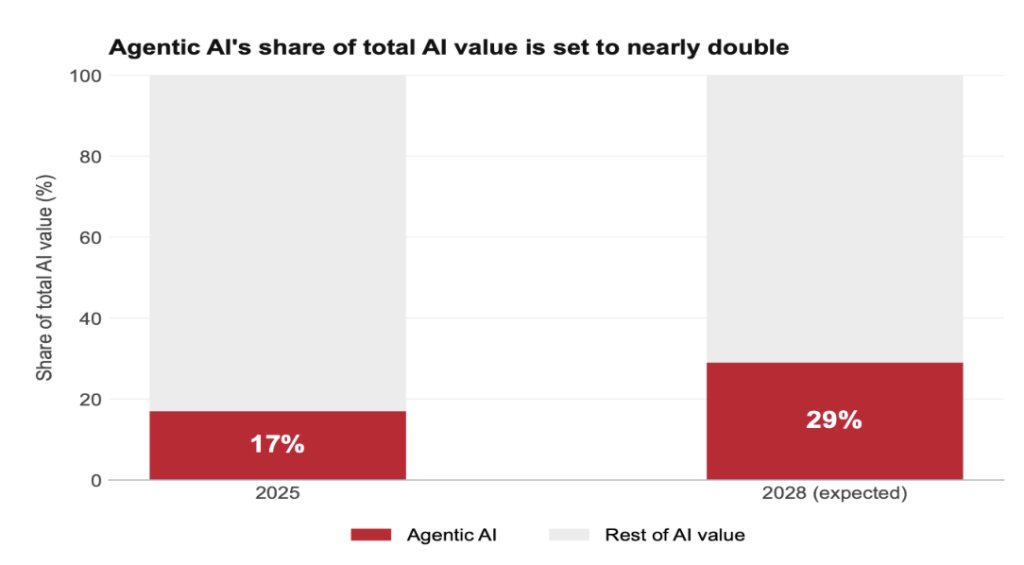
The frontier this year is agentic AI, systems that reason and act across multistep problems instead of answering a single prompt. BCG’s widening value gap study of more than 1,250 firms worldwide reports that agents already account for 17 percent of total AI value and are expected to reach 29 percent by 2028. The companies furthest ahead, which the report calls future-built, put 15 percent of their AI budgets into agents, and a third of them already use agents, against almost none of the laggards.
The caution attached to that finding is the part I want product leaders to absorb. Agents are the next step in scaling AI, not the place to begin, and they are not plug-and-play. Their value comes only after you redesign how work gets done, including the effect on existing processes and roles. Bolt an agent onto a broken workflow and you inherit the broken workflow at higher speed.
 Source: BCG, Build for the Future 2025 Global Study.
Where the value actually lands
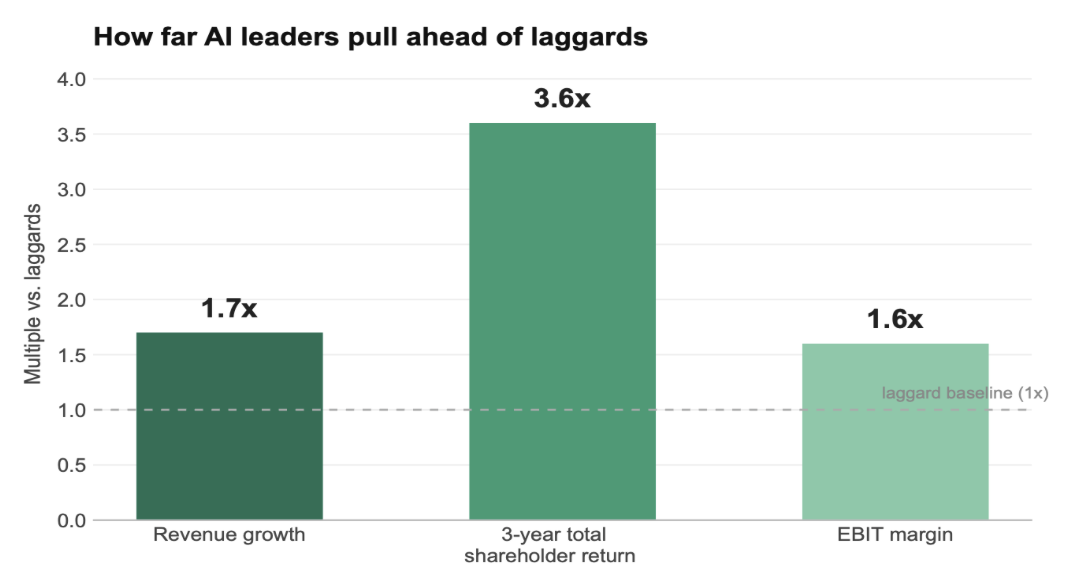
The same study helps answer a question product teams often struggle with: where does AI value actually sit? The answer is the core: about 70 percent of AI’s potential value is concentrated in core functions such as sales and marketing, supply chain, and pricing. And the separation between leaders and the rest is wide and widening. Future-built firms expect roughly twice the revenue increase and 40 percent greater cost reductions than laggards where they apply AI, and the report associates this group with 1.7 times the revenue growth of laggards, alongside stronger shareholder returns and margins.
Source: BCG, Build for the Future 2025 Global Study.
These findings line up rather than merely rhyming. The value shows up in customer-facing functions, it comes from reworking those functions end to end, and the companies that capture it set out to grow products rather than to trim a cost line. Each finding is a different cut of the same behavior.
The same pattern shows up outside consulting research. Analysis of European and US firms reported by CEPR finds a positive relationship between how widely firms adopt AI and how fast their productivity grows, with a 10-percentage-point increase in adoption associated with annual productivity gains in the range of roughly 0.5 to 2.6 percentage points. The relationship is an association rather than proven causation, but the direction is consistent with what the product-level research shows.
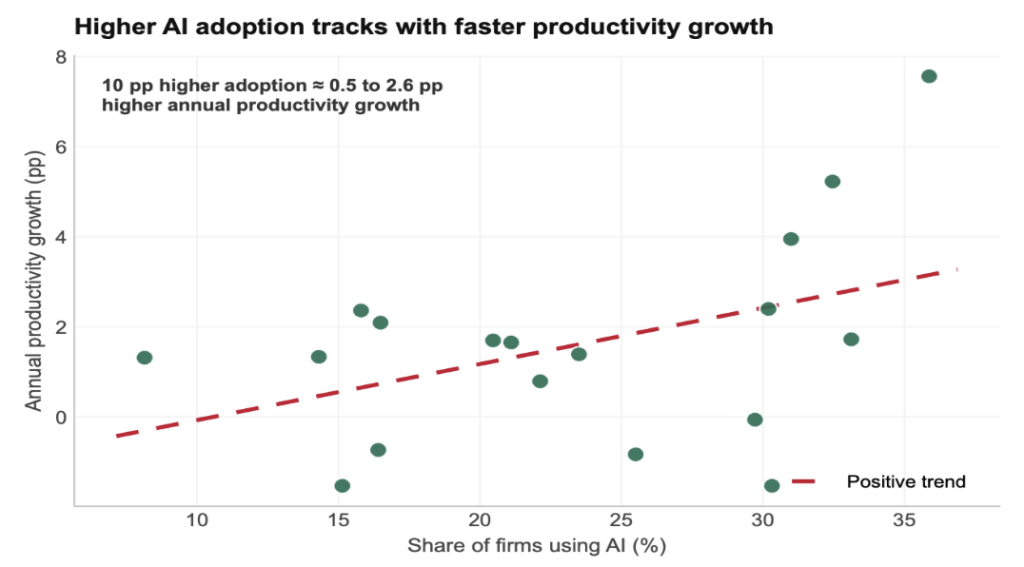
Illustrative scatter reproducing the relationship reported in CEPR/VoxEU (2026); association, not established causation.
What this means for how you build
Three conclusions follow. Judge AI initiatives by whether they sharpen demand and customer insight, not only by hours saved. Resist the portfolio of disconnected tools and instead reshape the full path from insight to launched product, putting most of the effort into people and process. And treat agents as a scaling move that comes after the core workflows are sound, not a shortcut that skips that work.
None of this replaces knowing your customer; it raises the return on it. A product organization that genuinely understands the job its customers are trying to do, with a fast listening layer beneath its roadmap, is precisely what this research describes as future-built. The tools are no longer scarce. The advantage belongs to the teams that choose the right customer problem, redesign the work around it, and measure the result in demand created, not only effort removed.
References
BCG, The Role of AI in Reshaping Product Innovation (2025)
BCG, Build for the Future 2025 Global Study (The Widening AI Value Gap)
McKinsey, The State of AI in 2025: Agents, Innovation, and Transformation
CEPR / VoxEU, Differences in AI Adoption in Europe and the US (2026)