What happens when AI becomes a character, not just a tool
As AI capability accelerates, the industry’s obsession with speed, scale and intelligence continues unabated. Models are getting bigger, answers faster, benchmarks higher, yet many AI products still feel strangely hollow. Powerful, yes. Memorable? Emotionally intelligent? Not really.
Sam Altman signalled something along these lines with his recent code red on ChatGPT.
Designers are beginning to recognise that we’re no longer just shaping interfaces, we’re shaping what some hope to be burgeoning relationships. And relationships aren’t built on capability alone. They’re built on behaviour, tone, timing and trust.
There’s a simple but provocative shift that designers must explore, and that is treating AI not as a backend utility, but as a character in a user’s life. A visible presence with a role, a personality and a way of behaving that evolves over time. Not a gimmick. Not an anthropomorphic avatar. But a deliberate act of character design.
The problem with “genius” AI
Most AI tools today suffer from the same issue: they try to be everything. Universal, neutral, endlessly capable, but often result in being emotionally anonymous. They greet you politely, offer help but stand for very little.
From a design perspective, this is a missed opportunity. Humans don’t form relationships with neutral systems. We connect with entities that have intent, understand context, show restraint, and behave consistently. Capability may impress people briefly, but character is what stays with them. And in a world where intelligence is rapidly commoditising, character becomes the thing that differentiates.
This shift was echoed repeatedly at the World Summit AI in Amsterdam. While much of the conversation still focused on what AI can do in terms of raw power, some of the more interesting discussions and diversions were focused on intent, such as why we’re building these systems, and how they should behave in our human lives. It showed that cultural obsession with optimisation – faster, cheaper, more automated – can often risk stripping empathy out of the experience altogether. And users will feel that absence.
From tool to presence
Once you treat AI as a presence rather than a tool, the design brief changes entirely. You stop asking how quickly it responds, and start asking how it listens. When it should speak. When it should step back.
A key concept to consider is an “AI relationship stack”, not a technical one, but a behavioural one. Signals such as tone, hesitation and rhythm. Behaviours like memory, interruption and emotional awareness. Values that define what the system optimises for, and what lines it won’t cross.
This is where a brand can truly express themselves. Not just in a logo or UI flourish, but in behaviour over time. Designing AI this way borrows heavily from narrative and character design. Much like in film, characters feel believable because they have boundaries. They don’t do everything. They have a role in the story.
Designing AI as a character
In practice, this means using tools designers already know well: storyboarding, emotional mapping, narrative frameworks and character definition. The questions sound less like engineering prompts and more like creative direction:
- What role does this AI play in the user’s life, it is a guide, collaborator, listener, expert?
- How does it speak when it’s uncertain?
- How does it behave when the user is stressed?
- When should it fade into the background?
Crucially, personality doesn’t mean noise. In fact, one of the strongest signals of emotional intelligence is restraint. When AI feels too powerful or overt, users trust it less. When it’s subtle, sometimes not even labelled as AI, comfort increases.
The best AI often disappears until it’s needed.
Lessons from Dell
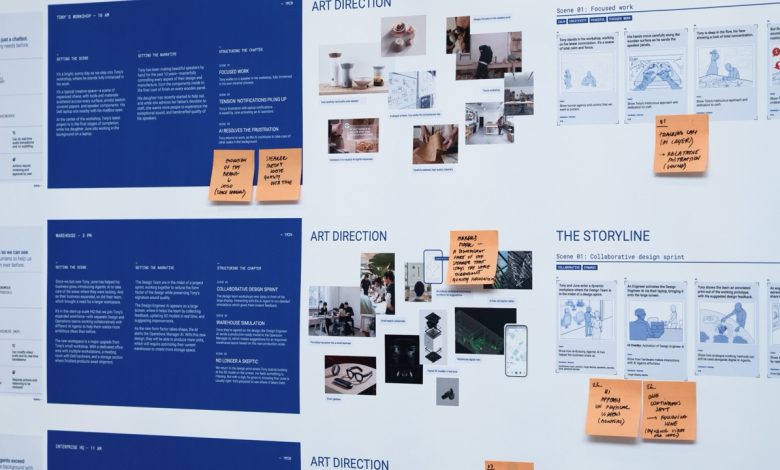
These ideas have been tested in real-world collaborations. In a vision project with Dell Technologies, led by forpeople’s Amsterdam studio, the team explored what AI could bring to the near-future workplace. Rather than framing the work around features or functionality, they created a short narrative in three chapters: moments from a working day where AI quietly reduced friction or unlocked new capability.
The breakthrough wasn’t technical. It was emotional. By casting AI as a supporting character, one with a clear role and point of view, the concept became relatable. The feedback wasn’t “this AI is impressive”, but “I don’t like AI, but I’d use this”.
That distinction matters. Narrative allowed people to imagine how AI might feel in their own lives, rather than judging it abstractly.
Why character matters now
When models change and evolve, behaviour becomes the constant. A strong character creates familiarity, even as underlying capability evolves. It keeps users calm, close and trusting.
For designers, this represents a clear opportunity, and responsibility. If AI is becoming relational, then design must lead. Not by making systems “cute”, but by making them considerate. Not by maximising presence, but by mastering timing.
The future of AI won’t just be defined by benchmarks or token counts. It will be also defined by how systems make people feel over time. By whether they listen. Whether they respect boundaries. Whether they feel aligned with our values. That isn’t based on raw intelligence, but emotional intelligence.