An analysis of more than 19.5 million notifications from approximately 16,000 schools shows that 92% of K-12 communication is routine — and that the systems schools trust in a crisis are the ones they rely on every day.
Key Facts:
- Not a survey: Drawn from actual usage across approximately 16,000 K-12 schools during the 2025–26 school year.
- Routine builds readiness: Operational messages account for 92% of K-12 notifications, so the systems used in a crisis are already familiar before one arises.
- Email outpaces app alerts: 76.7% of schools used email: more than mobile app push (56.5%) or text (53.1%).
- Threats don’t watch the clock: More than 52,000 emergency messages went out on weekends, with a rise in overnight activity between 11 p.m. and 2 a.m.
MADISON, Wis., Aug. 26, 2026 /PRNewswire/ — The best time to prepare a school for an emergency is every day before it. New data from Singlewire Software shows that routine communication makes up the vast majority of activity across K-12 schools, and that this everyday use forms the foundation for a confident emergency response.
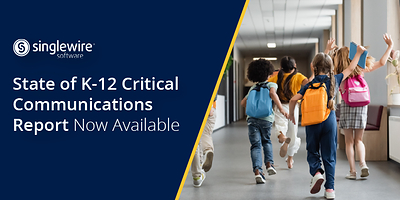
Singlewire Software’s The State of K-12 Critical Communications: 2025–26 School Year report analyzes actual notification activity from approximately 16,000 K-12 schools that use the Singlewire InformaCast critical communication and incident management platform. The analysis covers more than 19.5 million notifications and more than 343 million device activations across the full 2025–26 school year.
Unlike a survey, the report offers a system-of-record view of how schools genuinely used their communication systems, message by message, throughout the year.
“Emergency readiness is built long before an emergency happens,” said Terry Swanson, president and CEO of Singlewire Software. “When staff use their communication systems every day, those systems become familiar infrastructure instead of something to figure out under pressure. This data shows that everyday reliability is the foundation of emergency readiness.”
The Numbers Tell a Clear Story
Across the K-12 schools analyzed:
- 92% of notifications were operational communications; only 8% were emergency alerts.
- Automated bell schedules accounted for 60% of messaging and live paging for another 28% — together, roughly 88% of everything schools sent.
- 80% of emergency communications occurred during the school day, peaking between 8 and 9 a.m. as students arrived and moved between classes.
- Emergency communication ran about 23% higher on Wednesdays and Thursdays than on Mondays, the quietest weekday.
- 85.9% of schools used in-building devices such as speakers, phones, and displays, while 76.7% used email: more than mobile app push (56.5%) or text (53.1%).
- Smaller districts sent roughly three times more messages per student than large districts (a median of about 6.5 versus 2.0), because communication scales with the number of buildings rather than total enrollment.
Lockdown Dominates Real-World Emergency Communication, Drills Show a Different Mix
The “I Love U Guys” Foundation’s five standard response protocols are Hold, Secure, Lockdown, Evacuate, and Shelter, and they are used by tens of thousands of schools across the country. Of those five actions, Lockdown accounted for approximately 72% of real-world emergency message volume, nearly 10 times the combined volume of the other four. Singlewire Software is a proud mission partner of The “I Love U Guys” Foundation.
“A shared response vocabulary works best when schools exercise it consistently,” Swanson said. “Seeing how much communication each action generates, in both real activity and drills, gives school leaders a starting point to ask whether their communication patterns line up with their training.”
Emergency Communication Doesn’t Stop at Dismissal
The data also shows why districts should plan beyond the traditional school day. Schools sent about 52,000 emergency notifications on weekends, and overnight activity rose between 11 p.m. and 2 a.m. — a window that can signal after-hours issues waiting to affect the next school day.
Because messaging volume scales by building rather than by district size, smaller districts see a much higher concentration of communication per student. That makes building-by-building coverage a key consideration for leaders managing campuses of any size.
What School Leaders Can Take From the Data
The findings point to several practical steps for K-12 leaders:
- Use your communication systems every day. Daily use builds the familiarity that pays off in a crisis.
- Drill for real-world risks. Compare your drill communication with your real-world activity so the two patterns stay aligned.
- Layer your channels. In-building systems, mobile alerts, email, and text each reach people the others may miss.
- Plan for after-hours incidents. Safety communication needs continue during evenings, weekends, and overnight.
- Check coverage building by building. As districts grow, per-student reach thins, so confirm every facility and every person is covered regardless of enrollment.
The full report, The State of K-12 Critical Communications: 2025–26 School Year, is available at https://www.singlewire.com/ebooks/state-of-k12-critical-communications.
About Singlewire Software
Singlewire Software, based in Madison, Wis., is a trusted partner in safety and communication, dedicated to shaping a future where every organization can protect its people with confidence. The company delivers innovative solutions like InformaCast critical communication and incident management software, the InformaCast Wearable Alert Badge, and Visitor Aware visitor and safety management software. By enabling instant alerts, comprehensive reach, and rapid response, Singlewire Software empowers K-12, healthcare, manufacturing, higher education, and enterprise organizations to proactively manage critical events and foster secure environments. To learn more, visit: www.singlewire.com.

 View original content to download multimedia:https://www.prnewswire.com/news-releases/singlewire-software-report-finds-k-12-emergency-readiness-is-built-in-the-daily-routine-302859557.html
SOURCE Singlewire Software