For years, the promise of artificial intelligence has hovered over the business world like a shimmering possibility: automation, efficiency, reduced costs, better decisions. But as 2025 unfolds, executives have become less patient with vague predictions and more focused on measurable results. “Show me the ROI” has become the new anthem. Companies no longer invest in AI because it’s trendy — they invest because their competitors already use it to operate faster, cheaper, and smarter.
At the center of this shift are AI agents, rapidly becoming the most transformative operational technology since the emergence of cloud computing. These agents are not simple chatbots or one-function tools. They are autonomous digital workers, capable of understanding tasks, making decisions, interacting with systems, and completing workflows end-to-end. They behave less like software and more like highly competent employees — but without the limitations of human bandwidth.
The ROI they generate is not theoretical. It is practical, measurable, and increasingly impossible to ignore.
The New Digital Workforce: What AI Agents Really Are
In order to understand the size of the ROI being delivered by AI agents, it is essential to first comprehend how AI agents were created differently from automation technologies of the past. Traditional software was created using rigid instructions. RPA bots clicked through screens, but generally failed when the user interface changed. Chatbots responded to calls for assistance, but were unable to perform actual operations. Automation solutions were efficient at performing routine rule-based tasks, but became ineffective at handling workflows that required flexibility or involved operations across different systems.
AI agents are built to go far beyond those constraints. They can interpret context, break goals into logical steps, and execute tasks across multiple tools without human supervision. Give an agent access to your CRM, ERP, HRIS, or email system, and it becomes capable of completing tasks that previously required full-time employees.
This capability changes the economics of how work gets done. The moment a company introduces AI agents into multiple departments — support, operations, sales, HR, finance — something extraordinary happens: workflows that used to demand dozens of hours shrink to minutes. Processes that depended on human handoffs suddenly flow continuously through the night. Tasks that once required hiring new team members simply scale through automation.
Where Businesses Lose the Most Money (Long Before AI Enters the Picture)
Before understanding how AI agents generate ROI, you need to understand where businesses are currently bleeding time and money. Much of the operational cost inside modern organizations is invisible to leadership because it’s spread across dozens of small inefficiencies that no one questions. Employees spend hours each week searching for information, inputting data, updating systems, drafting reports, filing documentation, or waiting for someone else in the workflow to move something forward.
Individually these tasks seem insignificant — a few minutes of CRM updates here, a quick spreadsheet fix there — but collectively, they swallow thousands of paid hours each month. Teams that believe they are “busy” are often simply stuck in manual processes that drain time without generating value.
Then there is the problem of human error. Even highly competent teams make mistakes, especially when performing repetitive tasks. Incorrect data entry, duplicated records, outdated information, and misfiled documents ripple through departments and cause delays, confusion, rework, and sometimes losses that can’t be easily quantified. Every misplaced invoice or mishandled support ticket quietly erodes profitability.
Another overlooked cost lies in the delays created by traditional workflows. While humans sleep, take breaks, attend meetings, or wait for approvals, work sits idle. Those delays slow revenue cycles, frustrate customers, and generate bottlenecks that could have been avoided entirely.
When AI agents enter this environment, they immediately begin eliminating the “slow bleed” — the constant drain of time, energy, and money that businesses have unknowingly accepted as normal.
How AI Agents Transform Speed and Efficiency
One of the most immediate and visible ROI drivers of AI agents is pure speed. Humans work in sequences, while AI agents work continuously. Humans switch contexts constantly, while AI agents focus without interruption. Humans must wait for others to respond, while AI agents execute tasks the moment they are assigned.
In customer support, for example, the introduction of AI agents often reduces average resolution times from hours to minutes. That speed translates directly into cost savings, but it also produces intangible but equally valuable outcomes: happier customers, reduced churn, and better brand perception.
In sales, AI agents eliminate the administrative drag that slows down deal flow. Instead of spending a third of their day updating CRM fields, generating summaries, and following manual qualification workflows, sales reps can focus entirely on closing. Companies that adopt AI agents often witness shorter sales cycles, higher conversion rates, and a meaningful increase in revenue per rep.
In finance, AI agents reconcile transactions, process invoices, validate data, and handle compliance documentation without the delays that typically slow month-end closing. What used to take a team of humans several days can now be completed in a fraction of the time.
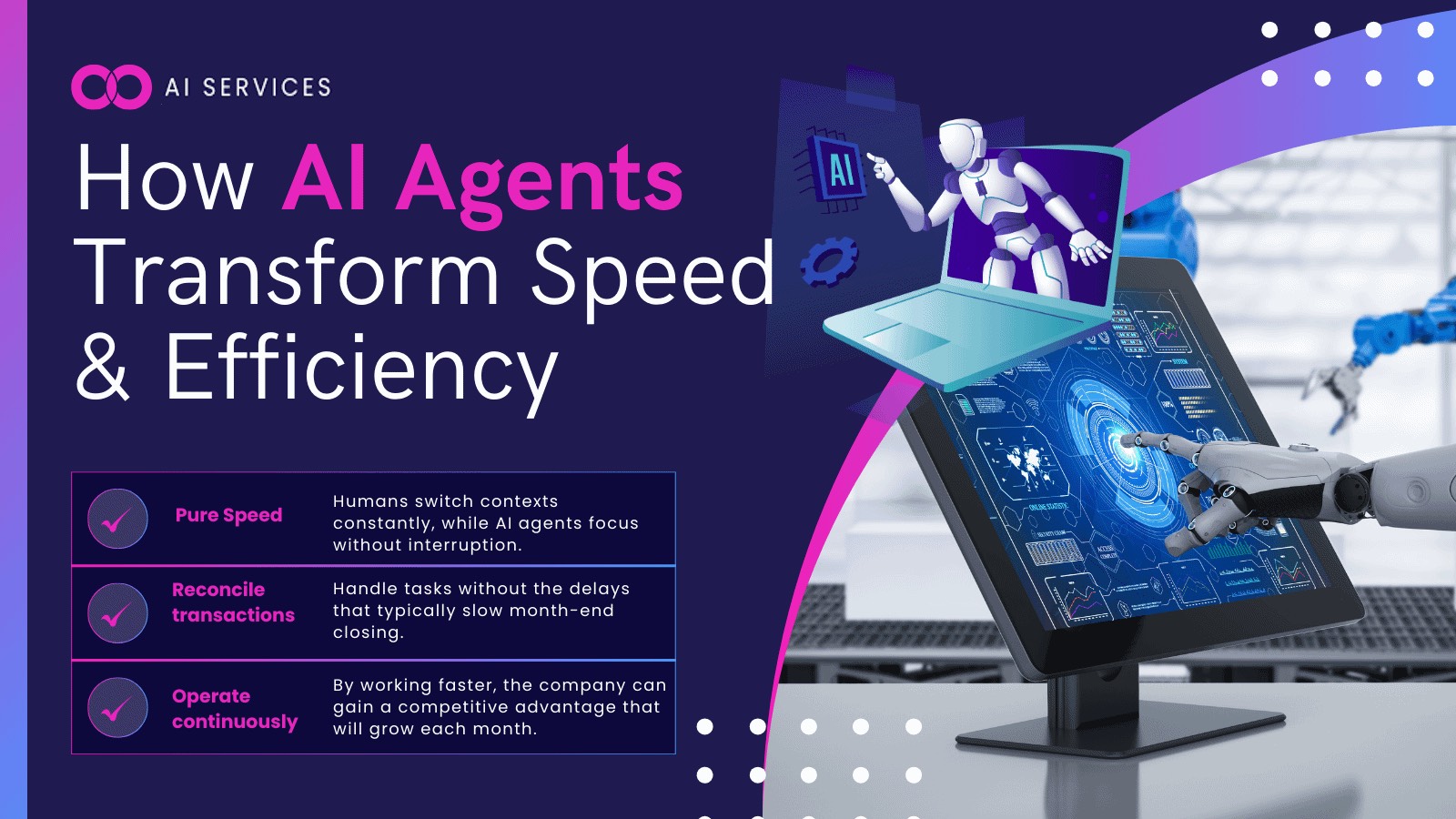
AI agents can operate continuously and with no time constraints. While the office is closed, the agents are still completing tasks, thereby reducing the number of tasks remaining to be done when the office opens again. By working faster and more efficiently, the organization is able to gain a competitive advantage that will continue to grow each month.
Reducing Operational Costs Through Intelligent Automation
The next pillar of ROI comes from direct cost reduction. While some executives fear the narrative that AI agents “replace jobs,” the reality is more nuanced: AI replaces repetitive tasks, not strategic roles. Organizations that implement AI agents rarely lay off employees — they simply choose not to expand headcount as they grow. Workloads increase without requiring new hires.
The financial impact is substantial. For example, a mid-size business may add six employees over the next year to its support staff. Each new employee will have an estimated total cost (including salaries, benefits, training, equipment and software) of between $40,000 and $70,000, this depends on the employee’s role. Companies can use AI agents to grow their workforce using a fraction of the budget.
Also, using AI typically eliminates most of the costs related to human error. Errors such as financial discrepancies, incorrect compliance or customer data can have a ripple effect. When AI is involved with those tasks, accuracy greatly increases and therefore so does the reduction of many expensive downstream issues.
Another dimension of cost savings comes from software consolidation. Many companies use multiple tools to handle workflow automation, form filling, simple chatbots, ticket routing, and system integrations. AI agents often absorb all of these functions into one unified layer of intelligence, allowing businesses to eliminate redundant SaaS tools and save tens or even hundreds of thousands annually.
The savings are not theoretical — they show up in budget reports, operation logs, and invoice reductions within weeks.
The Hidden ROI: Unlocking Human Potential
While time and cost savings produce some of the most visible ROI, the greatest benefit of AI agents is often more strategic: freeing human employees from administrative overload.
By allowing employees to focus all of their efforts on high-value work areas that drive innovation and business growth, AI frees employees from mundane, labor intensive tasks that consume mental energy (data entry, scheduling, research, documenting results, etc.), which directly causes a dramatic increase in employee morale. Instead of spending most of their working hours completing work that seems trivial, they are now able to use the vast majority of their time on meaningful contributions to the business, which decreases the likelihood of burnout.
Companies will also benefit from higher retention rates for employees. Employees are more likely to leave an organization because they have too many repetitious tasks (the tasks that the company has hired the employee to perform) in a day than because of AI taking over those tasks. When employees can devote more of their time to performing meaningful work for their organisation, they will remain in the company longer, earn lower salaries, and become more loyal employees. The ROI of reducing turnover is extremely high, primarily for companies with significant employee hiring costs.
This is how AI agents create a more fulfilled workforce, not a smaller one.
AI Agents as a Strategic Catalyst for Revenue Growth
One of the most powerful but least discussed ROI drivers of AI agents is their ability to accelerate revenue — not just cut costs. Faster support response times increase customer satisfaction and loyalty. Better-qualified leads result in higher closing rates. Instant data access enables executives to make decisions earlier and with greater accuracy. Operational fluidity means products ship sooner, contracts move faster, and billing cycles tighten.
Many companies obtain additional income of many millions of dollars in their fiscal year accounting, simply by reducing the sales cycle length by a few days. AI agents enable faster timing by providing an automated solution to administrative friction that exists throughout the revenue stream.
The cumulative result is impressive. Faster operational cadence increases customer satisfaction, provides cleaner data, allows employees to be more productive, and reduces operational costs. Therefore, every aspect of your business transforms into a more scalable and profitable system.
This reason illustrates why companies implementing AI agents today will dominate the marketplace over the next three to five years. Those companies have established infrastructures that enable them to substantially increase their output without increasing their costs, which is every executive’s goal.
A New Standard: AI Agents as an Integral Part of the Modern Workplace
The adoption of AI agents is no longer a question of if — it’s only a question of when. Organizations that start today gain the advantage of early momentum, smoother transformation, and deeper familiarity with AI-driven operations. Those who delay will find themselves scrambling to catch competitors that operate faster, serve customers better, and maintain lower cost structures.
Hiring will no longer be solely based on the number of people needed, but rather on the mix of AI and Human capabilities required to effectively execute the tasks required. As technology continues to evolve, hiring a traditional administrative assistant or back-office coordinator would be considered yesterday’s methods of hiring, similarly to how hiring full-time typists and or fax machine operators is viewed today.
Instead of evaluating themselves on the number of employees, companies will begin to evaluate their performance on how well they maximize their use of AI to augment the workflow and leverage it to its fullest potential.
AI agents are more than just a passing trend; They represent the future of workforce development through their reliability, ability to scale-up, be tireless, have an accurate output, and are instantly trainable. The continual evolution of their output also facilitates predictable costs. The return-on-investment for AI agents extends beyond a single job or department; AI assists in elevating the value of the entire business ecosystem.
Real-World Impact: How Companies Are Saving Hundreds of Thousands Each Year
Across industries — SaaS, e-commerce, logistics, healthcare, financial services — organizations are reporting similar patterns. AI agents take over a significant portion of operational tasks and immediately reduce the need for additional hiring.
Some companies save over $100,000 just in avoided headcount expansion. Others save hundreds of hours in manual work every month. Some eliminate entire categories of software. Others shorten their sales cycles enough to increase annual revenue.
A mid-range SaaS company successfully implemented Artificial Intelligent Agents in Support, Human Resources, Financial Services, and Sales, realising over $380,000 annually in cost efficiencies. Instead of taking days to resolve, support tickets were resolved more efficiently and provided quicker customer service. Onboarding was almost instantaneous. Financial reconciliation took only minutes compared to hours before. Document creation that had previously taken days to complete was now automated and completed instantly.
The organisation did not reduce staffing levels, but rather, they empowered their human resources to become more innovative, motivated, and productive. The client organisation’s ability to scale up while remaining within their current payroll level was achieved without subsequently adding long-term employees. Projects that moved at half-speed in the past could now move at years of acceleration.
The Path Forward: How Businesses Can Start Today
AI Agents used to take dozens of hours and millions of dollars of planning to implement. That is no longer the case. Thanks to the development of modern AI agent architectures that integrate with your existing tools, you can bring your agents live in days, not months.
Most companies today are starting their AI agent programs in two departments, usually one of the following: support, sales, or operations, and then expanding as results become apparent.
The most important point for companies to note is that they should only choose AI agents built for autonomy, security, and seamless integration across their entire digital infrastructure. Not all AI solution providers offer the same level of functionality and reliability; in fact, many AI providers only offer systems that look like advanced versions of today’s chatbots. Real AI agent providers offer truly autonomous digital employees who have the ability to plan, execute, learn, and improve over time.
The businesses that invest into the development and implementation of AI today will be the ones that drive the future evolution of digital operation technologies.