Abstract
The rapid integration of artificial intelligence into commercial sales processes has prompted widespread debate about the future relevance of the human salesperson. This article argues that rather than rendering human sellers obsolete, the proliferation of AI-driven automation has paradoxically elevated the strategic value of distinctly human competencies — empathy, trust-building, narrative persuasion, and relational judgment. Drawing on research in behavioral economics, organizational psychology, and technology adoption theory, the article presents a practical framework for sales professionals seeking to integrate AI tools while preserving the authenticity and interpersonal depth that remain central to complex buying decisions.
Introduction
There is a quiet revolution happening in the field of professional selling. It arrives not through dramatic disruption, but through incremental automation: AI-powered customer relationship management systems, generative tools that draft personalized outreach at scale, predictive analytics that score leads with mathematical precision, and conversational intelligence platforms that decode the patterns of successful sales interactions. According to McKinsey & Company (2023), roughly one-third of all sales tasks are now candidates for automation, a figure projected to rise substantially as large language models and agentic AI systems mature.
For many sales professionals, this trajectory raises existential questions. Yet the premise that AI will replace human sellers fundamentally misreads the nature of complex buying decisions. Research in behavioral economics has consistently demonstrated that purchasing decisions — particularly in high-stakes B2B contexts — are shaped as much by emotional resonance and interpersonal trust as by rational evaluation of features and pricing (Kahneman, 2011; Ariely, 2008). The implication is significant: in a marketplace increasingly saturated with algorithmically optimized outreach, the human capacity for genuine connection has become not merely relevant but competitively decisive.
The Limits of Algorithmic Selling
AI’s capabilities in sales are considerable and well-documented. Natural language processing enables personalized messaging at volumes no human team could sustain. Machine learning models identify patterns in buyer behavior that improve lead scoring accuracy. Platforms such as Gong, Salesforce Einstein, and HubSpot’s AI suite analyze thousands of data points to prescribe optimal outreach timing, channel selection, and talk-track strategies. The operational efficiencies are real and substantial.
However, these tools operate within a well-documented boundary: they optimize for measurable signals while remaining structurally incapable of interpreting latent emotional states. AI cannot detect the unspoken hesitation in a prospect’s voice when they say “let me think about it” but mean “I do not yet trust you.” It cannot sense the organizational politics shaping a procurement committee’s decision. It cannot sit across from a business owner who spent three decades building a company and intuit why they resist change. As Damasio (1994) demonstrated in his somatic marker hypothesis, human decision-making is inseparable from emotional processing — a domain in which AI remains fundamentally limited.
This distinction is not merely theoretical. A 2024 study by the Harvard Business Review found that buyers in complex B2B transactions ranked “trust in the individual salesperson” as the most influential factor in vendor selection — above product features, pricing, and brand reputation. The algorithmic sales landscape, then, is not displacing human sellers wholesale. Rather, it is functioning as a selection mechanism: separating those who relied on information asymmetry and volume from those whose value rests on relational intelligence and contextual judgment.
The Trust Deficit and the Opportunity of Authenticity
The proliferation of AI-generated outreach has, somewhat counterintuitively, deepened the trust deficit between buyers and sellers. Gallup’s annual survey of professional trustworthiness has consistently placed salespeople in the lowest quartile, and the saturation of automated yet superficially “personalized” messaging has accelerated this erosion. When every inbox contains dozens of algorithmically crafted emails that simulate personal familiarity, the net effect is not enhanced engagement but a new species of noise that recipients have learned to filter.
This dynamic creates a significant, if underappreciated, opportunity. When a buyer encounters a seller who listens more than they pitch, who asks questions informed by genuine curiosity rather than scripted cadences, and who follows up with substantive insight rather than templated sequences, the interaction becomes cognitively distinctive. In the language of signal theory (Spence, 1973), authentic human engagement serves as a costly signal — one that is difficult to fake at scale and therefore carries high informational value. The buyer’s reasoning, whether conscious or intuitive, is straightforward: a seller willing to invest real time and attention is more likely to be a reliable long-term partner.
Empathy as Strategic Competency
If trust constitutes the foundation of human-centered selling, empathy represents the core competency through which trust is constructed. Goleman’s (1995) model of emotional intelligence identifies empathy as a critical component of interpersonal effectiveness — the ability not merely to identify another person’s emotional state, but to respond in a manner that reflects genuine understanding of their perspective.
In practical selling contexts, empathy manifests as the capacity to read situational cues that exist beyond the reach of data analytics. Consider the contrast between an AI system that identifies a prospect’s LinkedIn post about supply chain disruptions and generates a relevant email, and a salesperson who, during a live conversation, notices a shift in the prospect’s vocal tone when discussing board expectations and responds with, “It sounds like there is considerable pressure on this decision. What would a successful outcome look like for you personally?” Both represent forms of personalization. Only the latter demonstrates the kind of relational attunement that research identifies as central to persuasion in high-trust environments (Cialdini, 2006).
Developing empathy as a professional competency requires deliberate practice: asking open-ended questions and genuinely processing answers rather than scanning for insertion points; conducting pre-engagement research to understand a prospect’s constraints and priorities; and cultivating comfort with conversational silence, which often precedes a buyer’s most important disclosures.
A Framework for Human-AI Integration
The most effective sales professionals in the current landscape are not those who reject technological tools, nor those who delegate the entirety of their process to automation. They are those who develop a sophisticated understanding of where the human-machine boundary should be drawn within their specific selling context. To conceptualize this, the article proposes the Human-AI Sales Competency Framework (Figure 1), which maps four seller archetypes along two axes: human competency (empathy, trust, judgment) and AI/technology adoption.
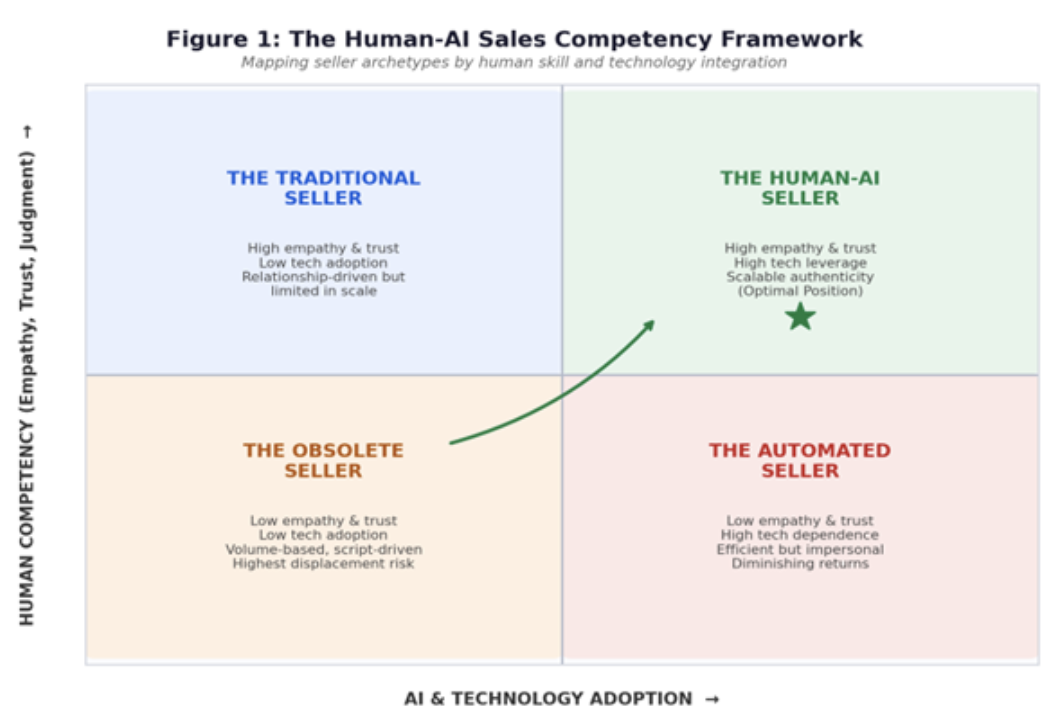
The framework identifies four archetypes. The Traditional Seller (upper-left) possesses strong relational skills but underutilizes technology, limiting their scale. The Automated Seller (lower-right) maximizes technological efficiency but neglects the human competencies that drive complex deal outcomes, resulting in diminishing returns as buyers disengage from impersonal outreach. The Obsolete Seller (lower-left) lacks both dimensions and faces the highest displacement risk. The optimal position is the Human-AI Seller (upper-right): a professional who leverages AI for research, administrative efficiency, pattern recognition, and content generation while investing their freed capacity into the irreplaceably human dimensions of selling — empathy, storytelling, relational depth, and ethical judgment.
The practical application is clear. AI should handle the what and the when: data aggregation, optimal timing, behavioral signals, and first-draft content. Humans should own the why and the how: interpreting behavioral data in relational context, choosing the appropriate communication modality for a given prospect, navigating organizational politics, and making judgment calls that require situational nuance no model can replicate.
Narrative Persuasion in a Data-Saturated Environment
Cognitive science has established that narrative is among the most effective vehicles for human persuasion. Zak (2015) demonstrated that stories which generate emotional tension trigger the release of oxytocin, increasing both empathy and cooperative behavior in listeners. In sales, this finding has direct implications: when every competitor has access to identical data and AI-generated ROI projections, the differentiating factor becomes the seller’s capacity to construct a compelling narrative about transformation.
Effective sales narratives follow a structure well-documented in rhetorical theory: a relatable protagonist (the customer, not the vendor), a recognizable problem, a genuine struggle, a turning point, and a resolution that serves as a vision of possibility. The power of this structure lies not in the data it conveys but in the emotional identification it creates. A prospect hearing the story of a peer who faced analogous pressures and achieved a meaningful outcome is engaging in what cognitive psychologists term “transportation” — a state of narrative immersion that reduces counter-arguing and increases attitudinal change (Green & Brock, 2000).
Vulnerability and Authenticity as Differentiation
Traditional sales culture has long valorized polish, confidence, and flawless presentation. The AI era inverts this hierarchy. AI-generated communications are invariably optimized, invariably fluent, and invariably devoid of the imperfections that signal genuine human authorship. This creates what might be termed an “authenticity gap”: as algorithmically perfect content saturates the market, buyers increasingly gravitate toward communications that bear the markers of real human thought — including admitted uncertainty, acknowledged limitations, and perspectives that reflect lived experience rather than data synthesis.
Brené Brown’s (2012) research on vulnerability in professional contexts supports this observation: leaders and communicators who demonstrate appropriate vulnerability — honesty about constraints, willingness to acknowledge mistakes, transparency about trade-offs — consistently generate higher trust and engagement than those who project invulnerability. Applied to sales, this suggests that the seller who says, “Our platform is strong in areas X and Y, but if your primary concern is Z, I want to be transparent that a competitor may serve you better there,” is not weakening their position. They are strengthening it through a mechanism that AI structurally cannot emulate: voluntary reputational risk in service of the buyer’s interest.
The Emerging Bifurcation
The trajectory of AI advancement suggests that the sales profession will increasingly bifurcate. Lower-complexity, lower-stakes transactions will be absorbed by fully automated systems operating with speed and cost efficiencies that human sellers cannot match. Higher-complexity transactions — those involving significant financial risk, organizational change, long implementation timelines, and multiple stakeholders — will become the exclusive province of human professionals whose value rests on trust, judgment, and relational depth.
This bifurcation has clear implications for professional development. Sales professionals who invest now in developing the competencies mapped to the upper-right quadrant of the Human-AI Sales Competency Framework — empathy, narrative skill, ethical reasoning, relational intelligence, and sophisticated technology integration — are positioning themselves for sustained relevance. They are becoming the kind of professionals whom AI makes more valuable, not less.
Conclusion
Selling, at its core, has always been a fundamentally human activity: one person helping another navigate a consequential decision. The instruments change — from in-person handshakes to telephone, from email to AI — but the underlying mechanism of trust remains constant. In the age of algorithms, the temptation is to become more like the machine: faster, more optimized, more scalable. The opportunity, however, is to become more deeply human: more empathetic, more authentic, more relationally present, and more ethically grounded.
In a world of artificial everything, the most real thing a seller can offer is themselves.