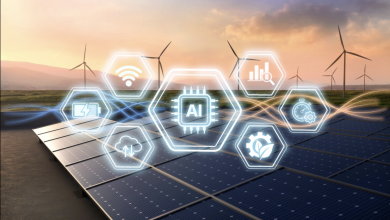
Artificial Intelligence (AI) is reshaping the data centre landscape, and critical digital infrastructure is under growing pressure to support it. In some regions, there are concerns that the speed and scale of AI development may outstrip the growth of available power. In these areas, utilities are reporting grid congestion and longer connection queues, while data centre operators face surging energy demands and increasingly dynamic workloads.
Power has become both the bottleneck and the opportunity for innovation. The way energy is generated, stored, converted and distributed inside a facility can now influence operational efficiency and competitiveness. The emerging concept of the data centre power train (covering the full chain from grid to chip) is becoming increasingly relevant for understanding how the industry is adapting to the AI era.
New demands, new dynamics
AI workloads create a fundamentally different power profile from conventional cloud computing. Training and inference tasks draw very high loads in short bursts, requiring systems that can respond instantly to surges and then scale back while minimising energy waste. This variability challenges conventional power conversion and distribution systems, which were designed more steady-state operation.
The result is a growing emphasis on flexibility and control. Engineers are now designing power systems that can sense, adapt to, and interact with changing load conditions. Modular converters, distributed energy storage and digital monitoring tools all form part of a more responsive power ecosystem – one that adjusts to the real behaviour of IT workloads rather than simply feeding them.
The rise of the intelligent power train
Every data centre power system performs the same essential functions: converting, conditioning and delivering electricity to critical equipment. But in an AI-scale facility, those stages are tightly interdependent. A fluctuation or loss at one point can ripple through the chain in milliseconds.
The goal is no longer just to maintain uptime, it is to optimise how energy flows through every layer. Facility-level conversion must manage both grid power and local generation. Room and row distribution need to handle higher voltages efficiently to reduce losses. At the rack, intelligent power distribution units (PDUs) and high-density converters enable clean power delivery to processors that can consume 80 kW or more each. Each layer collects data, communicates it, and contributes to the overall stability of the system.
Building flexibility into the grid relationship
For many data centre operators, the most pressing challenge lies outside the building itself. In regions where data centres already account for more than ten per cent of grid load, new projects can be delayed for years while waiting for additional capacity. Yet much of that strain occurs only for a few dozen hours each year.
To address this mismatch, facilities are beginning to operate as flexible grid participants rather than passive consumers. Grid-interactive uninterruptible power supplies (UPS) and large battery systems can temporarily discharge to support the grid during peaks, then recharge when demand falls. This approach, supported by smarter control electronics and tighter integration between utility and facility systems, helps stabilise local networks while giving operators more autonomy over energy use.
Energy storage as a strategic asset
Battery energy storage systems (BESS) are now an integral part of this evolution. Their role extends far beyond providing emergency backup. By storing energy during off-peak periods and releasing it when prices or local grid loads rise, BESS installations give operators a new level of flexibility and cost control. They can also reduce generator use, cutting emissions and maintenance costs.
Lithium-ion technology dominates for now thanks to its long life, high charge rates and compact footprint. But engineers are already experimenting with hybrid architectures combining different chemistries and capacities to create multi-layered backup strategies. The long-term goal is not just to ride through outages but to turn stored energy into a controllable, potentially revenue-generating resource.
Efficiency and environmental performance
With electricity consumption rising sharply, regulators and investors are scrutinising the efficiency and environmental footprint of every new build. Power usage effectiveness (PUE) remains the headline metric, but attention is shifting towards total energy efficiency – including conversion losses, cooling energy, water use and waste heat recovery.
Higher voltage distribution, optimised cabling routes and advanced monitoring are all helping to reduce losses. Some operators are now designing facilities that export captured heat to nearby homes or businesses, transforming waste into a usable product. These innovations turn the power train into a lever for resource efficiency while supporting reliable operation.
The value of integration and design collaboration
A high-performance power train depends on integration across disciplines. Electrical and mechanical engineers must work hand in hand from the earliest design phase. Cooling, layout and power conversion cannot be optimised separately when rack densities and power flows are so tightly linked.
Prefabricated and modular power blocks offer one route to better integration. They allow standardised, factory-tested components to be deployed quickly on site, reducing design time and human error. The result is a system that can be expanded or reconfigured as workloads evolve without major redesign. For colocation providers in particular, this ability to scale in measured increments is critical to maintaining profitability while meeting unpredictable demand.
Digital monitoring and predictive control
Intelligence is now embedded throughout the power chain. Energy power management systems (EPMS) provide real-time visibility of consumption, quality and status across thousands of sensors and devices. When linked to building management and IT operations, they allow data centre managers to anticipate stress points and automate fault response before an outage occurs.
Advances in data analytics and AI are enhancing these capabilities. Machine-learning models trained on equipment telemetry can help forecast component degradation or identify abnormal patterns that precede failure. Over time, this predictive approach will shift maintenance from reactive to proactive, further reducing downtime.
The path ahead
Power is likely to remain the central constraint on the expansion of critical digital infrastructure. Meeting AI’s hunger for energy requires not only more generation but better design and management of the systems that use it. The power train of the future will be a distributed, intelligent network capable of balancing reliability, efficiency and cost in real time.
Data centre operators and policymakers alike will need to collaborate to reach that goal. As technology advances, from grid-interactive UPS (uninterruptible power supplies) systems to new battery storage chemistries and adaptive control software, the boundary between the data centre and the energy grid will continue to blur. What emerges could redefine both sectors – a power system that learns, adapts and ultimately helps fuel the very AI it supports.