In the halls of high fashion, intuition has long been the most valuable currency. Yet, a quiet revolution is underway, one that is augmenting the creative director’s eye with the algorithm’s insight. The industry is moving beyond using data to simply predict best-sellers. The new vanguard is leveraging Artificial Intelligence as it prototypes and quantifies the very essence of luxury: desirability, cultural relevance, and narrative impact.
This is about giving a new intelligence to the atelier, not replacing it with robots. For professionals facing the pressures of sample trafficking, VIP relations, and editorial placements, this represents the biggest evolution in the luxury workflow in a generation. AI will become your best collaborator in building not just a product, but a legacy.
The Economics of Digital Transformation in Luxury
The financial implications of this shift are substantial. According to McKinsey & Company, the global fashion industry could see a potential economic gain of $150-$200 billion annually through the application of AI across the value chain. For luxury specifically, where margins are high but waste from overproduction and unsold inventory represents a significant cost, AI-driven prototyping and demand forecasting could reduce sample development costs by 20-30% and cut markdown losses by up to 15%. These savings aren’t merely operational efficiencies; they represent a fundamental realignment of how luxury houses allocate resources, shifting investment from physical logistics to creative experimentation and narrative development.
The transformation extends beyond economics to environmental impact. The traditional fashion cycle generates substantial waste through physical samples that are produced, shipped globally, and often discarded after limited use. By replacing a significant portion of this physical sample trafficking with digital alternatives, leading houses estimate they could reduce their carbon footprint from sampling activities by 40-60%. This aligns with growing consumer and investor pressure for sustainable practices while maintaining the exclusivity that defines luxury.
The New Luxury Workflow: From Physical Samples to Digital Prototypes
The most immediate impact is on the sample lifecycle. The traditional process, creating expensive physical samples for editors, influencers, and VIP clients, is notoriously inefficient. Garments travel globally, many of them getting damaged or lost, with their impact measured anecdotally.
The new model uses AI-powered Digital Showrooms and Hyper-Realistic Prototyping.
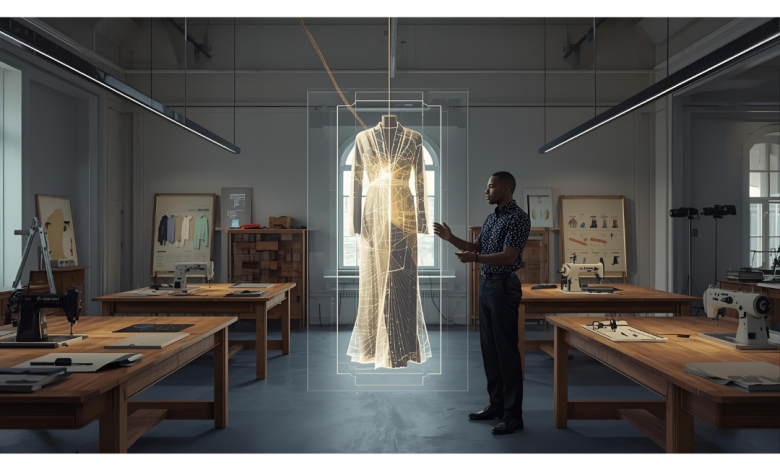
How it works: Instead of a single physical sample, a digital twin of the garment is created. AI tools then generate hundreds of variations – changing colour, fabric, or detailing – in minutes. These hyper-realistic assets are distributed instantly to a global network of editors and VIP stylists.
The technology behind these digital twins has reached unprecedented sophistication. Using neural radiance fields (NeRFs) and generative adversarial networks (GANs), fashion tech platforms can now create digital garments that accurately simulate how fabrics drape, move, and interact with light. Editors can virtually “feel” the weight of silk organza or see how lamé catches studio lighting, all without the garment ever leaving the design studio. This level of fidelity is crucial in luxury, where materiality and craftsmanship are as important as silhouette.
The Strategic Advantage: Brands can now gauge desire and editorial interest before committing to production. The data is clear: which variations generate the most saves, shares, and requests? This makes the sample a dynamic asset that produces data rather than an inanimate object. The process smoothes out logistics, cuts carbon footprint from shipping, and gives a quantifiable measure of a design’s potential media impact.
Quantifying the Invisible: The Data of Desire
The Exclusivity Algorithm: Luxury is based on scarcity. AI can analyse a brand’s archive, current collection, and the global market to define the “uniqueness score” of a product. It will be able to point out oversaturated silhouettes or advise on novel material combinations that maintain brand codes while offering genuine novelty, therefore ensuring new products feel both fresh and inherently part of the house’s world.
This algorithmic analysis extends to what industry insiders call “heritage integrity.” AI systems trained on a house’s complete archive – from sketches and runway footage to editorial placements and celebrity sightings – can identify which new designs authentically extend the brand’s DNA versus which feel derivative. For heritage houses with century-long histories, this provides institutional memory at scale, ensuring that even during creative director transitions, the brand’s aesthetic evolution maintains coherence and authenticity.
Forecasting Cultural Capital: For press and VIP teams, what it all comes down to is understanding the narrative potential of a product. New AI tools are able to analyse design elements against real-time data on art, cinema, and socio-cultural conversations. Does a specific jacquard pattern align with a resurgence of interest in Art Deco? Does a vibrant colour story connect to a rising social movement? This allows communicators to pre-arm themselves with powerful, data-backed narratives, moving from pitching a “beautiful coat” to presenting a “garment that embodies the current dialogue on craft preservation.”
Luxury and the Human-AI Collaboration
This is an evolution, not a negation of the role of the fashion professional. The PR specialist becomes a Data-Curated Storyteller, using the insights to finetune pitches with an unprecedented level of precision. The designer becomes Creative Conductor, testing the boundaries of creativity against the metrics of desire and impact through AI. The intuition for what makes a moment iconic is now informed by a deep, data-driven understanding of the cultural landscape.
The Future is Phygital
The future of luxury fashion tech is not a choice between art and algorithm, but a reality that is “phygital”-one in which the physical craftsmanship of a garment is inextricably linked to its digital intelligence. The brands that will lead are those that master this synergy, knowing how to use AI not to create anonymously, but to deepen their understanding of their own identity and their audience’s desires. Thereby, they will create products that are commercially successful, yet at the same time culturally resonant and of enduring value. It’s not that the algorithm has replaced the soul of luxury; it’s given it a new language.
The next frontier will see these technologies converging. Imagine a garment whose digital twin exists in the metaverse while its physical counterpart contains NFC chips that, when scanned, reveal its complete provenance – from the specific sheep that provided the wool to the artisan who wove it. Or consider personalized AI stylists that learn your aesthetic preferences so thoroughly they can co-design limited edition pieces with the house’s creative team. These aren’t speculative futures; they’re already in development at forward-thinking luxury houses.
Ultimately, the integration of AI in luxury fashion represents not a dilution of creativity, but its democratization within the creative process. Junior designers have access to insights that once required decades of industry experience. Smaller houses can compete with heritage brands in understanding cultural currents. And consumers receive more personalized, meaningful experiences. In an industry built on dreams, AI is becoming the most powerful tool for understanding what we dream about – and bringing those dreams to life with unprecedented precision and purpose.