Abstract
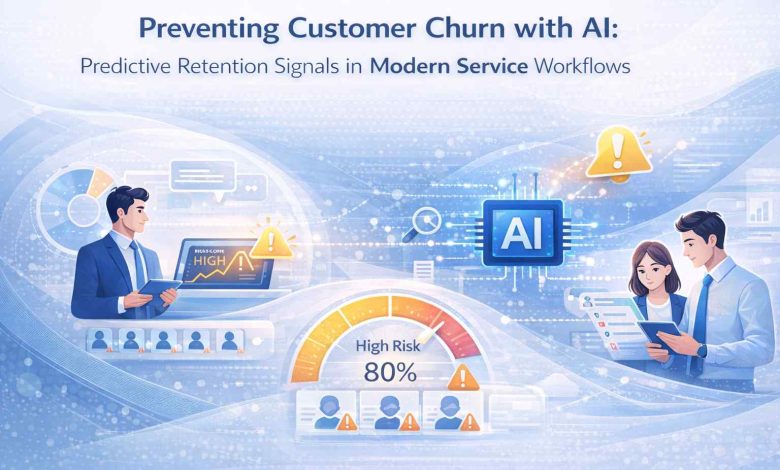
Customer churn represents a substantial risk to enterprise revenue and long-term growth. Traditional service models rely on reactive reporting—identifying churn only after a customer has already disengaged or canceled. Predictive Customer Retention systems introduce a more proactive, AI-driven approach by analyzing complaint keywords, sentiment patterns, case frequency, and behavioral signals to identify at-risk customers early. This article outlines a vendor-neutral framework for implementing Predictive Intelligence within Customer Service workflows, enabling service organizations to strengthen loyalty, optimize service interactions, and reduce preventable churn.
1. Introduction
Customer retention has become one of the most critical differentiators in modern service operations. Acquiring a new customer is significantly more expensive than retaining an existing one, yet many organizations lack early-warning systems that detect dissatisfaction before it escalates into churn. Rising case volumes, negative sentiment patterns, repeated complaints, and unresolved issues often indicate mounting frustration—but without predictive intelligence, these signals remain unnoticed.
AI-driven churn alert systems transform this challenge by examining real-time data generated through customer interactions. By analyzing sentiment, language, case recurrence, and behavioral trends, organizations can proactively identify customers who may be at risk of leaving.
2. Predictive Intelligence in Customer Service
Predictive Intelligence uses data signals—historical and real-time—to forecast potential outcomes. Within Customer Service, these signals reveal dissatisfaction trends and behavioral patterns that correlate with churn. Instead of relying solely on post-incident surveys or lagging indicators, predictive systems continuously monitor customer activity to surface early signs of disengagement.
Key goals include:
• Identifying frustration before customers escalate issues.
• Alerting managers when churn risk increases.
• Guiding proactive outreach to preserve customer relationships.
3. Architecture of a Predictive Retention & Churn Alert Workflow
A vendor-neutral churn alert workflow consists of five core layers:
1. Input Layer – Case creation or updates trigger analysis.
2. Signal Extraction Layer – Complaint keywords, sentiment, and case history are evaluated.
3. Risk Scoring Layer – The system assigns churn likelihood based on signal combinations.
4. Alerting Layer – High-risk cases trigger notifications to managers or retention teams.
5. Action Layer – Teams take corrective action to re-engage or support the customer.
This modular architecture ensures scalability, transparency, and proactive customer care.
4. Key Indicators of Customer Churn
The system evaluates several early-warning indicators:
• Complaint Keywords – Language expressing dissatisfaction or intent to quit.
• Negative Sentiment – Customer messages classified as negative or emotionally intense.
• Case Frequency – Multiple cases within a short timeframe.
• Unresolved Issues – Patterns of repeated escalations or stalled resolutions.
• Service Fatigue Indicators – Phrases suggesting exhaustion or loss of trust.
Together, these signals help build a holistic view of customer risk.
5. Manager Alerts and Escalation Workflow
When the system detects a high churn risk score, alerts notify supervisors and retention teams. This enables:
• Immediate case evaluation.
• Personalized outreach.
• Adjustment of service priority.
• Root-cause analysis based on trends.
This proactive escalation prevents minor issues from turning into lost customers.
6. Business Benefits of Predictive Retention Systems
Organizations adopting AI-driven retention workflows experience significant improvements:
• Reduced churn through proactive engagement.
• Increased customer satisfaction and loyalty.
• Lower operational costs by preventing rework.
• Improved service strategy through trend insights.
• Enhanced manager visibility into emerging problems.
7. Ethical & Responsible AI Considerations
Predictive retention systems must balance innovation with responsibility. Key considerations include:
• Data Transparency – Customers should understand how their data is used.
• Bias Prevention – Models must be evaluated for fairness across demographics.
• Privacy Protections – Sensitive customer information must remain secure.
• Explainability – Managers must understand why a customer was flagged.
8. Future of Predictive Customer Retention
Future advancements will expand predictive capabilities through:
• Real-time emotional trajectory modeling.
• Multi-channel behavior analysis.
• Multi-agent AI systems for retention planning.
• Automated next-best-action recommendations.
These innovations will strengthen customer loyalty and allow organizations to pivot from reactive service to predictive experience management.
9. Conclusion
AI-driven churn alert systems offer a proactive foundation for customer retention. By monitoring sentiment, complaint patterns, and case frequency, organizations gain early visibility into emerging dissatisfaction. This empowers service leaders to intervene before customers disengage—preserving revenue, strengthening trust, and building more resilient customer relationships.