Climate-driven wildfires across the US cost between around $400 billion and nearly $900 billion annually, according to the Joint Economic Commission. The first half of 2025 saw the costliest damages at $101 billion.
We’re losing critical infrastructure: substations, hospitals, telecommunications and water systems. But it’s not because we lack firefighters. It’s because the technology is inadequate for the threat level.
The problem
Fires are getting bigger, more frequent and more destructive. In fact, places that have never experienced fires are now seeing megafires. The World Resources Institute reports that “2024 was the most extreme year for forest fires on record, with at least 13.5 million hectares of forest burned — an area roughly the size of Greece. This surpassed the previous record of 11.9 million hectares, set in 2023, by about 13%.” Further, estimates indicate that “extreme” wildfires emitted more than eight billion tons of carbon dioxide during the 2024–2025 global fire season.
These are not isolated spikes; they are part of a sustained trend of increasing fire risk and loss. These changing fire dynamics are wreaking havoc on the climate, our infrastructure, public health and our economic stability.
Yet, despite that fire dynamics have changed drastically, fire suppression tools have remained unchanged for over five decades.
The firefighting operation
Firefighting is a complex, multi-tiered operation. The first tier is firefighter, who is at the front end of the operation, spraying water using firefighting nozzles. Several firefighters draw water from a fire engine. Several engines form a battalion, and the battalion chief determines the deployment of the engine company. The last tier is central command. Several battalions may be dispatched to fight a fire and may even call for additional support from aerial resources, like retardant drops or helitankers, when necessary.
Fire engines operate largely as they did fifty years ago. Pump operators still calculate water pressure manually, and nozzles deliver inconsistent flows. This leads to wasted water, unnecessary fatigue, slower fire knockdown and dangerous pressure spikes that can injure firefighters.
Additionally, the current method of firefighting doesn’t generate any data, leaving fire chiefs effectively blind to what kind of fire their teams are fighting or how their suppression efforts are performing.
Limitations of manual firefighting
Existing suppression methods are fundamentally limited by their reliance on manual calculations during high-stress, fast-moving scenarios. At the engine level, firefighters operate without data on optimal flow rates. At the command level, leaders deploy resources with incomplete visibility into fire behavior or water supply depletion. Without predictive tools, the entire system remains reactive and labor-intensive, struggles to keep pace with evolving threats and puts infrastructure at risk.
The hardware gap
Historically, equipment design prioritized mechanical function over intelligent performance. Consequently, pump operators are forced to manually adjust pressures and monitor gauges in life-or-death conditions. With no systematic data linking flow rates or nozzle performance to suppression success, firefighters are effectively forced to solve complex fluid dynamics problems mentally while standing before a raging fire.
Introducing a better model: Predictive, connected, autonomous
Data can provide firefighters with important information about each engine’s flow and pressure; what water levels are available; which lines are active; and the effectiveness of crews’ water application. All of this information is critical for battalion chiefs immersed in complex situations.
But that’s no longer enough.
Prescriptive analytics for fire suppression are emerging. Using fuel maps, GIS, weather data and suppression alerts, we can predict critical issues like when water will run out (with a 10-minute warning); weeks of advance notice if equipment is likely to break down; and how a fire might spread based on current strategies. This allows fire departments to plan ahead instead of solely reacting.
Looking ahead, prescriptive analytics will recommend strategies for effective deployment. Using reinforcement learning, systems will be able to identify where each engine should be; what flow rates should be used; and how to extinguish a fire quickly with the least amount of water. Based on many instances of real-world fire suppression, we believe prescriptive analytics could reduce water usage by 50 percent and double fire suppression rates.
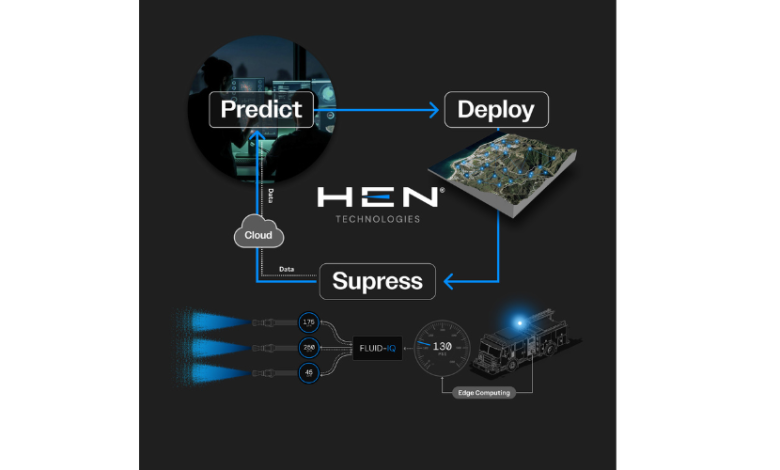
Reframing fire response: Predict, deploy, suppress
This is why firefighting hardware alone is simply no longer enough. Data changes the game, and a new model of firefighting – predict, deploy, suppress – will reinvent the way fires are fought.
Predict: From reactive to anticipatory
This phase shifts fire response from reacting to chaos to anticipating it. By utilizing data from connected systems, we move beyond static historical data to dynamic, real-time foresight.
- Fluid dynamics & pressure modeling: Smart AI models analyze how fluids move through the specific hydraulic systems of an engine and how pressure changes in real-time. This replaces the “mental math” pump operators currently perform with precise, physics-based calculations.
- Resource forecasting: A predictive model can calculate exactly when an engine will run out of water based on current discharge rates, giving commanders critical lead time to secure additional water sources before the tank runs dry.
- Risk identification: Predictive maintenance algorithms spot equipment anomalies, such as a failing pump seal or valve, weeks before they cause a breakdown on the fireground. This helps responders avoid the “hidden failures” that often cripple legacy fire protection systems at the worst possible moment
Deploy: Intelligent orchestration
The deploy phase puts the collected insights to work by organizing an immediate, data-driven response. It acts as the central nervous system of the fireground, coordinating components that previously operated in isolation.
- Dynamic resource allocation: Resources like water flow, pressure and nozzle direction are dynamically adjusted to align with predicted fire activity. If a fire front intensifies, the system recommends or automatically adjusts pressures to match the required suppression force.
- Decision support: This layer provides high-level decision support for battalion chiefs, minimizing the cognitive load of manual calculations. In fast-changing scenarios, it answers the question: “Where is the next engine needed most?”
- Adaptive control: The system is flexible; recommendations and controls change instantly based on new information. If the wind shifts or a hose line is shut down, the deployment strategy recalibrates immediately to maintain safety and efficiency.
Suppress: Precision at the point of attack
Information gathered in the “predict” and “deploy” phases culminates here, ensuring that fires are extinguished with maximum efficiency and minimum waste.
- Optimized delivery: This process reduces water damage and waste by delivering the exact volume and pressure required to kill the fire; no more, no less. It moves us away from “surround and drown” tactics and toward surgical suppression.
- Real-time feedback loops: Sensors evaluate the efficacy of suppression efforts in real-time. Is the temperature dropping? Is the fire line holding? If the current attack isn’t working, the system pivots, suggesting alternative flow rates or attack angles.
- Closed-loop automation: Ultimately, this method enables a closed-loop system where the hardware adapts its output based on the fire’s changing features, ensuring that the suppression effort is always one step ahead of the flames.
The bottom line
Capturing data transforms the fire engine from a mechanical tool into a smart, data-aware system powered by sensors, machine learning and real-time analytics that offer strategic insight. This creates a new class of operational visibility and an operating system for modern fire defense.
By turning data and AI into life-saving infrastructure, firefighters can not only measure fire suppression; they can transform it.