There is growing discussion across healthcare about how to responsibly deploy AI agents at the infrastructure level. Nowhere is this more urgent than access to care.
Despite decades of investment in patient engagement tools, healthcare access remains fragmented and heavily manual. Today, 1 in 4 patients delay care due to navigation or scheduling barriers. 61% skip appointments because of scheduling friction. 60% of provider scheduling still happens by phone. Health plans waste billions each year on inefficiencies and missed care gaps, while call centers remain overwhelmed and expensive to scale.
The issue isn’t a lack of digital touchpoints, but the absence of a centralized system that can reason, act, and follow through in real time without relying on constant human intervention.
Why AI Agents Actually Move the Needle
Most healthcare automation focuses on isolated tasks: a scheduling widget here, an IVR menu there, a chatbot that answers FAQs and then hands off the real work to staff. These tools create interaction and solve point problems, but they don’t manage the full conversation or deliver consistent outcomes.
AI agents represent a different approach.
Unlike traditional generative AI, agentic systems plan, execute, and complete workflows end to end. In healthcare access, that means understanding plan rules, eligibility, provider availability, and regulatory constraints, and then taking action across voice, text, inbound, and outbound channels until the task is done.
This is the gap PatientGenie was built to close.
The Bottleneck in Healthcare Access
Healthcare access workflows are deceptively complex. On paper, scheduling or care-gap outreach looks simple: identifythe need, contact the member, book the visit.
In reality, each step breaks across disconnected systems and stakeholders:
- Health plans lack real-time visibility into whether care actually happens
- Providers rely on phone-based scheduling with limited capacity
- Members receive fragmented outreach that rarely leads to completed appointments
This gap is what Alex Zoller, Co-Founder and CEO of PatientGenie, spent years seeing firsthand.
Over more than a decade in digital health, Alex built and scaled products at the intersection of virtual care, automation, and healthcare operations. Prior to PatientGenie, he co-founded Overl.ai, a healthcare automation company that was later acquired through a series of consolidations culminating with Teladoc. He also held senior product leadership roles at InTouch Health, where he worked closely with health systems on access and scheduling workflows at scale.
Across those roles, the pattern was consistent: the intent to deliver care was there, but execution broke down in the handoffs. What should have been a closed loop became a maze, driving delays, higher costs, and missed care.
PatientGenie was built in response to that reality as a system that could sit in the middle of plans, providers, members, and actually see the workflow through to completion.
PatientGenie: Purpose-Built AI Agents for Healthcare Access
PatientGenie is a member-centric AI agent platform designed specifically for healthcare access. Rather than adding another point solution, it acts as the connective layer between health plans, providers, and members.
Its AI agents automate:
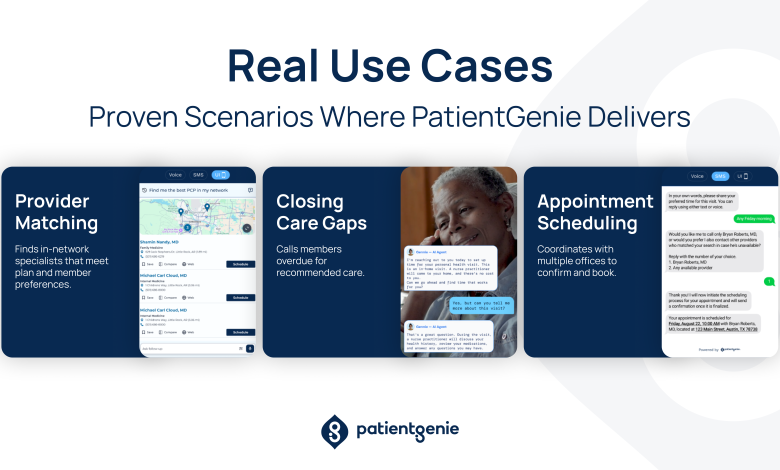
- Provider matching using plan rules and member preferences
- Appointment scheduling, including live coordination with provider offices
- Care-gap outreach for preventive and recommended services
- Post-visit follow-up and satisfaction confirmation
- Seasonal and targeted health campaigns, such as flu shots
All of this runs across voice and text, inbound and outbound without losing context between interactions.
Why Now: The Market Is Finally Ready
Three forces have converged to make agent-driven healthcare access viable at scale:
- Health plans are actively reducing call center spend and prioritizing digital-first access models
- Voice AI and LLMs now perform at near-human levels for real conversations
- Regulators increasingly mandate timely access and preventive care, raising the cost of inaction
The pressure is no longer theoretical. It’s operational.
Built for Health Plans
Healthcare access is not a niche problem. PatientGenie operates within a $47B+ addressable market, growing at roughly 20% CAGR, spanning patient engagement platforms, care management solutions, healthcare contact centers, and AI-driven engagement tools. More than 200 million insured lives are affected by access friction today.
PatientGenie is engineered for real-world health plan constraints and delivers measurable impact:
- Reduced call center dependency and operating costs
- Lower out-of-network spend through network-aware routing
- Faster closure of care gaps to support Star Ratings
- Real-time dashboards for operational visibility
- Deployment in weeks with minimal IT lift
The platform’s multi-agent architecture is built for compliance and scale, with plan-specific rules engines, audit-ready security, and omnichannel orchestration embedded by default.
Rebuilding Access as a System
Access to care needs to be approached at the system level, where information is unified and data, decisions, and action are coordinated across stakeholders in real time.
PatientGenie’s AI agents turn fragmented interactions into closed-loop outcomes, ensuring that timely, appropriate care actually happens.