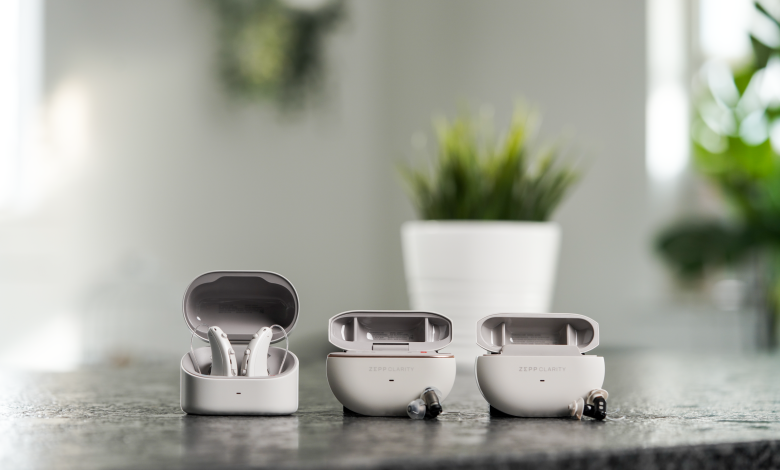
With the introduction of over-the-counter (OTC) hearing aids, online hearing tests are becoming more popular and widely used, providing easier access to hearing healthcare. While technology advances and AI integration are making online hearing tests more accurate and efficient, they are still considered screening tools that will provide only an estimate of hearing ability and are not meant to replace a full clinical hearing evaluation.
Online Hearing Tests
Online hearing tests are digital screening tools designed to give users a general sense of their hearing ability. Most will have someone listen to tones or speech through headphones and respond when they hear the sound.
These tests are widely available through hearing aid companies (like Zepp Clarity’s online hearing assessment), apps, and health websites. They typically measure basic pure tone thresholds or speech understanding in noise, and will either give a brief description of the estimated level of hearing loss or provide a simple audiogram.
Limitations of Online Hearing Screenings
While convenient, traditional online hearing tests cannot replace a clinical hearing evaluation. They are not calibrated to an individual’s specific headphones or environment, which can affect results. Background noise, device quality, and even how the headphones sit on someone’s ears can all influence outcomes as well.
Most importantly, these screenings cannot diagnose the specific type and degree of hearing loss or identify possible underlying medical conditions.
AI Hearing Tests
Research involving AI hearing tests is still ongoing, so they are not ready for clinical use, but results are promising so far. There are several approaches to implementing AI, with the primary goal being to improve quality and efficacy of hearing screenings.
AI hearing tests often include adaptive algorithms that personalize the experience. Instead of delivering a fixed sequence of tones or words, AI-driven platforms can adjust test stimuli in real time based on a person’s responses.
Many also integrate speech-in-noise or digits-in-noise testing, which better reflects real-world listening challenges and is less prone to calibration and background noise issues, leading to more accurate results.
Some AI systems being researched even incorporate data modeling, comparing an individual’s hearing test results or responses to a questionnaire to large datasets to predict hearing patterns and suggest next steps, taking into account things such as clinical symptoms, noise exposure, medical history, and genetics.
Limitations for AI Hearing Tests
Despite their sophistication, AI hearing tests are still screenings, not diagnostic tools. At this point, they cannot replace a comprehensive evaluation by an audiologist.
Although AI use in otoscopy is currently being researched, online AI platforms cannot examine someone’s ears for medical issues like earwax impaction or infections, nor can they pick up on potential diagnostic indicators of medically complex hearing losses, which require professional assessment.
Not all AI platforms are created with the same clinical standards, either, and some may overpromise on accuracy or outcomes. As a result, someone with a “normal” hearing test might delay in seeking care, even if they are experiencing real-world hearing difficulties. In another scenario, someone with a possible medical complication may remain unaware that a referral is needed, and the problem could go unaddressed or even potentially worsen over time.
When Are Online or AI Hearing Tests Useful?
These tools are particularly helpful for individuals who are curious about their hearing but not yet ready to see a professional. They can serve as a low-pressure first step.
They’re also useful for monitoring changes over time. Someone who suspects gradual hearing loss can use these tests periodically to track trends and discuss changes in hearing with their audiologist.
For those exploring OTC hearing aids, online hearing tests and AI hearing tests can help determine if they are a potential candidate for OTC hearing aids and guide initial decisions and expectations.
What Comes Next After an Online or AI Hearing Test?
After completing an online or AI hearing test, the next step depends on an individual’s results and goals. If their results were in the normal range, and they aren’t having any difficulties, they may choose to just continue to monitor their hearing.
If their results indicate hearing loss, they may decide to schedule a full hearing evaluation to confirm their hearing loss and discuss a treatment plan. For those with severe, asymmetric, or medically complicated hearing losses, prescription hearing aids will likely be necessary. For adults with mild to moderate hearing loss, however, OTC hearing aids can be an affordable alternative to try.
Choosing the Right Support
As online hearing tests and AI hearing tests become more advanced and integrated into hearing care, the importance of human expertise hasn’t diminished. Even if someone chooses an OTC hearing aid, speaking with a hearing professional can still be very valuable.
In addition to offering affordable, discreet hearing aid designs and advanced features like noise reduction and Bluetooth capability, reputable OTC hearing aid companies like Zepp Clarity are also working to pair technology with professional guidance to enhance user experience.
Zepp Clarity offers lifetime audiology support and personalized device tuning. Their audiologists partner with you to help with device set up, fit, programming, and troubleshooting. They’ll also help you set goals and realistic expectations for your hearing aids to achieve the best possible outcomes.
Final Thoughts
AI hearing tests are an exciting development, offering a smarter and more personalized way to explore hearing health. They can empower users to take that first step, often earlier than they otherwise would.
These hearing tests are not a substitute for professional care, but, when used wisely, these tools can be an excellent starting point to identify hearing loss and guide users toward the right combination of technology, support, and clinical expertise.
When considering OTC hearing aid options, choose a manufacturer, like Zepp Clarity, that offers audiology services to help bridge the gap between AI technology and professional expertise.