A practitioner’s perspective on why reality is moving slower than the hype
Last night someone sent me another article about AI “wrecking” SaaS.
That tends to happen once people know you think and write about this space. Everyone forwards the latest hot take, usually with a disclaimer attached. “Take this with a grain of salt,” they’ll say. “But interesting to think about.”
This one came through Facebook, and it was emphatic. According to the author, the $200 billion SaaS industry is somehow on the brink of collapse.
Not disruption. Not evolution. Collapse.
What these arguments consistently miss is that enterprise software doesn’t exist to automate tasks. It exists to stabilize messy, political, deeply contextual human behavior.
The argument in the article was familiar: SaaS only ever solved a deployment problem. AI agents will solve the work itself. Why buy tools when you can hire digital colleagues? Why pay per seat when AI can deliver outcomes? CRM, HRIS, project management, marketing automation – all of it supposedly headed for extinction within a few years.
I understand why this line of thinking is seductive. I’m excited about AI too. I use it daily. I believe it is materially changing how work gets done.
But as someone who has spent years inside large organizations, trying to align leaders, move cultures, clean up knowledge, and create clarity where there often isn’t any – I just don’t see this future arriving anytime soon. Not in this generation. Not in the way it’s being described.
And oddly enough, what convinced me of that wasn’t an enterprise system at all. It was my car.
I drive a Tesla, often with Full Self-Driving enabled. If you’ve experienced it, you know how surreal it feels. I can start my car in the garage, tell it where I want to go, and drive from my suburban neighborhood into downtown Kansas City and back home without touching the steering wheel or accelerator. With the latest update, it will even back into my garage—assuming my garage door opens fast enough.
It’s freakishly impressive. Every time I go somewhere, it feels like a glimpse into the future.
But here’s the thing: Tesla has been working toward this for over a decade. It’s required billions of miles of real-world data, purpose-built sensors, constant human intervention, and endless edge-case correction. Even now, it’s not ‘fully’ autonomous. I’m still required to pay attention. I’m still responsible.
That experience keeps me grounded when I read breathless claims about “AI colleagues” replacing entire categories of enterprise software in five years.
Driving is a constrained problem. Organizations are not.
The reason Full Self-Driving works—even imperfectly—is that the ‘world’ of a car is constrained by universal rules: lane lines, stop signs, and the laws of physics.
But a large enterprise has no universal map. It is a shifting landscape of unwritten rules and tribal knowledge where ‘edge cases’ are the norm, not the exception.
We’re tempted to assume AI can navigate an organization because it can navigate a highway, but an enterprise isn’t a paved road; it’s an off-road wilderness.
SaaS platforms act as the digital infrastructure—the ‘pavement’—that turns chaotic company data into something an agent can actually follow.
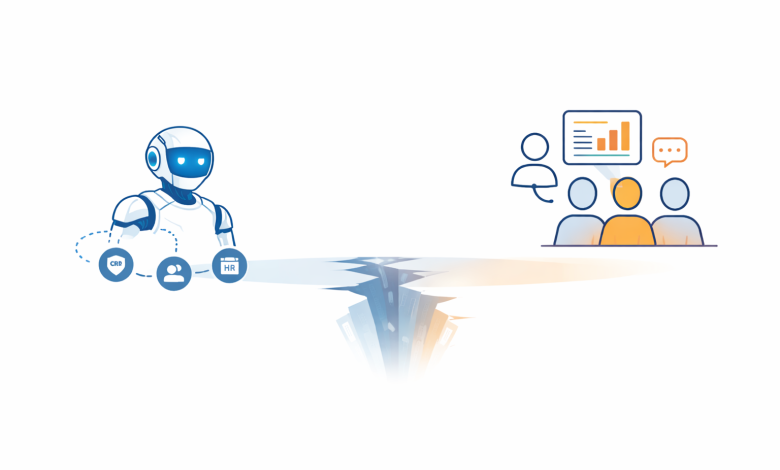
Which brings me back to digital workplace SaaS, and why the extinction narrative misses the point. While this tension exists across every category—from CRM to HRIS—it is most visible in strategic communications and intranets. These platforms are the connective tissue of the enterprise, and they expose why the ‘agents will replace SaaS’ narrative falls apart.
Take strategic communications platforms. Organizations don’t invest in them because employees can’t search for information. They invest because leadership needs a reliable way to push messages to curated places where employees expect to find accurate, relevant content, ideas, tools, and more. Notably if the search sucks, it starts to be a deal breaker in terms of employee trust. But that’s just table stakes. Alignment happens when leaders intentionally create shared context, shared narrative, and shared direction.
AI is exceptional at pull. Ask a question, get an answer.
Strategic communication is push. Here’s what’s changing. Here’s why it matters. Here’s what we expect you to do differently.
An AI agent can ‘push’ a notification, but it cannot create a ‘destination.’
In an era of infinite digital noise, the value of SaaS is the Environment of Authority. If every strategic update arrives as an automated nudge, leadership messages quickly degrade into background noise.
A dedicated platform provides ‘Architectural Weight.’ It is a persistent, high-signal space that tells the employee: This is not just another task; this is the direction of the company.
A CEO cannot pivot strategy and hope employees stumble into the right prompt. They need a stage where messages land with intent, authority, and shared context.
We love to imagine this is like a ‘process’ problem because processes are easy to automate. Leadership challenges don’t work like that; there’s no ‘Easy’ button.
The same misunderstanding shows up in how people talk about knowledge management. There’s a growing assumption that AI search will magically fix decades of messy content. But anyone who’s lived inside an enterprise knows the reality: multiple versions of the same policy, outdated documents, conflicting guidance spread across tools and folders.
AI doesn’t fix the mess (frustratingly, it puts a megaphone in front of it.)
We assume that because an AI can write an essay, it can manage a simple list. It can’t. I recently gave an agent a structured spreadsheet of just 20 articles with clear columns for authors and titles. It couldn’t even perform basic arithmetic. It hallucinated titles that weren’t there, ignored ones that were, and invented authors out of thin air.
This happens because AI is designed for pattern recognition, not record keeping. It treats a database like a suggestion rather than a source of truth. Without a SaaS platform to act as the ‘System of Record,’ an AI agent isn’t a digital colleague—it’s a storyteller trying to do the job of an auditor.
And then there’s the part that almost never gets mentioned in these conversations: people.
As we get flooded with AI noise, a human voice becomes a premium. Let’s be real: nobody builds a relationship with an algorithm.
You don’t put in that extra hour of ‘discretionary effort’ just because an LLM sent you a perfectly worded nudge. You engage because you recognize your leader’s voice, you feel the intent behind the message, and you know there’s a human on the other side, someone who actually gets your world.
That connection is built through specific, un-automatable signals. It’s the raw authenticity of seeing a CEO speak plainly on video—stutters and all—rather than reading a polished AI summary.
It’s the sense of belonging that comes from recognizing a colleague’s actual face and name across regions, reminding you that you’re part of a tribe, not just a node in a network. It’s the subtle but vital feeling that someone actually took care in how a message was delivered to you.
Those signals of “effort” are exactly what employees look for to decide if a message is worth their time. As the digital noise increases, these human markers become the only things we actually pay attention to.
Yes, AI will automate parts of workflows. It’s already handling the data entry, the summarization, the pattern detection, etc. Those are real gains.
But we have to stop confusing “replacing pieces of work” with “replacing the systems.” An agent can do a task, but it cannot provide the governance, the accountability, the shared understanding that holds a company together.
Enterprises can’t hand legal, ethical, and reputational responsibility to prediction-based systems without a human in the loop. The cost of a “corporate crash” is simply too high.
So when I hear predictions that SaaS will be destroyed in five years, I think about Tesla. About how hard the last 10% really is. About how long it takes to move from impressive demos to trustworthy autonomy.
AI agents will absolutely change the digital workplace. They will sit on top of platforms, accelerate work, and reduce friction. But they won’t replace the need for places where humans align, decide, and lead—at least not in this generation.
Far from dying, SaaS is becoming the essential scaffolding in the modern, AI-empowered workplace. SaaS solutions still provide the structure that agents (like humans) need to be effective at work. If you’re still thinking the agents can stand on their own, you’re probably confusing a great demo with the complex reality of how companies actually evolve.