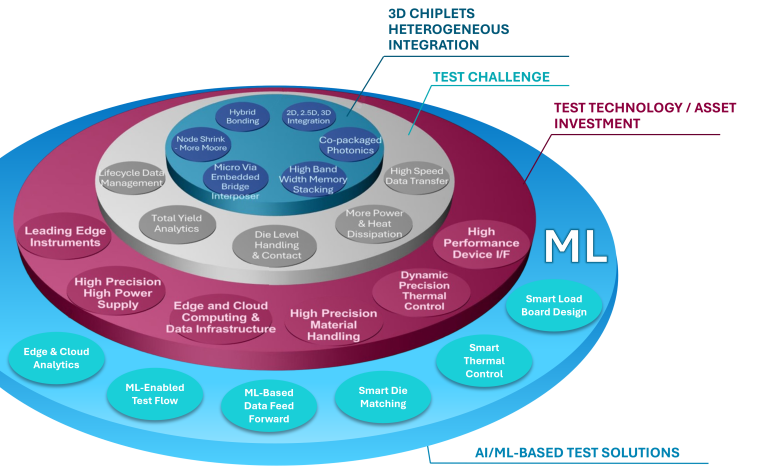
Semiconductor testing is a cornerstone of chip manufacturing. Traditionally, it has been focused on ensuring chip quality and reliability, acting as a critical checkpoint before devices reach customers. However, due to rapid advancements in semiconductor processing and packaging technologies test has become increasingly vital throughout the design, fabrication, and manufacturing process. To meet these challenges, AI technology is increasingly being utilized to test AI chips.
The role of AI extends across various testing applications, including adaptive test strategies, yield optimization, and fault prediction and isolation. By integrating AI into semiconductor testing environments, the industry can effectively tackle advanced defects related to chip packaging and other challenges.
With that said, as chips grow more complex, the demands placed on testing are intensifying. In this new “Era of Complexity,” semiconductor test itself must evolve. Increasingly, it is AI that is enabling the industry to meet its own heightened challenges.
The Era of Complexity
The Era of Complexity refers to the unprecedented scale, integration, and performance requirements of today’s semiconductors. Advanced AI and HPC chips contain billions of transistors and employ heterogeneous integration, which involves using advanced packaging techniques to stack and combine many dies into a single, compact system-in-a-package. The value of this technique is that it allows for greater performance, functionality, and efficiency than traditional chip packaging containing one or a few chips.
These architectures amplify thermal, power, and reliability challenges while creating more opportunities for subtle defects that can be challenging to detect. Traditional test methodologies—while still essential—are strained by these demands. The result is longer test times, higher costs, and an increased risk of defects escaping into the field.
Compounding the challenge is that test coverage itself must expand. It’s no longer sufficient to simply confirm functionality. Test systems must now detect sources of silent data corruption (SDC), where a hardware fault causes a wrong calculation result without an explicit failure signal. They must also validate thermal stability, and capture errors arising from intricate chip-to-chip interactions. The complexity is magnifying effort at every stage.
The Need for Speed and Quality
Speed has always been a driver in testing. The faster a manufacturer can bring up a complex device test, the sooner products can be shipped and revenue realized. And the faster that devices can be tested without sacrificing quality, the lower the cost of test (COT), resulting in greater profit margins. In the Era of Complexity, speed and quality must be simultaneously optimized. Faster test routines must still deliver deeper coverage, uncovering hard-to-detect failures in advanced packaging or AI accelerators. AI-driven tools make this possible by reducing false results, automating decision-making, and continuously optimizing test flows based on real-time data.
By shortening test cycles and boosting accuracy simultaneously, AI directly addresses the cost and time pressures that have traditionally limited test scalability.
Solving Tomorrow’s Problems
Testing is reaching a threshold where the problems are simply too complex for humans alone to solve. Just as electronic design automation (EDA) tools became indispensable for chip design, AI is emerging as an essential capability for chip test. Machine learning algorithms excel at finding patterns across enormous data sets, making them well-suited to identifying anomalies that would elude traditional approaches.
For example, AI can detect correlations between rare defect signatures and subtle variations in manufacturing conditions—insights that would be practically impossible to uncover manually. It can also adapt test strategies in real time, ensuring coverage even as chip architectures evolve. In short, AI is not just assisting human test engineers—it is extending their reach into areas where human analysis cannot keep pace.
How AI Is Changing the Game
The impact of AI on semiconductor testing is already visible across industries:
- Managing complex architectures: Multi-die packages and heterogeneous systems require sophisticated validation of interconnects, thermal behavior, and cross-die communication. AI helps map these interactions and optimize test conditions.
- Enabling faster, more accurate testing: By predicting failures earlier in the process, AI reduces unnecessary retests and shortens test program development.
- Using AI to test AI chips: AI-powered methods are uniquely suited to handle the intricacies of the very chips that power them. For example, they can simulate workloads to uncover hidden bottlenecks or stress points in neural processing units.
- Detecting hidden defects: Silent data corruption and intermittent failures are notoriously difficult to detect. AI-driven anomaly detection provides a way to catch these before they impact end users.
In essence, AI is helping testing move from a reactive discipline to a proactive one. Rather than waiting for failures to emerge, testing can anticipate and prevent them.
Diving into the Challenges
High-power devices such as GPUs and AI accelerators pose unique challenges. Their massive power consumption generates significant thermal loads, creating risks of localized hotspots, electromigration, and accelerated aging. Testing such devices requires not only functional validation but also stress testing under realistic conditions.
A practical example is the detection of packaging-induced defects. Structures inherent in advanced 2.5D and 3D (i.e., vertically constructed, multilayered) chip packages can develop latent defects during assembly. Traditional testing may miss these subtle defects, ultimately resulting in field failures. AI-based test flows can recognize subtle signatures that correlate with these hidden risks—preventing costly recalls and protecting brand reputation. This shift toward predictive, data-driven validation demonstrates why AI is no longer optional but central to future testing strategies.
Looking Ahead
Semiconductor test has always been a moving target, adapting to each new generation of chips. However, the Era of Complexity marks a profound turning point. With AI becoming essential to both the design of semiconductors and the systems that rely on them, the test industry must likewise embrace AI as a foundational tool.
The future will be shaped by two key drivers: innovation and collaboration. Innovation will deliver the algorithms and methodologies that push testing beyond current boundaries. Maintaining competitiveness requires a commitment to continuous improvement and collaborative advancement—across equipment providers, chipmakers, and standards bodies—to ensure these innovations scale across the industry.
AI’s role in shaping semiconductor test is only beginning. As devices grow in complexity and performance, the integration of AI into test processes will determine how effectively the industry delivers uncompromising reliability, reduces cost, and accelerates time to market. Those who embrace this shift will not only survive the Era of Complexity—they will thrive in it.