

NASA’s Roman Space Telescope launches with BAE Systems-built scientific instruments
The Nancy Grace Roman Space Telescope is the latest NASA astrophysics flagship observatory supported by BAE Systems, following Hubble and Webb
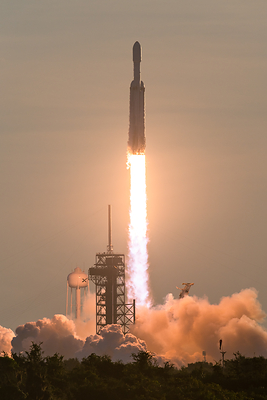
BROOMFIELD, Colo., Aug. 30, 2026 /PRNewswire/ — BAE Systems (LON: BA) is celebrating the successful launch of NASA’s Nancy Grace Roman Space Telescope today from Kennedy Space Center in Florida, which will support critical astrophysics discoveries as the latest flagship observatory.
BAE Systems designed and developed the Opto-Mechanical Assembly on the Wide Field Instrument (WFI), the primary scientific instrument on the Roman mission. The Opto-Mechanical Assembly provides the stable structure and thermal environment that enables the WFI to meet performance requirements. It includes the optical bench, thermal control system, precision mechanisms, optics and electronics. BAE Systems also provided integration services and testing for the assembly.
“Today’s launch of the Roman Space Telescope marks a significant achievement for furthering astrophysics discoveries,” said Bonnie Patterson, vice president and general manager of Civil Space for BAE Systems. “Roman will provide unparalleled views of the cosmos, helping to further advance our knowledge of the universe, the physics of our galaxy and the demographics of exoplanets.”
The Roman Space Telescope’s Wide Field Instrument will provide a field of view at least 100 times greater than the Hubble Space Telescope, allowing scientists to survey the sky up to 1,000 times faster. Roman will study billions of cosmic objects to explore how planets, stars, and galaxies form and develop over time.
BAE Systems has provided significant support for every NASA’s astrophysics flagship mission, from the Hubble Space Telescope to the James Webb Space Telescope. These missions complement the Roman Space Telescope through enhanced shared technologies, enabling science and supporting decades of discovery through innovative instrument delivery.
Looking ahead, BAE Systems is already contributing to NASA’s next astrophysics flagship mission concept: the Habitable Worlds Observatory (HWO). This mission would build upon the work of previous astrophysics programs and is in the early stages of development. BAE Systems’ Ultra-Stable Large Telescope Research and Analysis (ULTRA) studies are developing a picometer-capable mirror actuation system to provide greatly enhanced optical stability and performance.
The HWO mission would be focused on imaging Earth-like planets orbiting other stars and searching them for signs of life. The observatory would also be equipped with a powerful lens to explore stars, the planets of our solar system, different galaxies, and the evolution of the universe with unprecedented sensitivity and resolution.
For more information, please contact:
Brian Rantala, BAE Systems
Mobile: 720-995-8253
[email protected]
www.baesystems.com/US
@BAESystemsInc

 View original content to download multimedia:https://www.prnewswire.com/news-releases/nasas-roman-space-telescope-launches-with-bae-systems-built-scientific-instruments-302864401.html
SOURCE BAE Systems, Inc.


More from Cision PR Newswire
See all
Legacy Healthcare Welcomes U.S. Congressional Legislation Proposing 12-Year Market Exclusivity for US FDA Newly Approved Botanical Drugs

Triskell Software Positioned for the First Time in the 2026 Gartner® Magic Quadrant™ for Adaptive Project Management and Reporting

RAMINVEST HOLDING DIFC Unveils an Integrated Ecosystem for Commodity Trade with Africa

Qapture Investments Establishes Investment Manager and Acquires Hermetik Trading’s DeFi Strategies; Appoints Brendan MacNeil as Head of DeFi
Recommended for you
More stories Future of AI
Cysic CEO Says Paying for an AI Model Doesn’t Prove Your Host Ran It
 AI & Technology
From self-driving excavators to AI leasing agents, proptech’s AI moment has arrived
 AI & Technology
AI literacy shouldn’t begin in the workplace. It should begin in primary school.
 Data
The Data Centre Is Becoming a Product
 AI & Technology
Too often, AI narrows rather than widens access. Here’s how the tech industry can fix it
 AI & Technology