One fiber connector technology, from the optical engine to the box edge. Live connector demonstration at SEMICON Taiwan.
SAN JOSE, Calif., Aug. 31, 2026 /PRNewswire/ — Mixx Technologies, Inc., a US-based venture-backed deep-tech company building co-packaged optics for hyperscale AI infrastructure, today launched the SxC™ Connector, an optical connector for both the front plane and the backplane that terminates up to 24,576 fibers in a single rack unit. Mixx will hold live connector demonstrations at SEMICON Taiwan, booth #I2923, beginning September 2, 2026.
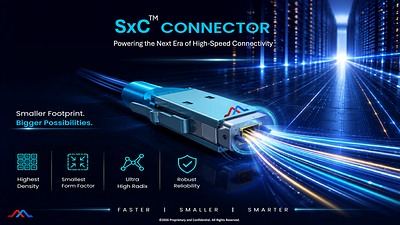
Mixx’s first product to market is a fiber connector. The industry is moving toward co-packaged optics (CPO) in steps, through near-package optics, CPX, and similar socketed approaches. Each step needs more radix out of the box than existing connectors can deliver, and true CPO won’t arrive without it. The connector determines how much optical I/O a box can carry. This layer decides whether optics solves the inference challenge at rack scale or only demonstrates it on a bench.
Inference has changed what a scale-up network needs. Mixture-of-experts and agentic workloads require every node to reach every other node with the lowest latency, and that all-to-all connectivity comes down to radix, the number of endpoints a single node can reach. Higher radix reduces the switching layers a packet crosses. Each layer removed takes its switches, transceivers, and cables with it, which means lower latency, lower aggregate power, and fewer components in the failure chain.
Scale-out runs on a mature pluggable transceiver ecosystem, and the opportunity in scale-up is to extend that ecosystem rather than replace it. But the arithmetic arrives at the connector. A 400T switch brings thousands of fibers out of a single box, and pluggable transceivers cannot support that density at the front panel. Once optics move inside the box, fiber becomes the next bottleneck, and existing connector families do not easily support the density this generation requires. The inference challenge also means replacing an electrical backplane with an optical one, a requirement the mature ecosystem was never built to meet.
One connector technology, inside the box and outside it
The SxC™ Connector is the first product in the SxC™ connector family, the system-level connectivity layer of the HBxIO™ platform. It uses the same core connector technology Mixx deploys across the optical signal chain. Mixx builds the optical engine and the connector, so it can optimize the interface from the start rather than negotiating it across multiple vendors.
Each connector scales up to 64 fibers, supporting both SMF and PMF in the same form factor depending on customer requirements. The same connector serves the front plane and the backplane, mounted at the faceplate or seated in a bulkhead. The industry workhorse, the MPO, carries 16 in the configuration typically deployed for this application, and the newer, more compact VSFF also usually carries 16. The SxC™ form factor does not change with lane rate or optical power, so the connector supports current and next-generation rates without redesign. By ganging up sixteen connectors within a bulkhead for the backplane, Mixx can terminate 1,024 fibers in less than 800 square millimeters, which is the figure of merit for a connector: fibers per square millimeter. Radix resolves to fiber count, and fiber count resolves to density at the box edge.
Twenty-four bulkheads bring a single OCP rack unit to 24,576 fibers. That is 4x the fiber density of MMC-VSFF, the highest-density connector platform qualified for deployment today, and what previously required a four-rack-unit enclosure with MMC connectors now fits in a single rack unit. That density is what makes the next step in CPO integration possible. Advanced packaging and cooling technologies have scaled what can sit inside a box faster than the front panel has scaled what can come out of it, and a box of co-packaged optical engines is limited today by the fiber at the box edge, not by the silicon inside. Bringing the fiber out through the edge of the box at this density removes that limit and puts multi-petabit connectivity from a single box within reach.
Mixx is a member of the Expanded Beam Optics Multi-Source Agreement (EBO MSA), the multi-source agreement standardizing expanded-beam optical connectors, and the first connector specification is now in development. Expanded beam is where the industry is heading, and Mixx is contributing to that work while building for deployments happening now. Mixx’s ferrule is glass rather than the plastic used in most connectors, which lets it handle the optical power levels that remote laser architectures and future multi-wavelength signals require.
How the ferrule is made
Expanded-beam ferrules are conventionally assembled in series: starting with a V-groove substrate or molded plastic ferrules, individually placing fibers, dispensing epoxy, polishing, then actively aligning a lens before the assembly goes into a housing. That sequence limits fiber placement to a single array and reduces throughput and yield. Mixx forms the optical structures in a full wafer-scale integrated process using no exotic materials. The free-form optics, 3D waveguides, and 2D fiber holes are enabled by true wafer-scale processing, which allows fiber to be placed in a two-dimensional array to achieve high density and low loss.
Mixx is building an EBO connector that scales further than what is available today, so operators committing to optical infrastructure solutions now are committing to something that keeps scaling. Because the same core connector technology serves the optical engine, the external laser source (ELSFP), the backplane, and the front panel, volume aggregates across product lines instead of splitting across them.
The ferrule was only half the problem. Cable assembly, the next step, has remained largely manual across the industry, and it is the constraint operators hit once ferrule supply is solved. Mixx is automating that step with robotic fiber assembly and automated visual inspection as part of the production pathway. The connector also supports passive fiber attach, drawing on years of pick-and-place optimization to remove the active-alignment step between lens and fiber that has historically limited yield and throughput.
“Every era of the data center has had a connector that carried it,” said Vivek Raghuraman, CEO of Mixx Technologies. “MPO carried one generation, and VSFF carried the next, and each one arrived because the network behind it had changed shape. Inference has changed the shape again. What Mixx has built is not a denser version of the last connector. It is one ferrule technology that terminates the signal chain at the package, at the laser, at the backplane, and at the front panel, so the connectivity problem gets solved once instead of four times.”
Demonstration
Mixx will show the connector at SEMICON Taiwan, booth #I2923, beginning September 2, 2026. The demonstration puts the hardware in visitors’ hands, not on a slide. Attendees can seat and unseat a fully populated bulkhead by hand, watch the link come up on each cycle, and see the ferrule that makes it possible.
About Mixx Technologies
Mixx Technologies, Inc. is a venture-backed deep-tech company founded by the team that commercialized many zero-to-one silicon photonics products. The company is solving the data-movement bottleneck for AI compute infrastructure through its HBxIO™ platform, a multi-terabit, ultra-high-radix co-packaged optical interconnect architecture enabling cloud service providers to deploy large-scale AI inference at the speed and efficiency hyperscale demands. Headquartered in San Jose, California, with R&D operations in India and Taiwan. Visit mixxtech.io.
Media Contact:
Ramya Barna
Head of Marketing & Investor Relations
Mixx Technologies, Inc
[email protected]

 View original content to download multimedia:https://www.prnewswire.com/news-releases/mixx-launches-sxc-connector-for-high-radix-scale-up-and-multi-petabit-connectivity-302865083.html
SOURCE Mixx Technologies, Inc