I’ll be honest with you: I used AI to help write parts of this article. I also used it yesterday to generate custom B-roll footage for a film project that looks startlingly real. Last week, I deployed it to refine a brand manifesto. The week before, I used it to analyze patterns in audience engagement data that would have taken my team days to surface manually.
This is my competitive advantage. Because the biggest problem facing media organizations right now isn’t whether to use AI—most already are. The problem is that they have no idea how to be themselves while using it, and their audiences can feel the disconnect.
The “I Hope This Email Finds You Well” Result
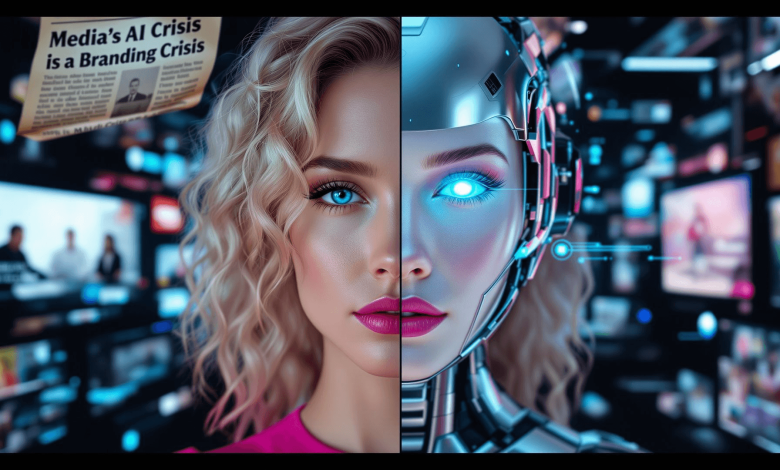
Media companies are suffering from what I call the generic AI voice crisis. You can spot it immediately: the flattened tone, the corporate hedge-speak, the content that could have been written by anyone, anywhere, about anything. It sounds helpful and harmless and utterly forgettable.
Here’s what’s actually happening: organizations are using AI as a crutch rather than a tool. They’re letting it drive their voice instead of amplifying their existing one. The technology amplifies everything—which means your brand identity matters more than ever.
When a news outlet publishes AI-assisted content that sounds like every other outlet, they’ve just automated their way into irrelevance. Audiences don’t just want information; they want it filtered through a recognizable perspective, a consistent voice, a trustworthy presence.
AI should make you more yourself, not less.
What Film Production Knows About AI That Media Companies Don’t
In film production, there’s a moment of truth when you show someone AI-generated footage. Either they believe it belongs in your story, or they immediately clock it as fake. The difference isn’t the quality of the AI tool—it’s whether the footage serves the narrative voice you’ve already established.
Here’s the reality: sometimes the footage you need doesn’t exist. Stock libraries can’t match the specific emotional beat your story demands. Traditional film has solved this problem for decades—actors on green screens, entire worlds built in post-production, environments that never existed outside a render farm. We just called it “special effects.”
My production team trains systems to generate visual content that matches our creative vision. Not generic stock footage. Not “good enough” filler. Content that reflects the aesthetic, pacing, and emotional tone of the project itself. This requires understanding what makes your work distinctive in the first place—and I’ve spent significant time learning how that training process works, even when I’m not the one executing it.
Media organizations often skip this step entirely. They implement AI tools without first defining what makes their editorial voice, their investigative approach, or their storytelling style unique. Then they wonder why their AI-assisted content feels hollow.
The 95% Recursion Advantage
I’ve built content systems that operate at roughly 95% recursion—meaning the AI learns from and reinforces my patterns, preferences, and decision-making frameworks. It’s not generating content from scratch based on general training. It’s extending my thinking, filtered through my values and creative instincts.
This is expensive in time and intention. It requires feeding the system examples of your best work, correcting its missteps, and continuously refining its understanding of what you consider quality. Most organizations aren’t willing to make this investment because they’re still thinking about AI as a plug-and-play efficiency tool.
But efficiency without identity is just faster mediocrity. The media companies winning with AI understand this: automation is cheap, but systems that think like you are priceless.
The Digital Twin Paradox
Here’s where it gets ethically complex. When you create an AI system that genuinely sounds like you—that captures your cadence, your reasoning patterns, your tonal signatures—you’ve created something powerful and potentially dangerous.
I have a digital twin of my voice, and I use it to record audiobooks—my voice, my cadence, available at scale. It’s also a liability. If someone with different values or malicious intent accessed it, they could create content that sounds authentically like me but serves purposes I’d never support. Public figures in media are already targets—from fake Biden robocalls to cloned CEO voices pushing investment scams. Research shows 1 in 4 adults have experienced an AI voice scam, with deepfake-enabled fraud costing an estimated $12.3 billion in 2023.
Yet here’s the paradox: this risk exists whether we use AI or not. Humans have always impersonated, misrepresented, and weaponized the voices of others. AI just makes it faster and more scalable. The answer isn’t to avoid creating authentic digital presence; it’s to build verification systems, establish clear attribution standards, and educate audiences about how to identify legitimate sources.
Media organizations need to get ahead of this. The ones who pretend their content is entirely human-generated while quietly using AI are setting themselves up for credibility collapse when the truth emerges. The ones who transparently establish their AI practices and governance now will own the trust advantage later.
Why This Is Actually About Brand DNA
If you stripped away all the AI tools tomorrow, would your media organization still know who it is? Could it articulate its editorial philosophy, its audience promise, its reason for existing beyond “delivering content”?
Most couldn’t. And that’s the real problem.
AI isn’t creating the identity crisis in media—it’s exposing it. Consider it a diagnostic tool that reveals exactly where your brand strength lives—or doesn’t. Organizations that never developed strong brand architecture are now floundering because AI requires clarity about values, voice, and purpose to be used effectively. You can’t teach a tool to sound like you if you don’t know what you sound like.
Strong media brands are using AI to amplify their existing strengths. Investigative outlets are using it to accelerate research without compromising verification standards. Explainer-focused publishers are using it to generate more accessible versions of complex topics while maintaining accuracy. Opinion platforms are using it to surface diverse perspectives while keeping editorial gatekeeping firmly human.
Weak media brands are using AI to generate volume, chase trends, and fill space—then wondering why their audience engagement is cratering.
The Evolution We’re Actually Living Through
I don’t think AI represents a rupture in media history. I think it’s the next iteration of technology integration we’ve been doing for decades. We used to call it “going digital.” Before that, “using computers.” Before that, “the telegraph.”
Every previous technological shift in media sparked the same fears: job displacement, quality degradation, truth distortion. Every time, the media organizations that thrived were the ones who treated technology as an extension of human capability rather than a replacement for human judgment.
What’s different now is the speed and the uncanny valley effect. AI can mimic human output closely enough to fool many people, which raises the stakes on authenticity, attribution, and accountability. But the fundamental challenge remains the same: stay true to your mission while leveraging new capabilities.
Real value has shifted from information access to intelligent synthesis. Search engines retrieve information. AI systems can integrate, contextualize, and generate insight from that information in ways that match how human experts think. That’s not cheating. That’s evolution.
What Responsible AI Integration Actually Looks Like
After working with these tools extensively, I’ve developed some principles that work across media contexts:
Make it yours. Don’t use AI to sound “professional” or “objective” if that’s not your brand. Train it to amplify your actual voice, including your quirks, your perspective, your edge.
Own your process. Be transparent about where AI helps and where humans decide. Audiences respect honesty more than they punish tool use.
Verify everything. AI is confident and often wrong. Your fact-checking standards should be higher when using AI, not lower.
Protect your assets. If you’re creating digital versions of your voice, style, or brand identity, treat them like you’d treat your physical assets. Control access. Monitor use. Establish ownership.
Stay accountable. If AI-assisted content creates harm, you own it. The “the algorithm did it” defense destroys trust faster than any mistake.
The Question That Determines Who Wins
Every media company has access to the same AI tools. The challenge is identity: knowing who you are clearly enough to use powerful tools without losing yourself in the process.
In Good to Great, Jim Collins documented how Walgreens faced this exact test in the late 1990s. When internet technology exploded, investors panicked that Walgreens was moving too slowly—their stock dropped 40%. But Walgreens stayed clear on their core identity: convenient drugstores maximizing profit per customer visit. They deliberately tested how internet technology could strengthen that concept before scaling. They walked, then crawled, then ran. The result? Walgreens outperformed companies that rushed to adopt technology without strategic clarity.
The organizations that will dominate the next era of media are the ones answering this question right now: “Who are we when we have access to infinite content generation?”
If the answer is “we’re whoever gets the most clicks,” you’ve already lost. If the answer is “we’re the same mission-driven organization we’ve always been, now with better tools to serve our audience,” you’re positioned to win.
Your Brand Identity Is Your Only Defensible Advantage
AI amplifies whatever brand strength you already have. Strong identities become stronger. Weak ones become irrelevant faster.
Here’s what that means practically: when your competitor can generate the same volume of content, at the same speed, with similar quality—your brand voice becomes the only thing audiences can’t get elsewhere. Identity is the differentiator.
The future of media belongs to organizations brave enough to be distinctively, unapologetically themselves—whether they’re writing every word by hand or collaborating with AI systems that have learned to think the way they do.
The technology is neutral. Your brand identity isn’t. That’s where the work actually lives.