Marketing has always evolved alongside technology, but the next shift is not about new channels or new analytics dashboards. It is about the interface itself. Marketers are entering a prompt-first era where they can navigate by expressing their goals in natural language rather than fiddling with complex logic, conditions, and difficult-to-use features.
In this model, marketers no longer need to stress over each step of a campaign. The operational layers that used to require time, tools, and team handoffs are handled by AI agents that understand both context and instructions.
The Traditional Problems with Campaign Workflows
Running a campaign has always involved far more than just writing copy and scheduling an email. It requires research and planning, segmentation, designing, automation setup, approvals, and performance monitoring. Even if you’re limited to just one channel, such as email, the execution cycle typically involves multiple roles: a strategist to define the goal and plan the campaign, a copywriter to write and revise messaging, a designer to build templates, and so on.
While AI has entered this workflow some time ago, it has mostly affected only parts of the workflow. There are AI tools that offer subject line suggestions, predict send times, or automate A/B tests. These features improve portions of the process, but they do not change the overall structure of the work itself. Marketers still move between platforms, export data, configure logic manually, and reconcile performance reports across channels.
The real friction comes from the gaps between each step — moving from planning to production, from production to setup and from setup to reporting. Even when AI speeds up a task, the workflow still breaks at the handoffs, which is where most time, energy, and error accumulate.
From Assistive AI to AI Agents
The next stage of AI in marketing is not another standalone writing assistant or dashboard plug-in. It is the emergence of AI agents: systems that can understand goals, respond to constraints, and run multi-step processes.
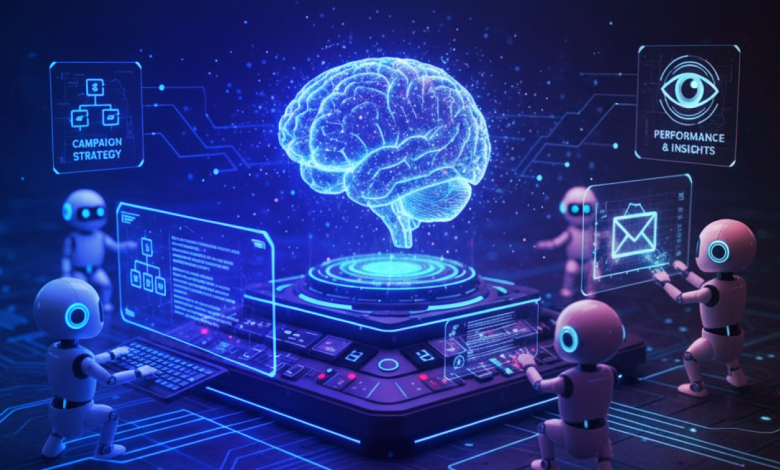
An AI email marketing agent does not wait for repetitive prompts like “write a subject line” or “create a list segment.” Instead of issuing individual prompts, you can give an agent a business objective you want to achieve, and it can generate a full structured campaign plan in response — audience, messaging, sequence, timing, and performance monitoring plan included.
That shift is what changes the role of the marketer. AI stops being just another tool they operate and becomes a teammate they direct and guide.
Planning in an Agent-Driven Model
Planning is one of the areas where agents make the biggest leap. Instead of beginning with a blank document or a spreadsheet, marketers can express the campaign goal in natural language, and the agent can translate it into a structured plan that includes everything that is needed to set up and execute the campaign.
This also removes the need to understand every layer of logic in the system. The marketer does not have to manually configure delays, conditions, or branching logics. Instead, they assess the plan, refine strategy, and approve changes — leaving the assembly to the AI agents.
The impact is not just speed, but iteration. Campaigns can be planned in minutes rather than days, and revisions no longer require restarting work.
Execution Without Manual Assembly
Execution has traditionally been the most resource-intensive phase of campaign work. Even when strategy is clear, turning that strategy into assets and workflows requires multiple tools, skillsets and teams. AI agents change this because they don’t just help create the assets — they also assemble the logic and delivery structure that turns those assets into a functioning campaign.
In a prompt-first system, AI agents can generate email templates, build variations of an email for A/B testing, create segments, and construct complete email journeys. They can apply logic that determines what happens when a user opens or ignores an email, and can edit the structure based on simple feedback from the marketer. So, instead of updating four places in an automation builder, the marketer simply requests a change in natural language.
This eliminates one of the core inefficiencies in digital marketing: the handoff between strategy and implementation. When execution becomes conversational, iteration becomes continuous.
Performance Monitoring and Analysis
The final phase of the campaign lifecycle has historically required dashboards, exports, and interpretation. Even when tools surface metrics automatically, performance data still need to be translated into insights. AI agents collapse that distance by allowing marketers to query results directly, the same way they would ask a colleague.
Questions like “Which segment performed best last week?” or “How did this campaign compare to the March launch?” no longer require digging through dashboards or exporting spreadsheets. Instead of navigating the data, the marketer requests the insight, and the system returns both the metric and the explanation behind it.
Beyond that, AI agents can identify patterns that are difficult to see manually, such as segment-specific fatigue signals or content attributes that correlate with conversion. Rather than waiting for monthly reporting cycles, marketers gain real-time, conversational access to performance intelligence.
The Changing Role of the Marketer
When execution is automated, the marketer’s value shifts from producing assets to defining direction. The core skill is no longer assembling campaigns, but deciding what they should achieve, how they should communicate, and how they should be evaluated.
This does not mean marketers become less technical; the technical skill requirements just shift focus. The skills that rise in importance are strategic clarity, creative judgment, brand voice stewardship, ethical awareness, and the ability to guide AI systems toward the desired outcomes.
The work becomes less about production and more about decision-making.
Why AI Agents Amplify, Not Replace, Human Expertise
Every major wave of automation in marketing has followed the same pattern. When manual tasks are automated, strategy becomes more valuable, not less. When email marketing automation systems emerged, they did not replace marketers — they replaced manual list sends. When programmatic advertising arrived, media teams did not disappear — they moved up a layer into optimization and audience architecture.
AI agents follow the same trajectory. They remove the need for marketers to build every component of a campaign, but they do not replace the human elements that determine whether a campaign resonates. This includes empathy, creative framing, risk judgment, cultural interpretation, and a sense of what “feels” right for the brand.
AI agents handle the how and the execution. Marketers still own the why.
Preparing Teams for the Agent Era
Organizations do not need to rebuild hiring models to prepare for agent-based marketing, but they do need to adapt expectations. The most valuable marketers in this era will be those who can articulate intent clearly, evaluate AI-generated options, and make decisions based on both data and brand instinct.
That requires a shift from tool training to outcome training. Instead of teaching people how to build journeys in a specific platform, teams should focus on how to define a campaign’s purpose, constraints, narrative, and target behavior. AI fluency is not about learning how to prompt, but learning how to frame goals so that the AI models can act on them effectively.
The companies that benefit most from AI agents will not be the ones with the most software, but the ones where humans and systems are aligned in what they are trying to achieve.
The arrival of AI agents does not change the purpose of marketing. It changes the cost structure of executing it. The work that once required multiple platforms, repeated handoffs, and expertise in tools will increasingly be handled by systems that can plan, build, and analyze campaigns from natural-language direction.
What remains human is the leadership: the ability to understand audiences, shape narratives, make ethical choices, and decide what is worth sending into the world. That is not the part of marketing that AI is built to replace. It is the part AI is built to support.
The agent era is not the end of human-led marketing. It is the removal of everything that kept humans from doing the work that mattered most.