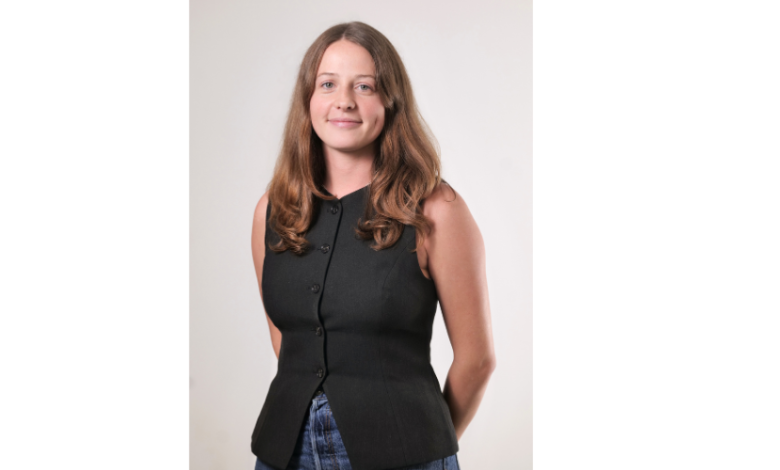
Selling artificial intelligence into an American hospital is not simply a matter of proving the technology works. Margaux Benoit learned that quickly. A product can impress in a demo, save physicians time, and still face a long road through procurement, compliance, clinical leadership, information technology, finance, and the habits of people who have already lived through enough software promises to be cautious.
For Benoit, that was the assignment from the beginning. She became the first US commercial hire for Nabla, a French AI company entering a market already crowded with American competitors. The company’s product helps automatically capture medical documentation by listening during a patient visit and generating the clinical note, reducing the time doctors spend typing after appointments. Benoit’s role was to build the American commercial operation around that promise, without a ready-made playbook to follow.
“When you enter the US as a European healthcare company, you cannot assume the market will meet you halfway,” Benoit says. “You have to understand how hospitals make decisions, what they are afraid of, and what proof they need before they trust you.”
She moved from Paris to New York to help build that trust. The work was not only selling. It meant creating the commercial foundation itself: pricing, pilot infrastructure, onboarding, and the sales process that would carry the company from its first American customers to enterprise conversations with major health systems. Today, Benoit runs deals with organizations including CHLA, Denver Health, Aultman Health, Carle Health, BronxCare Health System, and University of Toledo.
That rise came at a strange moment in healthcare technology. Ambient AI documentation moved quickly from curiosity to crowded category after ChatGPT changed how executives, clinicians, and vendors talked about artificial intelligence. Large health systems began taking the technology seriously, but that did not make buying decisions simple. The conversation shifted from whether ambient documentation could work to which vendor could be trusted inside complex clinical environments.
Benoit supported seeing that shift from the field.
“Health systems are not buying a note-taker in isolation,” she says. “They are asking whether this can fit into the way their physicians practice, the way their EHR works, and the way their organization measures value.”
That is why her background matters. Benoit did not begin in sales. She started in science, studying areas including biology, cancerology, and neurology during her Erasmus experience, then working in a lab at INSERM during her first internship. She later earned a BSc in Life Sciences Engineering and an MSc in Bioscience Entrepreneurship from UCL. Before joining Nabla, she co-founded Pharmatch during her time at X-HEC Entrepreneurs, an extremely selective program.
The scientific foundation gave her a different way into enterprise sales. She was not only learning how to run a deal. She was learning how to explain a clinical technology to people who cared about whether it would survive contact with real medical practice.
“I I don’t believe in being separated from the product,” Benoit says. “In healthcare, you cannot sell honestly if you do not understand what the clinicians are actually doing every day.”
That approach became especially important because US healthcare buyers do not evaluate new technology only on ambition. They want evidence. They want references. They want to know whether the vendor understands Epic, Cerner, clinical workflows, specialty documentation, privacy concerns, procurement cycles, and the politics of adoption across a large system.
For a French company, the challenge was even sharper. A product that worked in Europe did not automatically carry credibility in the United States. Benoit had to help translate the company’s value into a market where buyers expect US use cases, US operational support, and a commercial team that can stay present after the sale.
“You are not just adapting the product,” she says. “You are rebuilding the go-to-market motion for a different healthcare system.”
The category itself was changing while she was building. US competitors are strong during procurement conversations while Epic’s own product added another layer of pressure for health systems already deeply tied to Epic. The market became more competitive, and the standards rose. Physicians want documentation that feels natural to their specialty. CMIOs want integration depth. CFOs want proof that adoption could affect more than satisfaction scores.
Benoit’s work required her to sit across all of those concerns. She has run competitive displacement deals and seen firsthand what makes a health system choose one vendor over another. The answer, in her view, rarely comes down to the demo alone.
“A demo can get attention,” she says. “The harder part is showing that the product can be deployed, adopted, measured, and renewed inside a real hospital.”
That is where her commercial role expanded beyond closing contracts. Benoit stayed close to onboarding and implementation, working with clients after the sale and building relationships with hundreds of physicians across the United States. She understood that a hospital does not adopt AI because one enthusiastic doctor likes it. The product has to earn its way into daily behavior.
That closeness also helped her understand why US expansion is so difficult for foreign healthcare startups. The product may be strong. The clinical use case may be clear. But American health systems want to know whether the company understands their specific workflows, regulatory concerns, procurement habits, and internal politics. Trust has to be built in the room, not assumed from outside it.
“Selling into US healthcare teaches you humility,” Benoit says. “You can be proud of the technology and still have to prove yourself one conversation at a time.”
Still, she describes herself less as a commentator than an operator. Her authority comes from the work of building a market: walking into cautious health systems, earning references, adapting the sales motion, and staying close enough to the product to understand where adoption succeeds or breaks.
“Entering the US market can look glamorous from the outside,” she says. “The reality is much more practical. You have to be useful, consistent, and patient long enough for trust to form.”
For Margaux Benoit, the story is not only that a French AI company found customers in the United States. It is that building a US market in healthcare requires more than a strong product and a bold expansion plan. It requires a team willing to learn how hospitals actually buy, how clinicians actually work, and how trust is built one deployment at a time.