Across industries, organizations are racing to deploy artificial intelligence. Yet despite billions in investment, many AI projects never make it past the pilot phase. The problem rarely lies in the algorithms themselves; it lies in how organizations approach data and strategy.
Too often, AI initiatives fall victim to what I call “frozen yogurt syndrome” – too many choices without alignment to what truly matters. Like a self-serve frozen yogurt bar, organizations load up on every flavor of technology, tool, and model, only to end up with a swirl no one really wants.
The result is fragmented architectures, inflated costs, and stakeholders asking, “What did we actually achieve?”
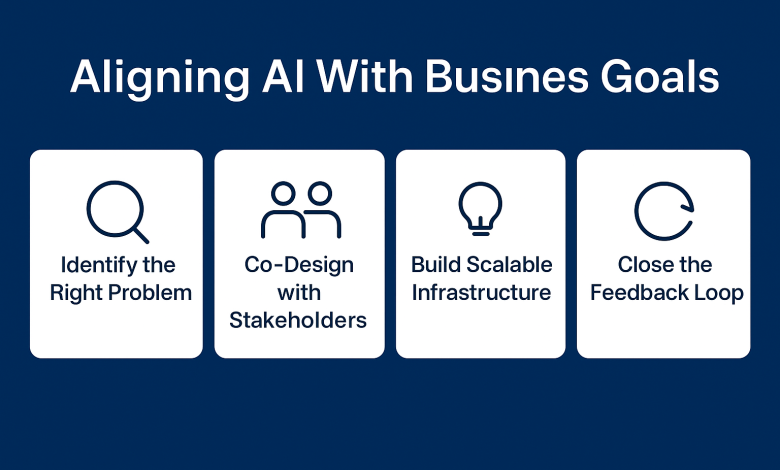
To make AI work, data strategy must begin and end with business value. Success depends on four core pillars: problem identification, co-designed strategy, scalable infrastructure, and feedback loops.
A Lesson from Zillow: When AI Outpaces Strategy
A few years ago, Zillow’s initiative became a high-profile example of what happens when AI strategy runs ahead of business alignment. Zillow used machine learning to predict home values and make cash offers at scale, but the initiative ended in losses exceeding $500 million, and the company shut it down in late 2021 (Inside AI News).
The problem was not the sophistication of the models; it was the lack of a feedback-driven strategy. The algorithms were optimized on historical pricing data that did not account for shifting market dynamics, operational limits, or the speed of on-the-ground decision-making. Without continuous calibration or human-in-the-loop governance, the models made decisions faster than the organization could interpret or correct them (AI Journal).
The takeaway is clear: AI cannot substitute for strategy. A model’s accuracy means little if it is not grounded in real-world feedback, operational context, and business purpose.
- Start with the Right Problem
AI does not fail because it is too advanced; it fails because it is misapplied. Before thinking about models or infrastructure, organizations must define the right problem to solve.
This means asking: What decision are we trying to improve? How will success be measured? Who will use this insight, and how?
Effective AI strategies begin with a business problem framed as a decision problem. For example, instead of saying “we need a churn model,” the better question is, “how can we proactively retain our most valuable customers?”. The second framing naturally ties data work to measurable outcomes such as retention rate, revenue, and customer satisfaction.
This ensures AI is not a technology experiment but a business intervention with a clear purpose.
- Co-Design the Strategy with Stakeholders
Many AI projects fail because strategy is designed in isolation, either by data teams without business input or by business leaders without technical grounding.
The antidote is co-design. Bring data scientists, engineers, and domain experts together early to jointly define the problem, the data needed, and the desired outcomes.
This collaborative approach builds shared ownership and prevents the “throw-it-over-the-wall” dynamic between business and IT. It also ensures the AI solution is usable, interpretable, and trustworthy from the start.
When stakeholders co-create the strategy, adoption increases dramatically. People trust what they help build.
- Build Scalable, Adaptable Infrastructure
Once the problem and strategy are clear, the next step is to ensure the organization can scale solutions sustainably. Too many teams rush into AI with siloed data, ad hoc tools, and manual workflows. They might get a proof of concept running, but when asked to scale it to thousands of customers or millions of records, it breaks.
Scalable infrastructure means data platforms that are unified, automated, and interoperable. It also means implementing governance structures such as metadata management, lineage, and versioning that keep models and data assets reliable over time.
AI systems are only as good as the infrastructure supporting them. The most successful organizations treat data engineering, MLOps, and governance as strategic enablers, not afterthoughts.
- Close the Loop with Continuous Feedback
Even the best AI models degrade over time. Markets shift, customer behavior changes, and new data emerges. Without feedback loops, organizations fall into a “deploy and forget” cycle.
The final pillar of an effective AI strategy is establishing mechanisms for continuous learning, not just for the models but for the organization itself.
This means tracking performance metrics, collecting user feedback, and adjusting both the model and the process as conditions change. It also means evaluating whether the solution continues to deliver the intended business outcomes.
Feedback loops transform AI from a one-time project into a living capability that evolves with the business it serves.
From Experimentation to Impact
The organizations that succeed with AI are not necessarily those with the largest budgets or the most advanced algorithms. They are the ones that align data strategy with business intent.
When you identify the right problems, co-design solutions, build scalable foundations, and embed continuous feedback, AI becomes more than a technical asset; it becomes a strategic one.
The “frozen yogurt syndrome” disappears when every choice is anchored in purpose.
AI works not when it is flashy or new, but when it is relevant, trusted, and tied to measurable outcomes. That is how data becomes intelligence, and intelligence becomes impact.