Team Led by John Heymach, MD, PhD receives $1.5 Million grant
NEW YORK, May 12, 2026 /PRNewswire/ — The Lung Cancer Research Foundation (LCRF) announces the first recipients of its LCRF | Boehringer Ingelheim Team Science Award on Innovative Therapeutic Strategies to Understand and Treat Lung Cancers Harboring HER2 Mutations. The project, “Integrated molecular, structural and clinical studies to characterize and develop therapeutic approaches for tyrosine kinase inhibitor resistance and drug tolerant persister cells (DTPCs) in HER2 mutant non-small cell lung cancer (NSCLC)” was made possible by a research collaboration with Boehringer Ingelheim.
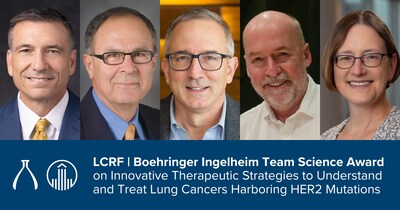
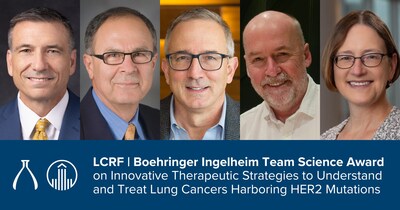
John Heymach, MD, PhD, will be the lead investigator on this project. Dr. Heymach is Professor, Thoracic/Head and Neck Medical Oncology and Chief, Section of Thoracic Medical Oncology at University of Texas MD Anderson Cancer Center. Joining him on the team is his colleague, Samir M. Hanash, MD, PhD, Professor, Department of Clinical Cancer Prevention- Research and Department of Molecular Pathology at University of Texas MD Anderson Cancer Center, Michael Eck, MD, PhD, Professor of Biological Chemistry and Molecular Pharmacology at Harvard Medical School, John W. Lawson, PhD, Computational Materials Group Leader at NASA Ames Research Center, and Heidi Greulich, PhD, Senior Group Leader, Institute Scientist at Broad Institute of MIT and Harvard.
Lung cancer is the leading cause of cancer-related death worldwide. A subset of patients with non–small cell lung cancer (NSCLC) have tumors driven by mutations in a gene called HER2. While recent approvals of HER2-targeted tyrosine kinase inhibitors (TKIs) have represented major progress, most patients eventually relapse because their tumors develop resistance to their current treatment. The team’s project seeks to understand why resistance occurs and to develop new strategies to overcome it, with the goal of delivering more lasting and effective treatments for patients with HER2-mutant lung cancer.
Lung cancers harboring HER2 mutations represent one of the most challenging subsets of oncogene-driven non–small cell lung cancers (NSCLC) to treat. Despite recent approvals of HER2-directed tyrosine kinase inhibitors (TKIs) and antibody–drug conjugates (ADCs), therapeutic benefit is often transient. Patients with HER2 mutated lung cancer often stop responding to treatment for two related reasons: the cancer’s HER2 protein changes shape so the drug can no longer attach to it, and the cancer finds entirely new ways to survive that don’t involve HER2 at all. Tackling both problems at once requires scientists from multiple fields, including drug design, cell biology, computer modeling, and immunology, to work together.
The research team brings together investigators with complementary expertise to systematically address these challenges in two distinct projects, utilizing the latest technological advances, including AI, in an innovative approach. The first project will apply deep mutational scanning, structural biology, and computational modeling to comprehensively define resistance mutations within HER2 and develop a predictive structure of TKI response to HER2 primary and resistance mutations. The second project will comprehensively characterize the landscape of HER2-independent resistance to HER2 TKIs and develop novel cellular therapies and T-cell engagers against drug-tolerant persister cells (DTPCs) and drug resistance cells (DRCs). This will identify candidate therapeutic targets and test efficacy of therapies which, if promising, could move into a phase 1 clinical trial.
“By analyzing tumor models and patient samples from before treatment, during minimal residual disease and at the point of resistance, we will be able to identify changes in gene expression, cell identity, and cell surface proteins,” says Dr. Heymach. “The resulting data will then be tested, and if the approaches work well in the lab and animal studies, the results will directly support a doctor-led clinical study, which will get us that much closer to additional options for patients whose tumors harbor HER2 mutations.”
“These projects represent the best kind of collaboration between laboratory and computational science,” remarked Antoinette Wozniak, MD, FASCO, Chief Scientific Officer for LCRF. “The hope is to arrive at viable answers more quickly, and these investigators are among the best in their fields.”
“We’re proud to support research through collaborations that help advance new approaches for some of the hardest-to-treat cancers and address areas of significant unmet need,” said Emmanuelle Clerisme-Beaty, Medical Director US, SVP Medicine at Boehringer Ingelheim. “By working together, we can help accelerate progress in cancer research, and we congratulate the Team Science grant recipients for the important work they are leading to improve patient outcomes now and in the future.”
To learn more about this award and the project, visit LCRF.org/2025her2teamscience.
About the Lung Cancer Research Foundation (LCRF)
The Lung Cancer Research Foundation® (LCRF) is the leading nonprofit organization focused on funding innovative, high-reward research with the potential to extend survival and improve quality of life for people with lung cancer. LCRF’s mission is to improve lung cancer outcomes by funding research for the prevention, diagnosis, treatment, and cure of lung cancer. To date, LCRF has funded 450 research grants, totaling nearly $53 million, the highest amount provided by a nonprofit organization dedicated to funding lung cancer research. For more information about the LCRF grant program and funding opportunities, visit lcrf.org/research.
About Boehringer Ingelheim in Oncology
We have a clear aspiration – to transform the lives of people with cancer by delivering meaningful advances, with the ultimate goal of curing a range of cancers. Boehringer Ingelheim’s generational commitment to driving scientific innovation is reflected by the company’s robust pipeline of cancer cell-directed and immuno-oncology investigational therapies, as well as the smart combination of these approaches. Boehringer’s ambition in oncology is to take a diligent and broad approach, creating a collaborative research network to tap into a diversity of minds, which is vital in addressing some of the most challenging, but potentially most impactful, areas of cancer research. Simply put, for Boehringer Ingelheim, cancer care is personal, today and for generations. Cancer | Boehringer Ingelheim
Contact:
LUNG CANCER RESEARCH FOUNDATION (LCRF)
Sheila Sullivan, Sr. Director, Marketing & Communications, [email protected]
 View original content to download multimedia:https://www.prnewswire.com/news-releases/lung-cancer-research-foundation-grants-team-science-award-focused-on-understanding-and-treating-lung-cancers-with-her2-mutations-302768793.html
SOURCE Lung Cancer Research Foundation