Most investors, whatever stage company they’re looking at, will tell you they don’t invest in products or business plans; they invest in founders. And most investors pride themselves on their ability to spot talent and what it takes to scale and lead a successful company.
During the 30 years that I have invested in software companies in Europe, I have witnessed how the technology of the moment impacts what kind of founder will thrive. The rapid explosion of AI applications has created an entirely new environment, and I suspected that this is shaping different founder archetypes. After analysing a large dataset, my hunch was confirmed: the types of founders who will succeed in this AI environment will be quite different from the ones that came before, and investors need to refresh their pattern recognition urgently. Although the signals for founder talent are changing rapidly, there are some constants that will always remain – even in this dynamic environment.
Before and after AI: dividing founders into B2B SaaS or AI/ML
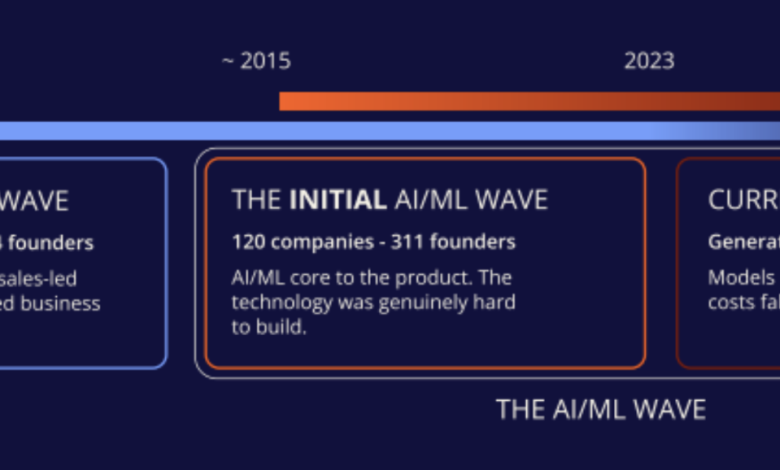
To understand this pattern, I assembled a dataset of 645 founders across 270 successful companies. They were broadly divided into two waves: business to business software as a service (B2B SaaS), and the artificial intelligence/machine learning (AI/ML) wave. B2B SaaS companies leveraged cloud technology to offer subscription-based, sales-led software that digitised business processes. The AI/ML wave came later, where artificial intelligence and machine learning was core to the product.
The AI/ML wave has two parts (the initial AI/ML wave and the current wave), with the launch of ChatGPT in late 2022 heralding the era of generative and agentic AI applications.
The AI/ML wave dramatically shifted founder credentials
There was a notable shift in the backgrounds of founders between the waves, with the PhD rate tripling. The portion of founders with PhDs was 6% in the SaaS wave, and this had jumped to 18% in the AI/ML wave. Meanwhile, MBAs slightly lost their lustre in the same period, with the portion of founders with an MBA dropping from 14% in the SaaS wave to just 4% in the AI wave.
These findings make sense, given the dominant technology of the time. With SaaS, companies (like Salesforce, Xero and Wix, for example) used cloud technology to make businesses more efficient, and scaled up by selling subscriptions. Founders typically knew their industries well and needed operational and business knowhow to get there. In the AI wave, that changed because the products needed a deeper level of technological expertise, hence why many founders had a research background. For successful SaaS companies, the bottleneck was commercial; with AI, it was technical.
The data clearly shows the SaaS wave rewarded the MBA and the initial AI/ML wave rewarded the PhD. That is set to change, however, with the current wave where generative and agentic AI tools are enabling non-technical founders to build software. The indicative data from this subset of companies in the current wave shows that the necessity of the PhD is already waning. Only 12% of founders in the current generative and agentic AI wave have PhDs, compared to the 18% for the broader AI/ML wave. The rate of founders with an MBA appears to be holding steady in the AI era, however, even though it dropped between the SaaS and the AI/ML wave.
AI founder talent gravitates toward the best universities
Although the credentials of founders shifted in the AI/ML wave, the calibre of their education has not. In fact, more AI founders attended top global universities such as MIT, Stanford, Oxford and Cambridge. It was a dramatic increase, with 61% of founders attending the best universities in the AI/ML wave, compared to 37% in the SaaS wave.
An interesting note here is that these founders attended university, but many didn’t finish their courses. There were quite a few dropouts and the trend was noticeable in the agentic and generative AI companies. The dropout rate was 4% for the whole AI/ML cohort, but this increased to 12% for the subset in the current wave (i.e. those that were founded after the launch of ChatGPT). Five of the 43 post-2023 founders dropped out, opting to move quickly and build a moat. In an era where speed is of the essence, there is no time to lose.
Although these founders aren’t reaching the graduation ceremony, certificate in hand, the environment that cutting-edge research institutions provide is significant. Clusters of talent form at the best universities so that would-be entrepreneurs can mingle with potential co-founders, future employees, and also attract investor attention.
Successful European and UK companies come to the fore
In the decades that I have been investing and scaling up software companies, I have always believed that the UK and Europe had the talent and product excellence to rival the US. Back in the SaaS era, however, it was the received wisdom that founders had to move to Silicon Valley to make it big. Over the years I have witnessed Europe and the UK emerge and develop a vibrant ecosystem that attracts the capital needed to succeed.
I’m personally delighted to see this trend confirmed in the data, with the UK and continental Europe increasing their share of successful companies. In the SaaS era, the UK accounted for a mere 1% of successful companies. That has now increased to 12% in the AI/ML wave. And for continental Europe, the figures jumped from 5% of successful companies to 10% in the AI wave. This has been a long time coming. This region has world-class universities for AI teaching and research, and founders have proximity to the industries that will be transformed by AI.
Investors need to adjust their talent radar for the future
In this current wave of generative and agentic AI, we are witnessing a Cambrian explosion [ https://www.oxx.vc/industry-perspectives/macro-capital-markets/the-state-of-software-2026-why-this-is-our-cambrian-moment/ ] of innovation in the application layer, where AI tools are easily accessible. This makes it easier for a seasoned operator in a particular industry, without any technical know-how, to build a software company that solves a particular problem they have observed in their careers. This deep domain expertise, and the ability to effectively use AI to transform a particular process or workflow, will be one of the keys to success in the future.
Each wave has rewarded a certain type of founder. The SaaS wave rewarded the domain-rich operators, the initial AI/ML wave rewarded researchers and technical depth. The next generation will likely reward something different altogether: the ability to see where AI intersects with real problems, the ability to execute at speed, and the self-awareness to assemble the right team. After all, it is not just the founders that predict success, but also the people who back them. For investors, it is clear that the signals that have been relied upon so far have changed. Now is the time to refresh the pattern recognition and adjust the radar for spotting the next wave of founder talent.
The original research can be found here: https://www.oxx.vc/wp-content/uploads/2026/05/Whitepaper_Who-will-build-the-next-wave-of-breakout-companies_web.pdf