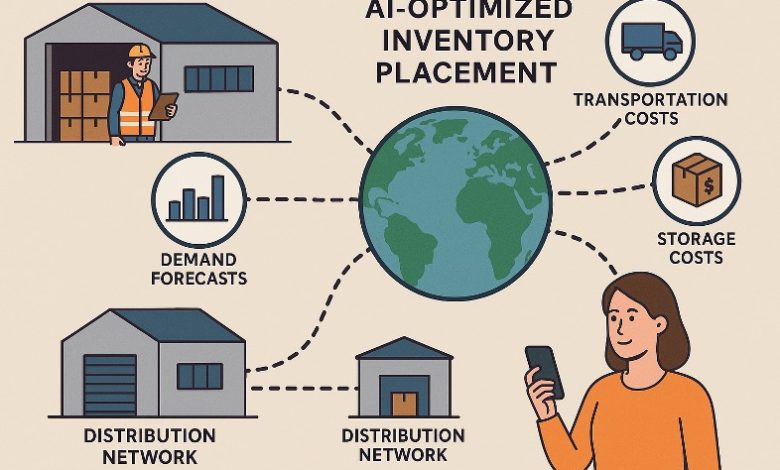
In a world where AI can predict when you’ll run out of toothpaste, or decide to host a last-minute BBQ, inventory stops being static. It becomes a living, learning system that adapts in real time. This article explores how inventory is evolving into a predictive, self-correcting network, one that moves ahead of demand instead of reacting to it.
From Static Warehousing to Intelligent Flow
Inventory has always been a balancing act. Holding too much locks up capital and space, while holding too little leads to missed sales and poor customer experience. To manage this uncertainty, businesses built buffers, safety stock, regional warehouses, and markdown strategies. These approaches help absorb variability, but they don’t eliminate it.
At its core, traditional inventory management is reactive. Companies respond to demand signals only after they appear. That model is now being challenged by systems that can anticipate demand before it materializes.
Demand That Doesn’t Surprise You
Traditional forecasting relies heavily on historical data. While useful, past behavior often fails to capture rapidly changing consumer intent. AI introduces a new paradigm: predictive demand sensing. Instead of asking what sold before, systems estimate what is likely to be needed next.
These models incorporate a broader set of signals, including browsing patterns, search behavior, weather changes, local events, and macroeconomic indicators. Research from the MIT Sloan School of Management highlights how companies are already mapping behavioral signals to purchasing outcomes to improve demand prediction. In this model, demand is no longer a surprise event. It becomes a continuously updated probability distribution that guides inventory decisions.
Where Inventory Lives Is Changing
If demand becomes more predictable, inventory placement must evolve accordingly. Traditional supply chains rely on centralized distribution models that optimize for scale but not always for responsiveness. In a predictive system, inventory is distributed closer to expected demand. This includes micro-fulfillment centers, store-based fulfillment, pickup lockers, and mobile inventory embedded in delivery fleets.
Supply chains are increasingly shifting toward dynamic inventory positioning, where stock is continuously reallocated based on real-time signals. As a result, inventory no longer sits idle in fixed locations. It flows through a network that adapts continuously to changing demand patterns.
Inventory as a Dynamic System
Once inventory becomes fluid, the network behaves differently. Instead of fixed supply chains, companies operate adaptive systems that continuously rebalance themselves. If demand spikes in one region, inventory is repositioned before orders are even placed, while delays in one node are absorbed by alternative fulfillment paths. Excess inventory is redirected, dynamically discounted, or matched with nearby demand in real time. This model resembles a network of connected nodes rather than isolated warehouses. Each node communicates, adjusts, and contributes to overall system efficiency.
Cost and Speed Are No Longer Opposites
For decades, supply chains operated under a fundamental tradeoff: faster delivery came at a higher cost. Expedited shipping, redundant inventory, and reactive labor planning all contributed to rising expenses. Predictive inventory systems challenge this assumption. When products are pre-positioned near anticipated demand, fulfillment becomes both faster and more efficient.
Transportation distances shrink, labor becomes more predictable, and operational waste declines. Gartner has identified AI-driven, decentralized inventory networks as a key enabler of this shift. Speed and cost, once competing priorities, begin to align.
The Rise of Self-Healing Supply Chains
Traditional supply chains are often fragile. A single disruption, such as a delayed shipment or warehouse outage, can cascade across the network. AI-driven systems introduce resilience through continuous monitoring and real-time decision-making. These systems detect anomalies early and adjust inventory flows dynamically. Orders can be reassigned, inventory can be rerouted, and priorities can shift based on real-time conditions.
According to insights from ProcureCon 2025, a majority of procurement leaders are actively investing in AI-enabled orchestration to support autonomous decision-making. Supply chains are evolving from execution systems into intelligent, adaptive systems.
Rethinking Returns and Excess Inventory
Returns and excess inventory have traditionally been treated as inefficiencies. Products often move backward through the supply chain, incurring additional handling and storage costs. In a predictive model, these flows are reimagined. Returned items can be reintroduced into nearby demand zones instead of being sent back to centralized warehouses.
Excess inventory can be dynamically matched with local demand, discounted intelligently, or redistributed across the network. The goal is to minimize idle inventory and maximize utilization across the system.
A World Without “Out of Stock”
The vision of predictive inventory is not perfection, but precision. Out-of-stock situations may still occur, but they become significantly less frequent and more predictable. Instead of reacting to shortages, systems anticipate and prevent them. Shelves become leaner, but more accurate. Fulfillment networks adapt in real time, aligning supply with expected demand. Inventory becomes less about storage and more about timing.
In this world, inventory transforms from a static asset into a continuously optimized system.
Final Thought
For decades, supply chains were designed to respond. Today, they are being redesigned to anticipate. This shift changes how inventory is managed, how networks are structured, and how value is created. The companies that succeed will not necessarily be the ones with the largest infrastructure. They will be the ones with the most intelligent flow of goods. Because in a predictive world, the advantage is not having inventory. It is having it in the right place, at the right time, before anyone asks for it.