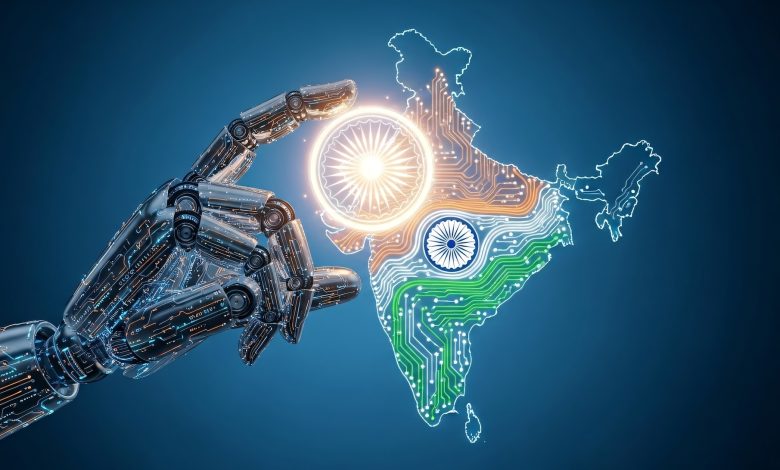
Artificial intelligence is moving rapidly from experimentation to real-world deployment, but few markets are seeing this at the scale and speed of India. Drawing on his work with Indian innovators, Jai Mallick, MD of Intralink India, explores why the country is emerging as a critical environment for building, testing and scaling AI systems.
Artificial intelligence is reshaping our world, bringing a wide array of efficiencies and opportunities alongside concerns about risk and uncertainty. While many markets are still debating its long-term promise, India is already focused on implementation.
I see this shift not just in policy or investment announcements, but in everyday conversations with founders, enterprises and leaders across the country. It was also evident at the AI Impact Summit in New Delhi earlier this year, where Ruby Sinha, President of the BRICS Chamber of Commerce & Industry Women Empowerment Vertical, explained that India had moved beyond the “wow phase” and “how phase” into the “execution and impact phase”.
This transition is particularly compelling for international technology companies considering where to design, build, test and scale the next generation of AI products. India is no longer simply a destination for outsourced development. Increasingly, it’s a market where AI systems can be developed, deployed and validated at scale.
The foundation: decades in the making
India’s position is the result of decades of development. In the 1990s and 2000s, companies such as Infosys, Tata Consultancy Services and Wipro established the country as a global IT services hub, embedding Indian engineers within the operations of major international corporations.
This created a workforce experienced in complex enterprise systems and built a foundation that’s difficult to replicate. By the time AI emerged as an industrial force, India already had the essential ingredients: talent, delivery capability and deep institutional relationships.
The next step is to build on this base. Manan Suri of IIT Delhi has highlighted the shift from India’s traditional role as an AI services provider towards becoming an original equipment manufacturer for AI systems.
AI systems in action
What stands out to me today is how operational the AI conversation has become. Across sectors including manufacturing, agriculture and financial services, the focus is no longer on pilots but on systems running at scale.
India’s digital public infrastructure provides a strong example. The Aadhaar identity system and UPI payments network generate large volumes of real-world data, enabling new approaches to credit scoring, service personalization and logistics optimization.
Physical infrastructure is also evolving. Harish Krishnan, Managing Director of Cisco Systems India, notes that while India produces nearly 20 per cent of global data, it accounts for only around 4 per cent of data centre capacity. Investment is increasing to address this gap, supported by government efforts to accelerate development.
Meanwhile, a new generation of startups is emerging. Ranganath Sadasiva, CTO of Hewlett Packard Enterprise India, has described this as a shift “from experimentation to acceleration”. These companies are developing India-specific innovations, including voice interfaces for non-English speakers, sovereign language models and agricultural tools tailored to local needs.
Why India appeals to global AI companies
India is an attractive environment for international AI firms. A key advantage is its role as a testing ground: solutions that work across India’s diversity, infrastructure constraints and scale are likely to succeed globally.
The country has also shown it can deploy technology nationwide at speed. At the AI Impact Summit, Sunil Gupta, CEO of Yotta Data Services, highlighted the rapid evolution of India’s AI ecosystem, including advances in domestic infrastructure and the emergence of sovereign AI models. As he put it, “Across the stack, India has come a long way.”
Demographics strengthen its position. India has one of the world’s largest populations aged between 15 and 29, many actively adopting AI tools. The culture of frugal innovation remains strong, and startups are willing to experiment quickly.
Their experimentation is now supported by a maturing funding ecosystem, producing founders capable of competing globally.
The next phase: infrastructure, policy and responsibility
Scaling AI systems is less about technology and more about infrastructure. The Indian government is investing heavily in AI programmes and semiconductor development to support growth.
Initiatives such as the IndiaAI Mission are expanding access to GPU infrastructure through shared platforms like IndiaAI Compute, enabling startups, researchers and enterprises to build and deploy models easily. Recent budget allocations are expected to drive further investment in cloud and data centre capacity.
At the same time, policymakers are addressing the broader implications of AI adoption. Kishore Balaji, Executive Director at IBM India, notes that AI is reshaping education, employment and earnings. He has emphasized the need for public–private partnerships and large-scale skills programs to prepare the workforce.
He’s also stressed the importance of aligning with global frameworks, positioning India not only to serve domestic needs but to contribute internationally.
A defining moment
For international companies willing to engage as partners rather than service buyers, the opportunity is clear. India combines scale, talent, real-world data and an increasingly supportive policy environment.
From what I’m seeing on the ground, this is India’s AI moment: a shift from experimentation to real-world impact at scale.
About the author
Jai Mallick is the MD of Intralink India, a business development consultancy that helps companies to secure customers, partners and investors in overseas markets. Jai previously worked at Barclays International and Foresight Group and is experienced in raising capital, developing go-to-market strategies and international partnership development. He’s a Chartered Financial Analyst and holds an MSc from Imperial College London. He can be contacted at [email protected]