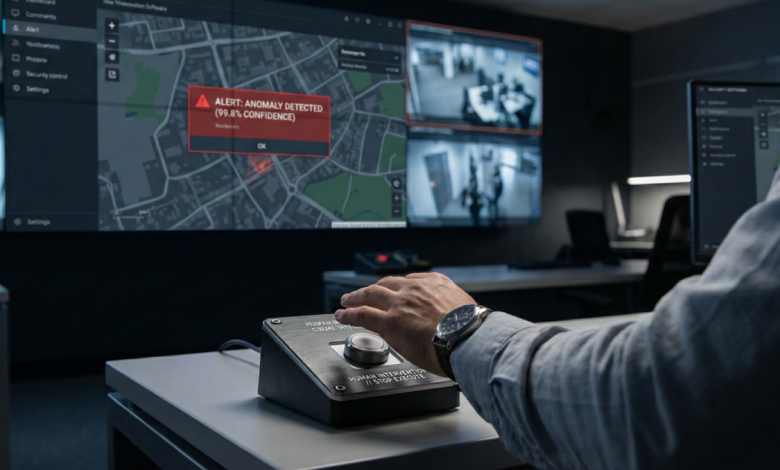
Let’s enter a Global Security Operations Center. The room is cool, dimly lit by the glow of a video wall that spans fifty feet. The only sound is the low hum of cooling fans and the rhythmic clicking of a mouse. On the screen, an algorithm simultaneously processes camera feeds, scanning for anomalies that the human eye might miss due to sheer volume. Suddenly, a dashboard turns red. A bounding box locks onto a figure near a restricted perimeter.
The system flashes a metric: “Intruder Detected. Confidence: 99.8%.”
The machine is successful. It has identified a pattern that matches its training data. But as the operator zooms in, the context shifts. What the algorithm has labeled as an intruder is a tired maintenance technician taking a shortcut, badge visible but not swiped.
Technically, the AI is correct. But operationally, it is wrong; there is no threat.
The algorithm had 1 in 500 odds of being incorrect, yet here we are. If this system were fully autonomous, it might have triggered a facility lockdown or dispatched law enforcement, a faster response, but a disastrously expensive one.
This moment illustrates a misconception in business: that higher-accuracy metrics in a model translate directly into better operational decision-making. Critics argue that keeping humans in the loop creates a bottleneck, that biological decision-making is too slow for machine-speed threats (are autonomous cars safer than humans in that sense?). AI indeed excels at velocity, scale, and pattern detection. It can watch ten thousand feeds without blinking. But humans excel at context, accountability, and consequence.
Organizations today should not chase fully autonomous systems to replace human judgment. They should use a Human-in-the-Loop (HITL) architecture to augment Humans. This approach is about acknowledging that when systems encounter ambiguity, undefined escalation paths, or potential for unintended consequences, the responsibility must return to a human agent.
Where AI Must Stop, and Human Judgment Must Intervene
To build a resilient operational framework, we must define automation’s boundaries without becoming anti-technology. The fundamental limitation of AI, regardless of whether it is diagnosing a patient or monitoring a supply chain, is its inherently backward-looking nature. It is trained on historical data, existing patterns, and defined rules.
The point being: AI is optimized for known patterns and struggles with novel intent.
Let’s explore this deeper in High-stakes environments. Let’s think of a hospital triage unit, a financial trading floor, or a critical infrastructure control room. High-stake Environments are defined by characteristics that inevitably confuse algorithmic logic:
- Incomplete Information: In crisis scenarios, leaders rarely have a “clean” data set. They must bridge the gap between what is known and what is necessary.
- Rapidly Shifting Conditions: The baseline for “normal” can change in minutes. A sudden market crash, a natural disaster, or a grid failure creates a new reality that the model has never seen before.
- Human Behavior that Defies Precedent: People under stress, whether they are customers, patients, or employees, do not act in ways that align with clean training data.
If we allow fully autonomous decision-making in these scenarios, we introduce risk. A system might justify an action that is efficiently correct but operationally disastrous.
Anchor Insight: Human intervention isn’t a failure of AI; it is a critical control mechanism. The strongest systems explicitly define where automation hands off, not where it replaces judgment. The goal is not to have the AI decide, but to have the AI curate the information so the human can decide faster and more accurately.
Why Context Matters More Than Confidence Scores
One trap in enterprise today is the over-reliance on probabilistic outputs, specifically, “confidence scores.” When a predictive model flags an event with a “95% Confidence Score,” it creates an illusion of certainty. Operational leaders often interpret this as a 95% chance that the prediction will come true and require an immediate response. But high confidence does not equal high relevance.
AI outputs are shaped by their training data, historical assumptions, and static rulesets. These are rigid frameworks. They lack the fluidity of Context. Context includes the intangible factors that AI struggles to interpret, such as:
- Situational Nuance: Is the sudden spike in transaction volume a sign of money laundering, or a viral marketing campaign that just succeeded? Is the employee running through the warehouse fleeing an accident, or rushing to fix a critical error?
- Environmental & Systemic Factors: Determining whether a sensor alert in a manufacturing plant is a critical machinery failure or simply the result of a temporary power fluctuation or weather affecting the sensor.
- Reputational & Relationship Risk: Understanding that a strictly “by-the-book” automated response to a policy violation might save money in the short term but cost the company a ten-year client relationship.
Consider a predictive logistics system for a global supply chain. A model may be 92% confident that a specific route is the most efficient path for a critical shipment, saving 40 minutes. It automatically reroutes the fleet. However, that confidence score does not reflect the reality that the “efficient” route passes through a district currently experiencing a flash protest, an event too recent to be in the training data. An autonomous system sends the trucks into a gridlock. A human in the loop reviews the local news and overrides the optimization to ensure the delivery arrives on time, as your business promised.
Early Framing of Responsible AI in Practice
Moving from philosophy to practice requires us to stop viewing “Responsible AI” as a compliance exercise. Responsible AI needs to be seen as an operational resilience strategy. It begins with establishing Clear Decision Thresholds. Let’s define this as digital guardrails that define exactly where the algorithm’s authority ends and human discretion begins. In a command center, these thresholds act as a “circuit breaker,” forcing the system to pause during critical anomalies and hand control to a person. This ensures Defined Accountability.
This architecture fundamentally transforms the role of the workforce. We must stop training operators to be passive monitors who accept “95% confidence” alerts, and start teaching them in Active Interpretation. The modern operator is an investigator who must interrogate the AI’s output, checking the math against the messy reality of the physical world. Crucially, this relationship is not a one-way street.
Through Continuous Feedback Loops, every time a human corrects the system, identifying that the “breach” was a shadow, or the “fraud” was a loyal customer, that data point is fed back into the model.
Organizations that frame human-in-the-loop strategies early gain distinct advantages:
- Reduced Liability: By ensuring a human validates critical actions, the organization maintains a chain of custody and accountability.
- Higher Adoption Rates: Operators trust tools that assist them, rather than tools that attempt to bypass them.
- Operational Agility: Humans can adapt to new threats instantly; AI requires retraining. Keeping humans in the loop bridges the gap during novel crises.
The Future Is Not Autonomous, It’s Accountable
As we look toward the remainder of the decade, the simplistic narrative that AI will replace the human element in business is fading. It is being replaced by a more mature realization: AI doesn’t just automate tasks; it raises the stakes of decision-making.
The organizations that will succeed are not those with the most autonomous algorithms, but those with the most accountable workflows. Human-in-the-loop design ensures:
- Ethical Alignment: Decisions remain aligned with organizational values and human dignity, preventing brand-damaging automated errors.
- Operational Continuity: Systems remain functional and logical even when market conditions shift, sensors fail, or data inputs become erratic.
- Trust: Stakeholders, whether they are patients, investors, or customers, retain trust in the system, knowing that a human is ultimately at the helm.
We are building a world where machines process and humans govern. The organizations that get this right will build stronger, more resilient enterprises.