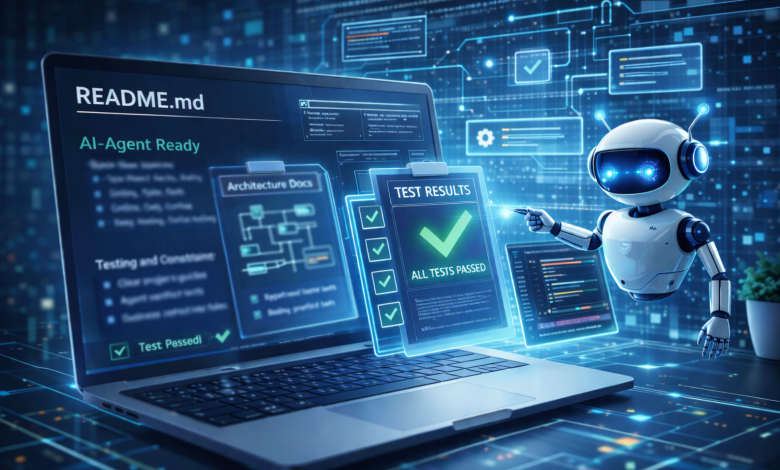
Why most AI coding efforts fail—and what engineering leaders should fix first
AI coding agents are already writing production code, but most teams are not ready for them. Organizations are investing heavily in AI-assisted development, yet results vary widely across teams. Some see clear productivity gains, while others face increased regressions and review overhead. This gap is not driven by model capability, but by the systems those models operate in.
From experience in production systems, one pattern is consistent: AI does not improve weak engineering systems; it exposes their gaps faster. This has direct business impact, including slower delivery, higher operational risk, and increased maintenance cost. Recent industry reports in 2026 continue to highlight that AI-assisted development improves speed but does not automatically improve code quality or system reliability without strong engineering foundations.
Feedback loops, not models, determine outcomes
AI agents are effective when they can iterate quickly based on feedback such as type errors, lint failures, and test results. Without these signals, they behave like any developer working without validation and rely on assumptions. This leads to code that appears correct but introduces subtle issues.
In many environments, feedback is slow or missing. Tests may run only in CI, linting may be inconsistent, and type checks may not be enforced. This creates a weak feedback loop where errors accumulate before detection.
The solution is to make feedback fast and local. Linting, formatting, and type checks should run with a single command, and tests should execute quickly. When feedback is fast, agents converge faster and reduce downstream issues.
Make the system easy to reason about
AI agents operate with limited context and cannot understand the entire codebase at once. They typically work with a small number of files and infer the rest. When logic is spread across multiple layers, the agent fills gaps with assumptions. This is where correctness begins to degrade.
To address this, systems should prioritize clarity over abstraction. Related logic should stay together, and control flow should be explicit. Deep chains of indirection make reasoning harder for both humans and AI.
This is especially important in enterprise systems such as pricing, payments, and customer workflows. These systems often include implicit rules that are not obvious from code alone. Making flows visible in one place reduces ambiguity and improves correctness.
Design for context efficiency
AI agents work within fixed context limits and cannot load large codebases entirely. This makes context efficiency a practical design constraint. When workflows are distributed across many files, key information falls outside the agent’s view.
Effective teams reduce this by keeping workflows compact and limiting unnecessary abstraction. Orchestrator files that show end-to-end behavior are particularly useful because they provide a clear mental model without deep traversal.
There is also a tradeoff between reuse and clarity. In AI-assisted systems, strict abstraction can increase complexity. A small amount of duplication is often acceptable if it improves readability and reduces context fragmentation.
Make constraints explicit
AI agents can read code but cannot reliably infer business intent. This creates risk in systems with compliance requirements, financial rules, or strict invariants. When constraints are not explicit, agents may generate changes that violate critical assumptions.
Examples include minimum payout guarantees, idempotent operations, and restrictions on external calls. These rules are often understood by engineers but not encoded in the system.
To address this, teams should document key constraints close to the code. Comments should explain why a rule exists, not just what it does. Lightweight documentation ensures that both engineers and AI agents operate with the same understanding.
Consistency improves reliability
AI agents rely on patterns in the codebase. When patterns are inconsistent, outputs become inconsistent. This increases review effort and introduces risk.
Standardizing file structure, naming conventions, and testing patterns reduces ambiguity. It allows agents to learn and apply patterns more effectively. Organizations that maintain consistent engineering practices are better positioned to realize productivity gains from AI-assisted development.
Tests are the primary interface
Tests act as the main feedback mechanism for AI agents. They define expected behavior and guide iteration. When tests are slow or incomplete, that guidance breaks down.
High-performing teams invest in fast local test suites with strong coverage of edge cases. Tests should be easy to run and focused on meaningful behavior. This allows agents to validate changes quickly and improve outputs.
It is also important to be specific when generating tests. Generic prompts often produce weak assertions. Clear scenarios and constraints lead to stronger validation.
Enable self-verification
Manual verification introduces friction in AI-assisted workflows. Engineers spend time testing and providing feedback, which slows iteration and reduces productivity gains.
A better approach is to enable self-verification. Agents should be able to run tests, validate outputs, and check behavior independently. This reduces back-and-forth and improves efficiency.
This shifts the workflow toward reviewing validated changes instead of debugging generated code. The result is faster iteration and higher confidence in outputs.
The shift for engineering organizations
AI agents are not just another tool; they change how systems should be designed. The most effective environments are those with fast feedback loops, clear structure, explicit constraints, and consistent patterns.
Organizations that invest in these areas see meaningful improvements in development speed and reliability. Those that do not often experience increased rework and reduced trust in AI-generated outputs.
Final takeaway for technology leaders
Before expanding investment in AI tools, evaluate the foundation. Can developers run tests locally in under a minute? Are linting and type checks enforced? Is the system easy to understand? Are constraints documented? Are patterns consistent?
If the answer is no, the priority is not more AI. It is improving the system around it.
The biggest gains from AI do not come from the model itself. They come from the environment in which the model operates. Organizations that recognize this early will move faster and reduce long-term risk.
Author Name
Ridhima Mahajan
Senior Software Engineer (10+ years experience)
Bio:
Backend and distributed systems engineer with experience in large-scale marketplace systems and compliance-driven architectures. Focused on building reliable, auditable backend systems that integrate machine learning into production environments.