There are only so many hours in a workday, and a surprising number of them go toward tasks that don’t really need you. Sorting emails, logging data, scheduling meetings, drafting routine messages, these things eat time without adding much value.
Employees using AI tools report an average 40% productivity boost. And frequent users of generative AI save over 9 hours per week. Not by working harder, but by letting AI handle the repetitive parts.
Learning how to automate tasks with AI is no longer a technical skill reserved for developers. Almost anyone can set up meaningful automations without writing a single line of code. This guide walks you through what AI automation actually is, where it works best, and how to start.
What Is an AI Automation?
AI automation is the use of artificial intelligence to perform tasks that normally need manual human effort. AI-powered systems can read and understand context, make decisions based on patterns, and adapt when inputs change. This makes them genuinely useful for real-world work.
At a basic level, AI automation works by connecting triggers to actions with intelligence in between. Something happens (an email arrives, a form is submitted, a deadline is near), the AI interprets it, and a defined action follows. What makes this different from old-school if-this-then-that automation is that AI can handle messy, unpredictable inputs. It doesn’t break when the format changes or the wording is different.
Tools like n8n, Zapier, and Make sit at the center of most automation setups. They act as the connectors, linking your apps together and defining what happens when.
Why Automate Tasks With AI?
Three real reasons:
- You get time back. McKinsey research found about an hour of daily personal activities already has the technical potential to be automated, with that figure potentially rising to three hours by 2030.
- You make fewer errors. AI doesn’t have bad days. Repetitive data entry, formatting, scheduling conflicts, these are exactly the kinds of tasks where humans slip up.
- You focus on better work. When routine tasks run themselves, your mental energy goes toward decisions, relationships, and creative thinking, things AI still can’t replicate well.
Examples of AI Automation in Action
It helps to see what automation actually looks like before thinking about where to start. A few real-world examples:
- A sales team uses AI to scan incoming leads, score them based on behavior and engagement, and automatically send personalized follow-up emails, without a rep touching each one manually.
- A content team feeds raw interview notes into an AI tool, which generates a structured draft article, social captions, and an email newsletter version, all from the same input.
- An HR manager gets a notification that a candidate applied; AI automatically screens the resume, checks it against the job criteria, and schedules an interview, all before the manager opens their inbox.
- A freelancer connects their project management tool to their calendar; when a new task is assigned, AI blocks focused work time automatically.
- Companies like Netflix and Amazon use AI to create personalized email campaigns that adapt content, timing, and frequency based on individual customer behavior, increasing email open rates by 25% and conversion rates by 35%.
But before you start automating tasks, know that giving AI clear instructions is the hardest and most important part. For this, you can either use an AI prompt generator or simply ask the AI itself to help you build the prompt.
What Tasks Are Actually Worth Automating?
Not everything should be handed to AI. The key is identifying where automation adds value without introducing new problems
Good candidates for automation:
- Happens repeatedly, on a regular schedule
- Has clear inputs and predictable outputs
- Is high volume and low stakes if something goes wrong
- Requires little creative judgment or relationship sensitivity
Keep it human when:
- The task involves emotional nuance or a sensitive relationship
- Errors have serious downstream consequences
- Creative judgment is the entire point of the work
- The process itself is still broken or unclear
A useful test: if you could write a step-by-step instruction manual for a new employee to follow blindly, AI can likely handle it. If the task requires reading the room, leave it with a person.
Tasks Where AI Automation Has the Most Impact
Once you know what you want to automate, here’s how to approach each area.
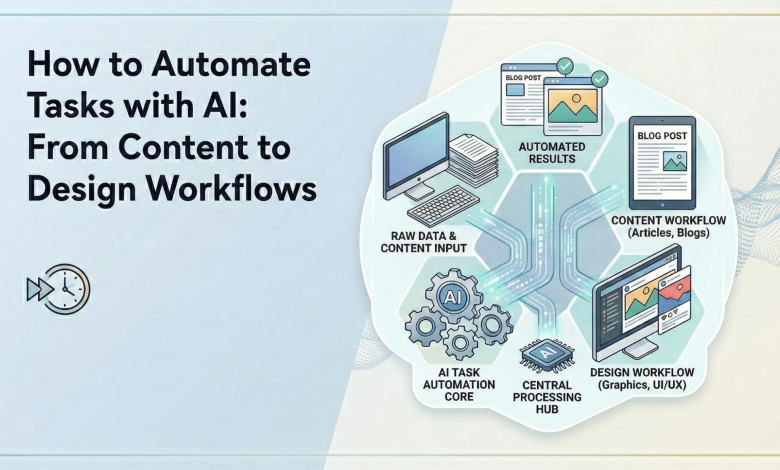
Content Creation
Content creation is one of the most automatable workflows today.
AI can handle everything from writing first drafts and social media captions to generating images with an AI image generator. You can repurpose long-form content into short-form clips, produce video scripts, build email newsletters, and draft creative writing.
ChatGPT and Claude are the strongest general-purpose writing tools. Jasper works well for marketing teams that need consistent brand voice at scale. Specialised content tools like AI story generator, AI script generator, etc., cut content drafting time in half, and increase content output by 3.2x without requiring additional staff.
Email and Communication
Email is one of the most automatable parts of any workday. AI tools can separate incoming emails by importance, draft replies in your voice, flag messages that need action, and handle routine responses entirely on their own.
Tools like Superhuman and SaneBox filter and prioritize automatically. Shortwave summarizes long threads and suggests replies. For teams, Gmelius adds shared inbox management with AI-powered workflows built in.
A typical automated email flow: email arrives, AI reads and labels it, drafts a reply, you review and send in one click. What used to take 10 minutes takes 30 seconds.
Design Workflows
AI has made design workflows more automatable than most people realize. Tasks that used to require a dedicated designer can now be partially handled by AI. For example, generating social media graphics, producing ad creatives, creating presentation visuals, and building brand assets. Tools like Canva’s AI features, Looka, AI svg logo generator, etc., make this accessible even for non-designers working under deadline pressure.
Scheduling and Calendar Management
Scheduling is another area where most people still waste more time than they should. AI scheduling tools like Reclaim.ai and Motion automatically block focus time, protect it from meeting creep, and reschedule when priorities change.
Tools like Reclaim.ai help users reclaim up to 40% of their workweek by intelligently scheduling focus time, meetings, and breaks. Aristeksystems You set your priorities once; the calendar manages itself from there.
Meeting Notes and Follow-Ups
Recording what was said and sending follow-ups after calls is one of the most time-consuming low-value tasks in any professional’s week. Tools like Otter.ai and Fireflies.ai join your meetings automatically, transcribe everything, pull out action items, and send summaries to all participants, without anyone having to take notes. You leave the call with a clean summary already in your inbox.
Data Entry and Reporting
Moving information between tools, logging CRM updates, generating weekly reports, all of this follows predictable patterns that AI handles well. Zapier and Make can connect virtually any two apps so data flows automatically.
A new form submission can create a CRM record, trigger a welcome email, and log a spreadsheet row, all without touching any of it.
How to Actually Get Started (Step by Step)

This is where most people get stuck. Here is the exact process:
Step 1: Audit your week first. For three days, log the tasks you do and tag any that feel repetitive, low-thought, or copy-paste in nature. Be honest. Most people find 5–10 candidates immediately.
Step 2: Pick exactly one automation to start. Don’t try to overhaul everything at once. The best first automation is usually email triage or meeting notes, low risk, immediate payoff, and you’ll see results within a week.
Step 3: Choose the right tool. If you’re non-technical, start with no-code platforms (Zapier, Make, Reclaim.ai). Only move to developer tools like n8n or LangChain if you have specific needs that simpler tools can’t meet.
Step 4: Write clear instructions. This part matters more than people realize. The quality of what AI does for you depends entirely on how clearly you tell it what to do.
Step 5: Run it, review it, refine it. Set a two-week check-in. Does the output need corrections? Are there edge cases the automation isn’t handling well? Adjust the instructions. Automation isn’t set-and-forget, at least not at first.
Best AI Automation Tools
Here’s a straightforward breakdown of the tools worth knowing, based on what they’re actually best for:
| Tool | Best For | Key AI Features | Free Option |
| Zapier | Simple no-code workflows | AI Zap Creator (natural language to automation), ChatGPT integration, 7,000+ app connections | Yes |
| n8n | Developer-friendly, open-source | Native AI agents, LangChain integration, self-hostable, 400+ integrations | Yes (self-hosted) |
| Lindy | AI agents for sales and ops | Prompt-to-agent, autopilot browsing and sheet updates, email and calendar agents | Yes (400 tasks/month) |
| Make | Visual multi-step workflows | Drag-and-drop builder, complex conditional logic, 1,500+ app integrations | Yes |
| Microsoft Power Automate | Microsoft ecosystem / enterprise | AI Builder with sentiment analysis, GPT prompts, deep Microsoft 365 and Salesforce integration | Yes (limited) |
| UiPath | Enterprise RPA | AI agents, email intent detection, prediction validation, Salesforce and Oracle integrations | Trial only |
Where to start: If you’re non-technical, begin with Zapier or Lindy — both let you describe what you want in plain language and build the automation from there. If you need more flexibility or want to self-host, n8n is the strongest open-source option. If your team is already deep in Microsoft tools, Power Automate is the obvious fit.
What Not to Automate
This is the section most guides skip, and it’s where people run into the most problems.
- Don’t automate client-facing messages without a review step. AI drafting plus human approval is a solid workflow. Fully unsupervised outbound emails to real clients, with no one checking them, is a risk most businesses shouldn’t take.
- Don’t automate a broken process. If the manual version of a task is chaotic or unclear, automation won’t fix it, it’ll just produce the same mess faster. Fix the process first, then automate it.
- Don’t ignore failures. Automation can fail silently. Build in a notification or review checkpoint so you know when something goes wrong rather than finding out weeks later when the damage has been done.
- Don’t automate pure judgment calls. Deciding how to respond to a difficult customer complaint, whether a piece of writing is actually good, how to handle a sensitive personnel situation, these require a person.
Best Practices to Automate Tasks with AI
A few principles that separate automations that actually work from ones that get abandoned after a week:
- Start with one thing. The most common mistake is trying to automate everything at once. Pick the single most repetitive task in your week and get that working first. Confidence builds from small wins.
- Write clear instructions. The quality of any AI automation is only as good as the instructions you give it. Being specific about what you want, the format you expect, and how to handle edge cases makes a measurable difference in output quality.
- Build in a review step at first. Don’t send AI outputs directly to the world until you’ve reviewed enough of them to trust the quality. Start with human approval in the loop, then remove it once you’re confident.
- Review and refine regularly. Set a two-week check-in when you launch a new automation. Does the output match what you expected? Are there edge cases it’s not handling? Small adjustments early prevent bigger problems later.
- Match the tool to your skill level. No-code tools first, always. Move to developer tools only when you hit a specific wall that simpler platforms genuinely can’t solve.