Nobody warned me at dental school that I would end up working in AI. I spent a decade in clinical practice, including four years in public health dentistry treating patients with complex needs and limited access to care. The move into technology felt like a detour, but it turned out to be the thing that made me think most seriously about what dentistry is actually for: not just drilling and filling, but helping patients understand what is happening in their own mouths and giving them the information to make real decisions about their health. AI, done well, serves that goal. Done badly, it can undermine it.
The AI that interests me most in dentistry is not the version that makes appointments feel more automated. It is the version that helps a dentist notice something they might otherwise have missed, or explain something to a patient in a way which actually lands. A dental student qualifying today may spend their entire career working alongside it in some form: radiographic analysis, implant and aligner planning, voice-assisted notes, patient communication, scheduling and more. The question is not whether AI will be part of dentistry, because it already is. The question is how to use it without letting it do your thinking for you.
AI is a tool not a clinician
The first thing I would say to any dental student or newly qualified dentist is that AI is a tool, not a clinician. It did not go to dental school, has never drilled a tooth, looked inside a patient’s mouth, taken a history, tested vitality, or noticed that someone is frightened. You have to do all of those things. What AI can do is give you another piece of information, flag something worth a second look, or help you show a patient something they could not otherwise see on a radiograph. What it cannot do is replace the judgement of the person who has examined the patient and taken responsibility for their care.
When software highlights something on a radiograph, the right response is neither blind trust nor automatic dismissal. It is curiosity. Does this fit what I can see clinically? Should I look in the mouth again? Is another radiograph justified? If I agree with the output, can I explain why, and if I disagree, can I explain that too? That is not resistance to technology. That is clinical judgement, and clinical judgement remains the part of the job that cannot simply be handed over to software.
A rapid evidence assessment commissioned by the General Dental Council found that real-world implementation of AI in dental services remains limited, with gaps in the evidence around UK-specific applications, best practice, data protection and ethics.¹ That is not a reason to be dismissive, but it is a reason to ask careful questions about any tool you use: what is it designed to do, what evidence supports it, and where does your responsibility sit?
Learning to look again
One area where I have seen real value is in giving a clinician a reason to pause and look at an image more deliberately than they might otherwise have done. Anyone who has worked clinically knows that radiographs are not always reviewed in ideal conditions. You may be running behind, thinking about the next patient, managing a question and trying to keep your notes in order simultaneously. For a dental student or newly qualified dentist, there is often the additional pressure of making a call while the patient is sitting beside you waiting for an answer.
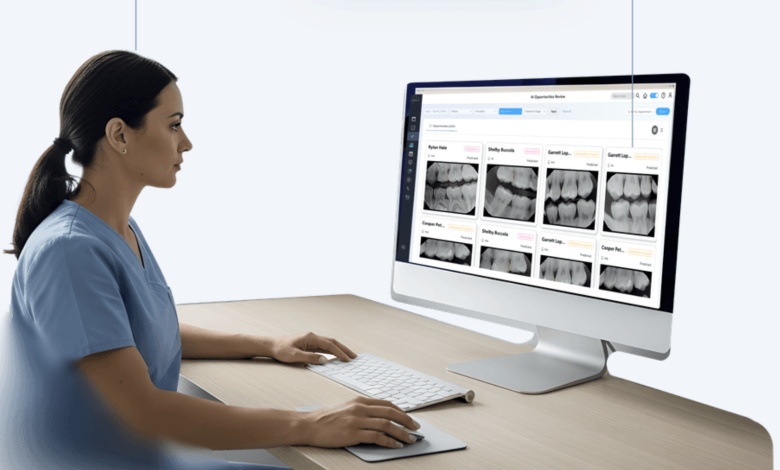
AI-assisted radiographic analysis tools, including Hello Pearl’s Second Opinion software, work by reviewing the image and flagging areas that may warrant a closer look, covering findings such as suspected decay, bone loss and calculus. They do this without fatigue or distraction, which is part of their value on a long clinical day. Sometimes you will look again and decide the finding is not significant, and that is a perfectly reasonable outcome because the value is that you looked deliberately rather than moved on by default. Other times, the prompt may help you catch something earlier than you would have otherwise, and that can matter a great deal for the patient.
Early enamel caries is a good example of where this kind of prompt has practical value. These lesions may not need operative treatment, and in a busy list it is easy to note them and move on. But they can be the starting point for a conversation which genuinely changes a patient’s oral health trajectory, opening up questions about acidic drink consumption, plaque control, or whether fluoride support might help. The AI prompt does not have that conversation, but it may help make sure the conversation happens at all and importantly, the patient really understands the implications because they have seen it for themselves.
Recent Adult Oral Health Survey data from England makes clear why early intervention matters. The 2023 survey found that 21% of dentate adults had at least one tooth with extensive obvious decay, rising to 41% when non-cavitated decay affecting inner dentine was included, and 93% had at least one observed periodontal condition.² Prevention is not peripheral to UK dentistry. It sits at the centre of it.
Patient education is clinical care
If I had to identify the single most important thing AI can do for dentistry, I would not start with productivity. I would start with patient education.
Dentists spend years learning to read radiographs, and we become so used to subtle changes in density and shade that we forget how unfamiliar those images look to patients. To us, a radiograph might clearly show decay approaching the pulp, but to the person in the chair it can look like a blurry grey scale image of something entirely unidentifiable.
Patients are often asked to make decisions about fillings, root canals, extractions or periodontal treatment when they cannot feel a problem, cannot see it in the mirror, and cannot read the image you are pointing at. They may nod along and leave still unsure what they actually agreed to.
Visual tools can help with this in a meaningful way. AI-assisted radiographic analysis tools such as Hello Pearl’s Second Opinion can highlight areas of concern directly on the patient’s own image, after which intraoral scans, digital planning tools and treatment simulations can all make clinical conversations more concrete. The dentist still has to listen, explain and check understanding, but what these tools do is make the explanation less abstract. Instead of asking someone to interpret a blur of grey shapes, you can build the discussion around something you are both actually looking at together, which changes the nature of the conversation considerably.
That matters for consent, trust and treatment acceptance. Most importantly, it matters because patients have a right to understand what is happening in their own mouths. The GDC is clear that patients should be given information they can understand, and that clinicians must check that they have.³
Using AI responsibly
Record-keeping tools are one of the most common ways AI is entering dental practice. Ambient documentation tools can generate a consultation summary for the clinician to review and approve, and the DDU has written sensibly about this, noting the potential value while being equally clear that the clinician must be satisfied the final record accurately reflects what actually happened.4 A good note supports continuity of care, protects you medico-legally and helps any colleague who sees the patient later understand what was discussed and what was agreed. If an AI-generated summary is going into the record under your name, you need to be sure it says what happened, not what the software assumed happened.
There are also important questions around data and confidentiality. Any tool that records, transcribes or processes patient information raises questions about consent and data protection, and students and foundation dentists should not experiment with patient data independently. Use the systems your dental school or workplace has approved, and ask your supervisor or training programme director if you are ever unsure. Convenience is not a justification for cutting corners on professional responsibility.
What this means for your training
Students should learn to interpret radiographs without AI first, because that skill cannot be outsourced. You need to understand anatomy, pathology, image quality and clinical correlation before you can make a sensible judgement about whether an AI output is reliable. At the same time, students should be exposed to AI tools before they qualify, because a newly qualified dentist who has never worked alongside them is more likely to either over-trust them or dismiss them entirely, and neither of those responses helps patients.
AI literacy does not mean becoming a software engineer. It means knowing enough to ask sensible questions: what is this tool designed to do, what are its limitations, and how do I check the output against what I am seeing clinically? These are becoming routine professional questions for the dental workforce, not technical extras reserved for those with a special interest in technology.
There is also a point worth making about generative AI and academic work. Used thoughtfully, tools such as ChatGPT can help with summarising material or structuring revision. Used to pass off generated work as your own, they raise serious professional concerns. Dental students are held to professional standards from the start of training, and honesty issues at university can become fitness to practise matters later. The habits you build now are the habits you will carry into clinical life.
The bigger picture
I did not move into the AI sector because I wanted dentistry to feel more automated. I moved because I think these tools can help clinicians communicate better and help patients understand more, and those two things have always been at the heart of good dental care.
For the workforce of tomorrow, AI will become part of how dentistry is delivered, documented, explained and planned. The challenge is to make sure the clinician remains thoughtful, questioning and accountable throughout that process. If we approach it in that way, AI has a genuinely useful place in dentistry: not as a system that makes decisions for you, but as one that helps you look carefully, explain clearly and keep the patient at the centre of everything.
References
- General Dental Council. Artificial Intelligence in Dental Service Provision: A Rapid Evidence Assessment. gdc-uk.org/about-us/what-we-do/research/detail/report/ai-dental-service-rapid-evidence-assessment
- Office for Health Improvement and Disparities. Adult Oral Health Survey 2023: report summary. GOV.UK. gov.uk/government/statistics/adult-oral-health-survey-2023/report-summary
- General Dental Council. Standards for the Dental Team: Standard 3, Obtain valid consent. standards.gdc-uk.org/pages/principle3/principle3
- The Dental Defence Union. Getting real about AI in dentistry. theddu.com/for-students/interviews/getting-real-about-ai-in-dentistry