As the UK healthcare system continues to navigate rising demand, staffing constraints, and outdated infrastructure, the integration of artificial intelligence (AI) is no longer just a ‘nice to have’ – it’s a necessity. With growing government support and real-world results already visible, NHS Trusts are turning to AI agents to enhance efficiency, simplify operations, and support overstretched frontline teams.
While AI won’t solve every challenge facing the NHS, its targeted implementation is already delivering visible outcomes. By automating routine tasks, reducing administrative burdens, and enabling faster access to information, AI is freeing up time for healthcare workers, enabling them to focus more on patient care and less on process management.
Transforming everyday operations
At the heart of AI’s promise in healthcare is its ability to streamline the operational backbone of NHS Trusts. From IT service management to patient communications, the deployment of AI agents and automation is creating more efficient and responsive systems that can better meet the needs of both staff and patients.
For example, Royal Free London NHS Trust now logs around 50% of its incoming calls through AI-powered self-service portals. This has led to a noticeable reduction in call wait times, which, in turn, improves both clinician efficiency and patient satisfaction. By minimising the need for manual intervention in routine queries, clinicians can redirect their time toward frontline care – exactly where it’s needed most.
Efficiency gains at scale
The operational impact of AI is perhaps most clearly seen in organisations that have scaled its use across multiple workflows. Princess Alexandra Hospital NHS Trust implemented automation and self-service capabilities as part of a broader infrastructure overhaul.
Within just three months, the Trust:
- Reduced open tickets from 1,308 to 550
- Cut SLA breaches from 629 to 13
- Automated handling of 210,000 monthly calls using AI and digital workflows
These improvements are not just metrics on a dashboard – they reflect a real and measurable reduction in administrative overhead and an increase in time available for direct patient services.
Solving problems, not creating new ones
One of the most common concerns around adopting advanced technologies is that they may complicate, rather than streamline, operations. This is a valid risk – but one that can be mitigated by selecting AI solutions that are intuitive, configurable, and purpose-built for healthcare environments.
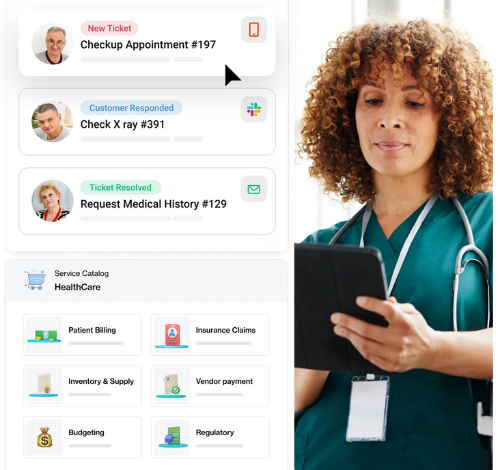
AI agents can offer 24/7 support across IT, HR, and finance systems – serving as the first line of interaction on unified digital platforms. When deployed thoughtfully, they reduce ticket volumes, lower support burdens, and cut down on staff frustration. The most effective solutions don’t require months of onboarding or expensive system overhauls – they are quick and simple to deploy and can be scaled with the needs of the organisation.
However, success relies on more than just the technology itself. Staff training and buy-in are critical. AI tools must be embedded into workflows in a way that feels natural and empowering to healthcare staff, rather than disruptive or overly complex.
Data protection is a non-negotiable
In any discussion about AI in healthcare, data security and regulatory compliance must remain a priority. Sensitive patient and organisational data must be protected through secure systems that comply with GDPR regulations. AI solutions must ensure that data processing is limited strictly to its intended purpose and that robust controls are in place to maintain trust and accountability.
Building a modern NHS, one process at a time
NHS Trusts like Royal Free London and Princess Alexandra Hospital demonstrate how modernising internal systems with AI is not about replacing human expertise, but amplifying it. By removing operational friction through automation, healthcare staff are empowered to focus on what truly matters: delivering exceptional patient care.
Looking ahead, the adoption of AI agents across UK healthcare is set to accelerate. As more Trusts experience real improvements in efficiency and staff and patient experiences, the case for scalable, secure, and easy-to-implement AI solutions will only increase.